
“A foreigner with a 3-hour layover in Beijing came straight from the international capital airport to play disc golf here!” Bai Fan, who runs the disc golf project in the park, told me over coffee.
On weeknights, the Mini 4WD track is still running at eleven – office workers who clock off at ten, drive over, take a couple of laps and go home. Others come at the opposite end of the day: six in the morning, a few laps, then go to work by seven.
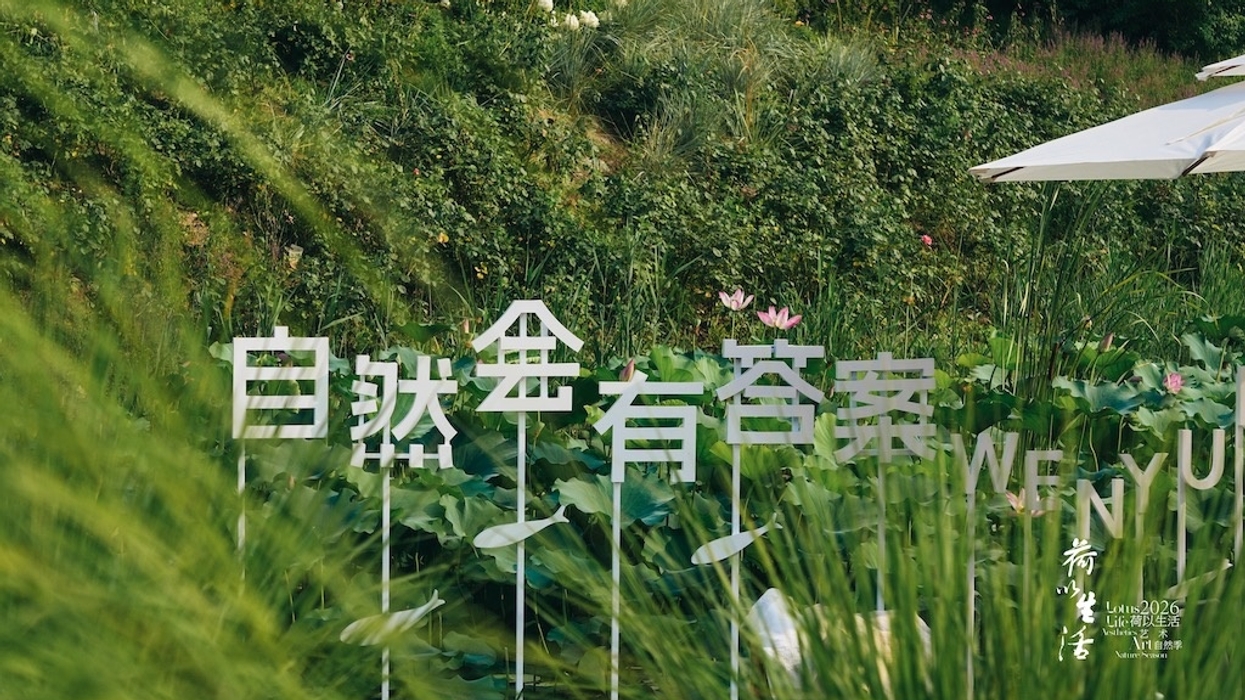
Stories like these began to surface at the Chaoyang section of Beijing Wenyu River Park (hereafter 'the park') this year. Its demonstration area opened in 2020, in the middle of the pandemic.
Across three districts, the full park covers some 30 square kilometres, making it the largest of Beijing's thousand-odd parks, and one of the newest. The oldest, Zhongshan Park, opened to the public in 1914.
I should declare an interest: I run a laser-combat game in the park at weekends, with two other partners. It is a small market. Before we started, this kind of game had never been run in a public space in the city.
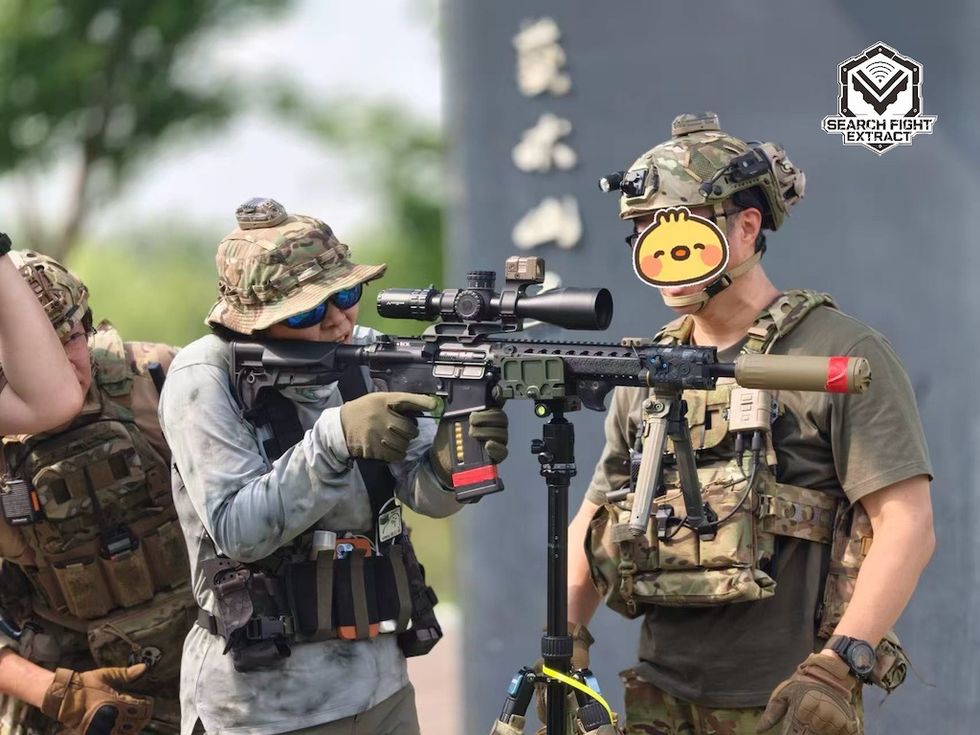 One of the activities on offer at Beijing Wenyu River Park is laser combat
We began working with the park in May; it welcomed the trial, and helped us file the advance notice that local authorities require for an activity like ours in a public park.
Our own project is a small version of a larger story: how a young park is being operated into a destination.
The park is not weighed down by how these things are usually done, and it is willing to try. It treats what it does as an experiment, one that leaves room for failure, and that is why a number of similar projects have taken root here.
Some have already begun to flourish.
Curating passions, not building attractions
The clearest sign of the strategy is what the park did in 2026: it gathered the enthusiasms already growing on its grounds into an annual IP – Super Weekend, nine events over the last weekend of May: disc golf, lure fishing, karting, show jumping, pump-track racing and a high-ropes challenge, tennis, paddleboarding and RC off-road racing.
Nothing new had to be built. The park didn't create the content. It curated what its operators had already grown and gave it a name.
The park seeks experience operators with a following of their own, who also value the park as a growth platform, creating a cycle in which each side feeds the other.
The goal is to avoid creating an experience that enjoys brief viral fame only to fade away shortly afterwards.
The operators who end up here share a set of values: they are enthusiastic about what they do, they are working out how to balance passion against profit in a small market, and they have taste and an ambition to leave something lasting in their field.
Over time, this works like a law of attraction, drawing in more operators of a similar mind.
Beijing Sunshine Landscape Company designed and built a French-style garden and a plant-based café in the park – Sunshine Garden – to create a relaxing space for city people amid the park's greenery.
The payback period was built into the plan from the beginning; what the company is after, it says, is a long-term return rather than a quick one. The hope is for a place people come back to, appreciate, and grow to love.
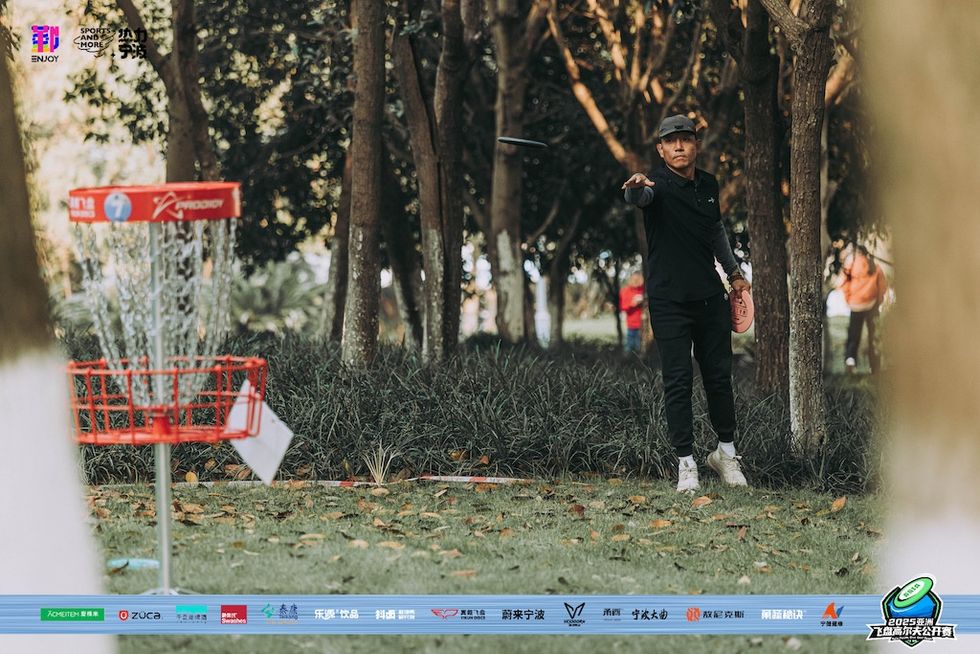 Disc Golf has proved popular at Beijing Wenyu River Park
As Laozi said, “One begets two; Two begets three; Three begets the myriad creatures.”
Bai Fan is another. Disc golf has half a century of history in the United States; it only reached Beijing during the pandemic. Back in 2021, the only place to play in Beijing was a makeshift course enthusiasts had put up in Yanqing, on the city's far north-western edge.
Bai, an enthusiast himself, started to commercialise this activity in 2024.
Since landing at the park, they have built what is, by basket count, the largest single site in Asia: two 18-hole and two 9-hole courses, 54 baskets in all. It is a distinction worth boasting about, and one almost nobody outside the sport has heard of. The reach is deep rather than wide.
Bai said several hundred people are active in the club's WeChat groups, about 50 of whom pay an annual membership fee. The long-term retention rate of participants who engage more than twice can reach 90%. A first session decides everything, so training the trainers has become part of Bai's work.
While promoting awareness of this sport among the public and converting more public participants, Bai is also building out the professional end of it, launching the China Disc Golf Tour with two other club owners to create the conditions for training the next generation of players.
China’s experience economy takes a different path
None of this was decided in a boardroom. But nor is it simply a matter of temperament.
What the park has been feeling its way toward, one project at a time, is something larger than itself: a change in what people in China now think is worth paying for.
On the surface, China's turn toward experiences looks like a recession story: a post-pandemic cooling economy, consumers who have grown careful with their money, and who would rather pay for a good afternoon than another possession.
That reading isn't wrong – it's just shallow. The shift is structural, and it was already underway before the downturn made it visible.
Several forces push in the same direction.
On the supply side, once goods become abundant and interchangeable, pricing power shifts towards whatever is still scarce. What stays scarce is the experience: something you must be there for, in person, that cannot be copied or streamed.
On the demand side, something you buy soon fades into the background of your life, while an experience does not. You look forward to it, you remember it, it becomes part of who you are. That is simply a better return on the spend.
Underneath both is the slower generational shift Ronald Inglehart described half a century ago: as material security comes to be taken for granted, value migrates from having to meaning.
But it would be a mistake to treat China's version as identical to the West's. In the West, the experience economy grew slowly out of settled affluence.
China compressed two centuries of that arc into a single generation – so anxiety about making a living, hunger for status and the appetite for self-expression can all sit inside the same person, sometimes in the same weekend.
Its turn toward experience is not a value shift that simply grew out of prosperity; it is a composite, pushed into being by several pressures at once. And unlike in the West, the Chinese government actively promotes service and experience spending as an explicit engine of domestic demand.
From a distance it looks like the Western experience economy; up close it behaves quite differently.
Letting visitors shape the experience
When people are looking for the most value out of every yuan, the surest thing a destination can do is to cultivate the experiences its visitors help make.
The Mini 4WD track is the clearest example. Wang Weiqi drew it in late 2021, during the park’s landscape design phase, after playing with the cars himself as a boy. What he laid into the ground was a Ruyi, a traditional Chinese good-luck motif, in two unconnected halves, and it was approved as landscape.
For four years nobody realised a car could be run on it.
Then it was found. Images of the track spread online, where users christened it the course the designer had smuggled in, and children of the 1980s and 1990s, now in their thirties and forties, came to relive something.
Fathers brought sons. Players began modifying the course themselves – the two halves were joined up. Later, the park went back to Wang Weiqi and asked him for a version 2.0 – Chinese coverage called it the park listening to its fans.
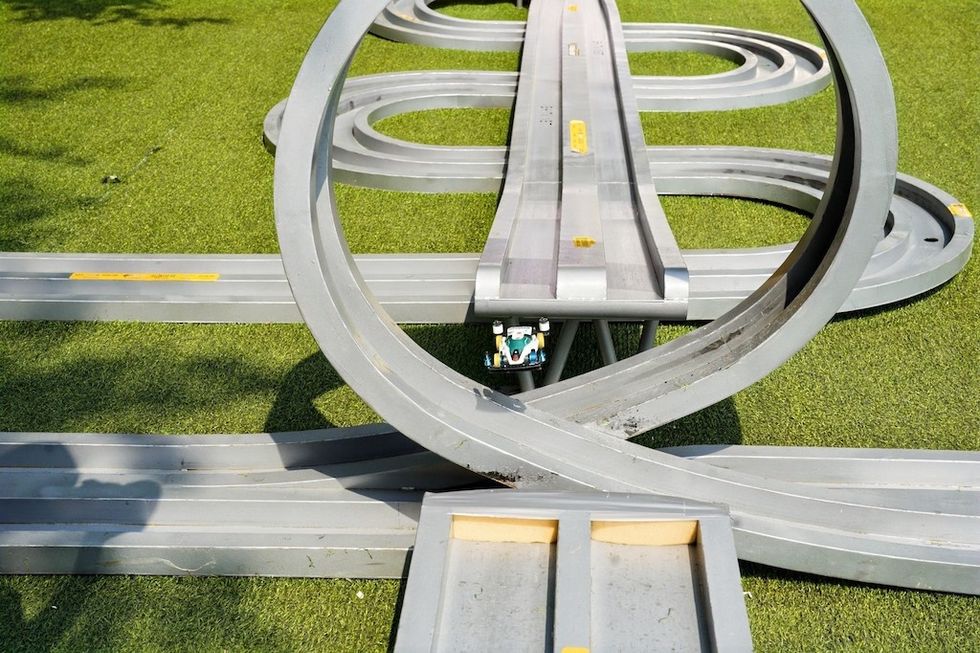 Beijing Wenyu River Park's mini 4DW track has led to the creation of events and tournaments
The park held its first mini 4WD charity race in February 2026.
What happened next is the telling part. When registration opened in April for its Yeqinghui Cup, a name that translates roughly as “our youth returned”, the racing places were gone in two hours.
A new track opened in July with jumps, a rainbow-arched slope, and a loop-the-loop. More than 500 people registered and over 2,000 turned up for an evening race that followed, the cars fitted with miniature headlights. It was the first outdoor night-racing format for these cars anywhere in China.
In a matter of months, a thing nobody had planned had become one of the park’s flagship IPs, and a profitable one. The pattern is the one the disc golf course follows: the users come first, and the operation is built around what they have already started.
“Every throw is a new start.” That is how Bai describes disc golf. Each round belongs to the person playing it, and no two are alike, which is precisely why people come back.
For the laser tactical game we operate, we have adapted the loot-and-extract gameplay from Escape from Tarkov into an offline experience; we call it Search, Fight, Extract.
Before coming to Wenyu River Park, we ran this game and evolved the experience for over a year. “Search Fight Extract” is now a “classic” mode we run. In our game, we use NPCs to balance the combat and enhance the experience.
We design scripts around each site's terrain. We once tested a bounty hunter storyline in the tactical game. Players can make their own decisions at any point, which means the possibilities are close to endless. They shape the game as they play it.
From building destinations to operating them
The model this one is replacing belonged to another era.
For two decades, a Chinese cultural-tourism project meant a big number and a long wait: pour a few billion yuan into a themed town or a mega-park and recoup it, slowly, over ten years or more.
That arithmetic only ever worked because it sat on top of a rising property market – much of what called itself "cultural tourism" was really property development under another name, underwritten by land values that could be relied on to rise.
When the property market turned, the model lost both the money to build and the way to get it back. These projects were not unlucky. The premise they were built on had gone.
The country is now full of the evidence – a ¥5bn "ancient town" outside Changde that emptied into a ghost town, an animal kingdom in Liyang, Jiangsu, halted a year into construction – and the developers who once built them can no longer afford to, nor want to.
Demand has changed as well. Large-scale, fixed attractions still play an important role in the visitor economy, particularly when they offer the spectacle and immersion that cannot easily be replicated elsewhere.
But they also face a familiar challenge: once visitors have experienced the core offer, operators need to keep creating reasons for them to return. New attractions, seasonal programming, events, and refreshed content can extend the life of a destination, but they also require ongoing investment.
This places greater emphasis on what happens after a destination has been built. Increasingly, the question is not simply how many people an attraction can draw, but how effectively it can develop an ongoing relationship with them.
Repeat visitation, community, programming and the ability to respond to changing interests are becoming just as important as the initial act of construction.
Building value through repeat visitation
That is where places closer to home have a different kind of advantage. For many city dwellers, a meaningful day out does not necessarily require a major journey. It may happen in a park at the end of a metro line: familiar, accessible and easy to incorporate into everyday life.
Proximity does not replace the appeal of a major destination, but it changes the relationship between visitor and place.
A destination visited once a year may need to offer something exceptional enough to justify the journey. A local park operates on a different rhythm. Its value can accumulate through repetition: a Saturday activity, an evening game, a seasonal event, or simply a familiar place that keeps offering something new.
The ambition, then, is not to draw 10,000 people once, but to have one person come 10,000 times.
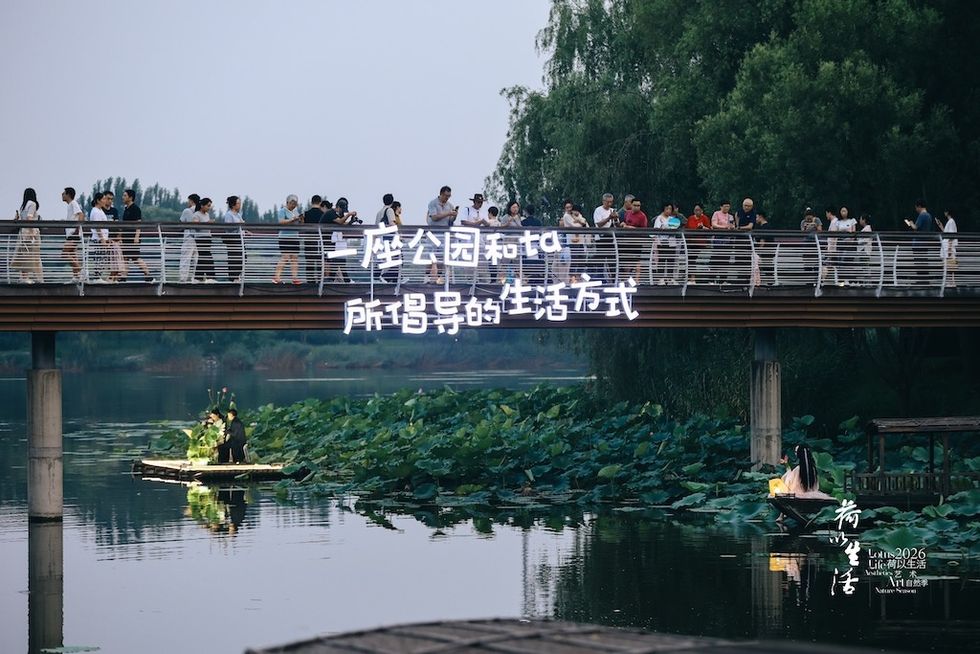 The community gathers for events at Beijing Wenyu River Park
If the old model's binding constraint was capital – who could raise the billions and guess right about demand a decade out – a park's is operations. The park is already there; nobody has to build a destination from nothing. Its lawns, its water, its paths are sunk cost.
What decides whether it becomes a place people return to isn't how much was spent laying it out, but how well it is run afterwards – what gets put on it, curated into it, allowed to grow.
A park, in other words, doesn't have to make the big bet at all: it does not have to predict what people will want and then pour concrete on the guess. It can let demand show itself, and cultivate whatever takes hold. Running a park well isn't one way to turn it into a destination.
For a park that has given up its walls and its ticket, it is the only one.
And the most surprising thing a park can cultivate is the small stuff – the niche passions, too odd, too early or too unprofitable for anywhere else to bother with.
That is the story of Wenyu River Park: not a destination that was built and then filled, but one that was grown, one small enthusiasm at a time. As Life Week magazine put it, “Every passion finds its home ground at Wenyu.”
Can experiences make public parks sustainable?
It would be easy to read all this as vision, or civic idealism, or some enlightened new philosophy of public space. But underneath it is something plainer: money, or the lack of it.
A park like this is no longer a line item the state simply pays for. It is run by a state-owned company that was handed the park's future earnings and told, in effect, to make it pay for itself.
Whatever happens inside has to cover the bills: the operators, the events, the coffee, the play. The experience economy here isn't only a trend the park is riding; it is the park's survival strategy.
And an unfinished one. By the honest account of the researchers who have studied it, Wenyu's own operations still don't cover its costs; public money still flows in. Nobody here has cracked the self-sustaining park. What they have is a bet: that if you cultivate enough small enthusiasms, and cultivate them well, a park can eventually pay for itself.
For now it is still running at a loss, though a smaller one than before.
In 1870, Frederick Law Olmsted wrote that a park was the one place in a city where you would find “vast numbers of persons brought closely together, poor and rich, young and old.”
That, too, is happening here. And the more niche projects the park draws, the more its visitors stick – because niche means you cannot get it anywhere else, and a thing you can only do here is the thing that keeps bringing you back.
Ten or twenty years from now, one of the small things being nursed on these lawns may be a sport the world knows. And this will have been where it started.