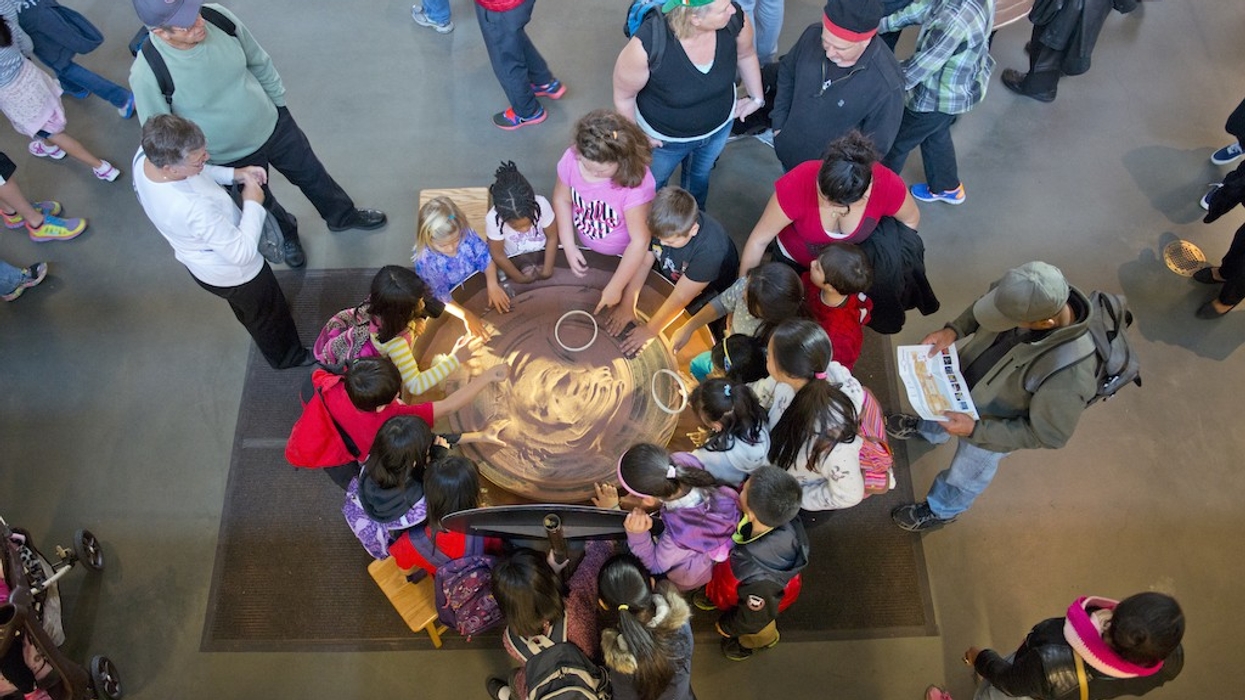

Across the attractions industry, edutainment has become one of the most promising and most overused ideas at the same time.
Science centers, children’s museums, discovery spaces, and family entertainment venues increasingly combine play with educational content. STEM labs, maker corners, digital interactives, hands-on exhibits, and similar elements are now common ingredients in these spaces.
The assumption is often simple: if educational content is present, learning will follow.
But that assumption is too narrow.
Learning is not shaped only by what content is delivered. It is also shaped by what capacities are being developed, and even more importantly, by how the experience is structured, sensed, and remembered.
Educational frameworks have long distinguished between cognitive, affective, and psychomotor learning, while more recent school-based frameworks such as CASEL have pushed emotional and relational development into sharper focus.
At the same time, major OECD work on the future of education continues to emphasize not only knowledge, but also skills, attitudes, values, student agency, wellbeing, and similar dimensions.
For experience designers, this suggests a useful shift. Instead of beginning only with the question “What should children learn?”, we may need to structure learning environments around three fundamental questions:
- Why do we learn?
- What do we learn?
- How do we learn?
That distinction matters because many edutainment environments are still strongest in only one of those layers.
The three layers of learning design
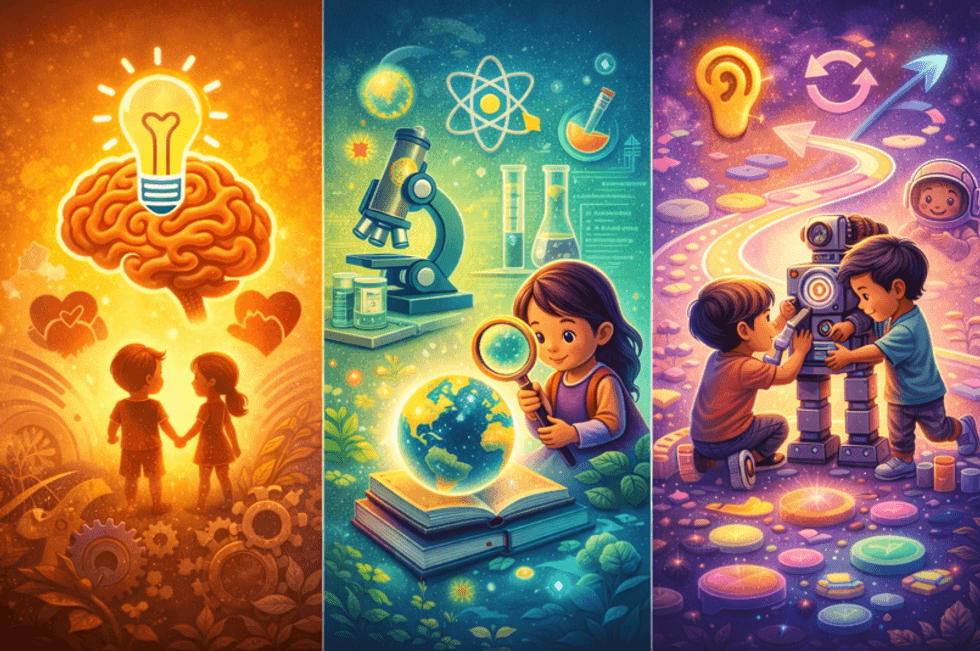 The three layers of learning designImage credit FORREC
Layer 1, why we learn: human capacities
The first layer concerns why humans learn in the first place.
Learning helps us survive, adapt, grow, connect with others, create meaning, and enjoy the world around us. Education, therefore, is not only about transferring knowledge but about developing the human capacities that allow people to live, interact, and thrive.
These capacities include cognitive thinking and problem-solving, emotional intelligence and self-awareness, social collaboration and empathy, physical coordination and movement, creativity and imagination, and communication and storytelling.
Most education frameworks recognize these capacities in one form or another. However, in many edutainment environments, not all of them receive equal design attention.
Three areas in particular often remain underdeveloped in many edutainment centres: emotional intelligence, social collaboration, and creative imagination.
These capacities are central to how people understand themselves, interact with others, and generate new ideas. Yet learning environments frequently prioritize information and stimulation over these deeper forms of development.
A simple classroom group project shows how these capacities develop together. Students asked to design a small bridge using basic materials must think through structural problems, share ideas, listen to different perspectives, and imagine possible solutions.
Along the way, they experience emotions such as excitement, frustration, and satisfaction. While the task appears to focus on building an object, the deeper learning occurs through collaboration, emotional awareness, creative thinking, and problem-solving.
Layer 2, what we learn: knowledge domains
The second layer concerns the fields of knowledge that people explore. These knowledge domains are not independent from the first layer. They exist to support and develop the human capacities described earlier.
Through them, people learn to understand the world, solve problems, create new ideas, communicate with others, and navigate society.
These include familiar domains such as natural sciences, mathematics and logic, engineering and technology, arts and creative expression, humanities and culture, social sciences, sports and physical culture, as well as life skills like leadership and entrepreneurship.
Most edutainment environments focus heavily on this layer. Zones are often organized around subjects, such as science exhibits, robotics labs, art studios, engineering challenges, STEM activities, and similar categories.
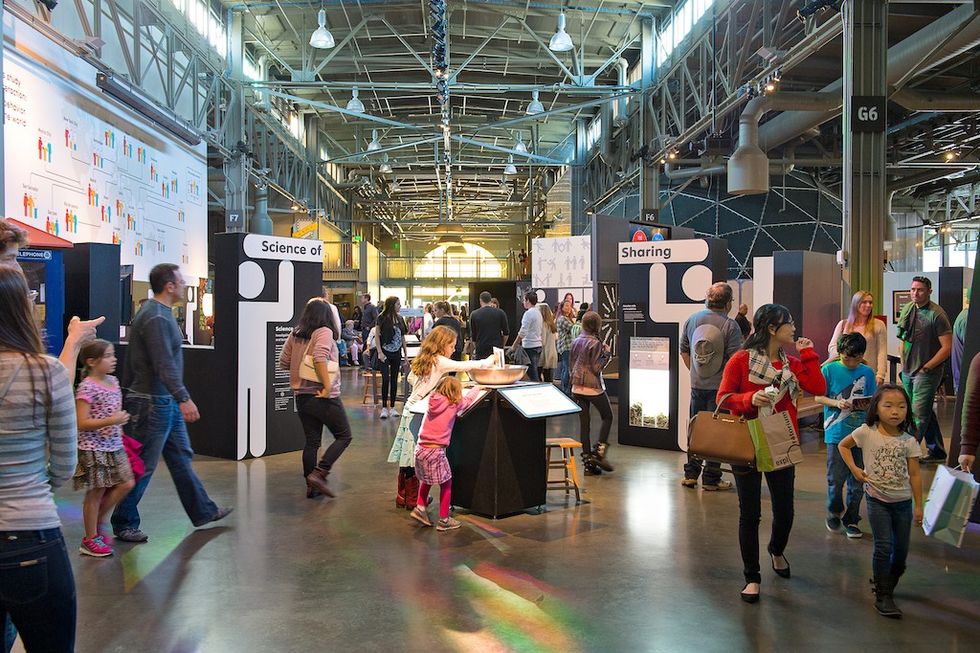 Osher Gallery, Exploratorium, Pier 15 Image credit Exploratorium
Science centres illustrate this subject-based organization clearly. At the Exploratorium, visitors encounter exhibits dedicated to fields such as physics, perception, biology, and environmental systems through hands-on exploration.
Similarly, Montessori classrooms organize learning around areas such as mathematics, language, cultural studies, and practical life activities, allowing children to explore different domains through specialized materials.
In these environments, learning is structured around fields such as science, engineering, mathematics, arts, and humanities, helping learners understand how different disciplines explain the world.
This structure provides clarity and allows visitors to explore many subjects. However, these experiences often remain separate rather than forming a cohesive learning journey. How they connect depends on the third layer.
Layer 3, how we learn: experience design
The third layer focuses on how learning happens through experience. While the first two layers define why we learn and what we learn, this layer shapes the environments and interactions that make learning engaging and memorable.
This is where the attractions industry has the greatest opportunity to contribute.
Today, many edutainment centres rely on a familiar set of formats and interaction tools.
These appear repeatedly across science centres, children’s museums, and discovery spaces, including exploration and discovery, puzzles and challenges, games and competition, building and making, simple collaborative missions, guided experimentation, multisensory experiences, and basic storytelling formats.
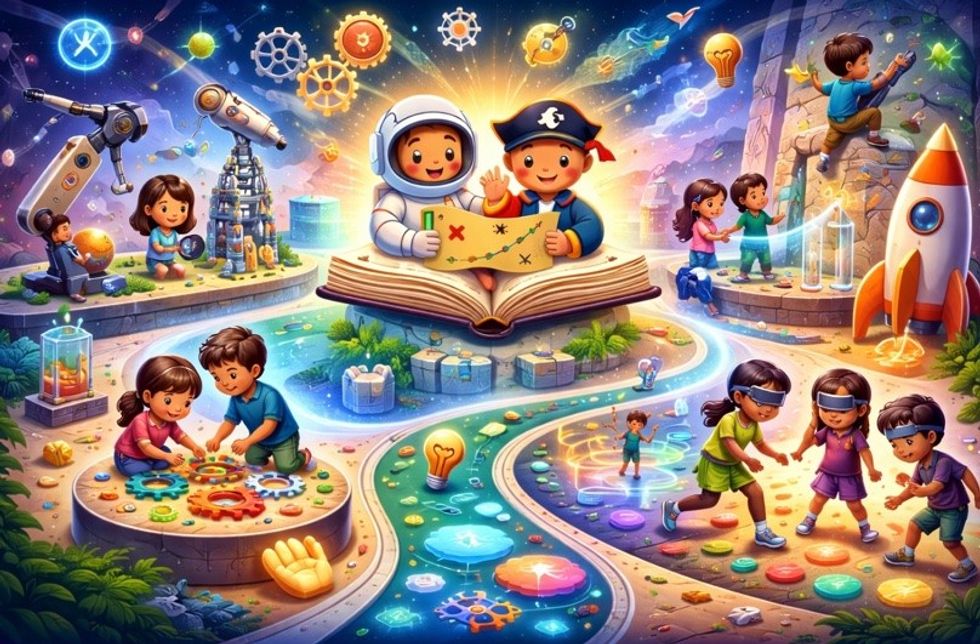 Image credit FORREC
If we organize them, we can see that all of them include the following fundamentals of learning experience.
- Learning Construct: something has been intentionally designed as a learning tool, based on Layer 1 and Layer 2.
- User Interaction: the guest interacts with the experience through the body and senses.
- Story Framework: the story creates interest and motivation to engage with the experience and learn.
These formats are powerful tools, but they are often used too narrowly, repeatedly, and in an unorganized way, resulting in clichéd edutainment centres.
- Exploration becomes wandering between stations.
- Sensory experiences focus only on sight, hearing, and sometimes touch.
- Puzzles become individual logic tasks.
- Storytelling appears as a decorative theme rather than a narrative journey.
- Maker spaces sometimes focus on assembling predefined kits rather than invention.
As experience designers, we should rethink these three parts of the experience architecture.
The opportunity is not to replace existing formats, but to apply them more intentionally across all learning domains, especially the underdeveloped capacities in layer 1.
To do this, we need to rethink the fundamental parts of every learning experience.
The essential components of each learning experience
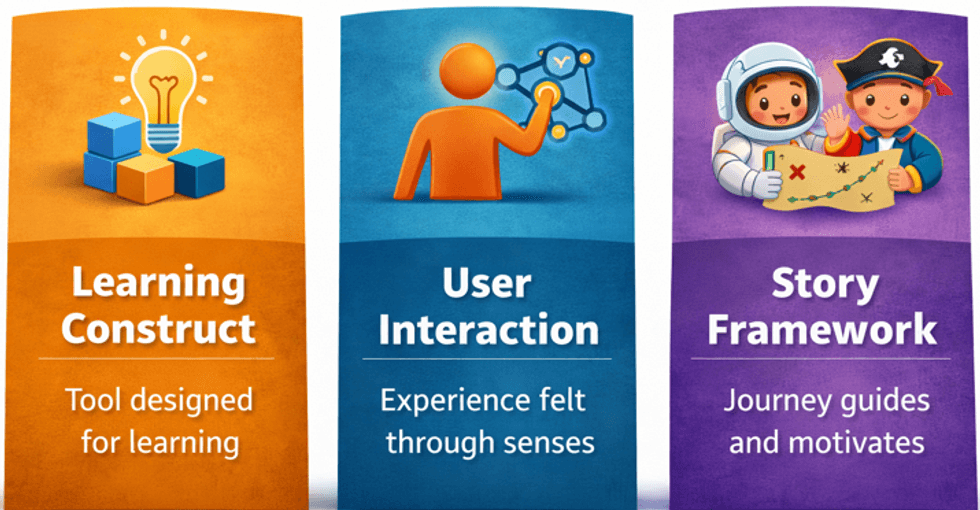 Image credit FORREC
1. Learning construct
As experience designers, the first step is to rethink what we create as the learning tool itself.
This begins with a deeper study of Layers 1 and 2 in collaboration with researchers and subject-matter experts.
The goal is to understand not only what should be taught, but also which developmental needs are still receiving less attention, especially the emotional, social, and creative domains.
Instead of repeatedly designing tools around only logic, information, or physical activity, we should intentionally create systems, environments, and activities that respond to these overlooked needs.
That means designing learning constructs that help children build empathy, collaboration, imagination, self-expression, and emotional understanding, not just knowledge or task completion.
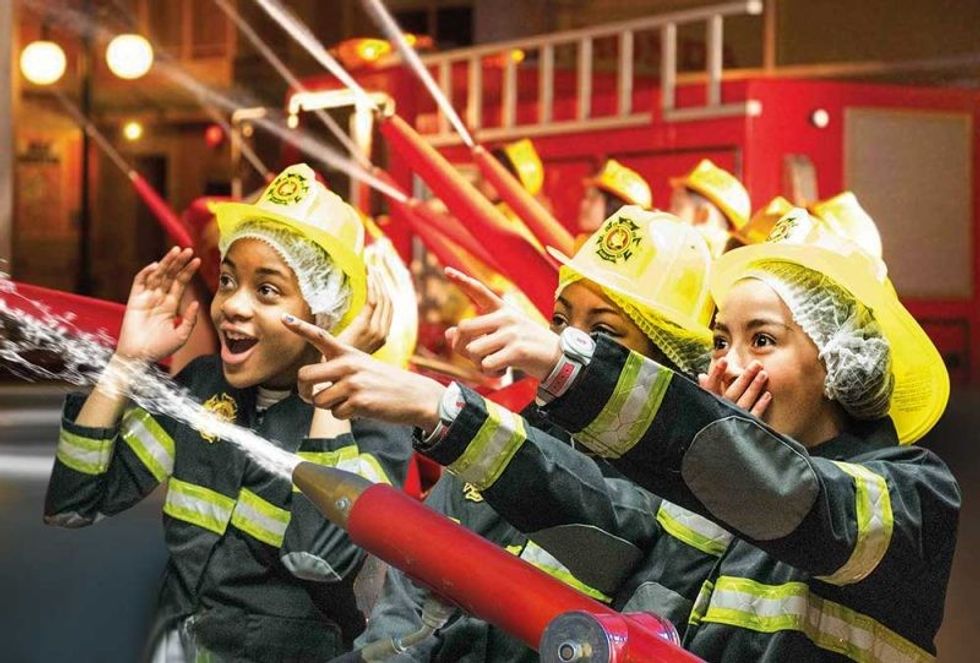 KidZania ManilaImage credit KidZania
KidZania illustrates this approach through its miniature cities where children take on roles such as doctors, pilots, journalists, or engineers. In these environments, activities are intentionally structured to simulate real systems of work, collaboration, and communication.
Children interact with tools, uniforms, and workplaces while solving small challenges and working with others, thereby developing social awareness, teamwork, and self-expression through the experience itself.
2. Use the full capacity of the sensory system
Not just sight and hearing
Researchers suggest that humans rely on far more sensory inputs than the traditional five senses often described in popular culture. Yet most edutainment environments still engage primarily sight and sound, sometimes touch, while leaving much of the body’s perceptual system underused.
Neuroscience and physiology describe a wider range of sensory systems involved in perceiving both the environment and the body itself, including, among others:
- Vestibular sense, balance and spatial orientation
- Proprioception, awareness of body position and movement
- Kinaesthesia, perception of motion and muscular effort
- Thermoception, perception of temperature
- Interoception, awareness of internal body states
These systems shape how we experience space, movement, atmosphere, and environmental conditions.
For designers, this opens an important line of thinking. If we want stronger emotional engagement, deeper memory, and more embodied learning, the answer may not be only better content or more screens.
It may be a smarter orchestration of sensory channels within the formats we already use.
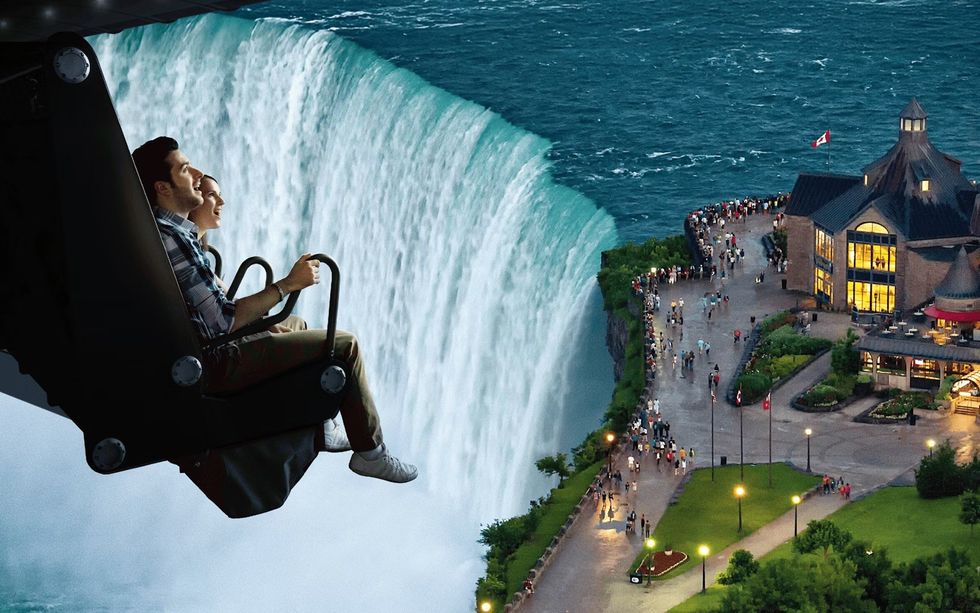 Niagara Takes Flight flying theatre experienceImage credit Niagara Takes Flight
Experiences such as Niagara Takes Flight combine large-scale visuals with motion, airflow, scent effects, and environmental cues to engage multiple sensory systems at once.
The attraction takes guests on a journey through Niagara’s natural landscapes and cultural history, touching on themes such as the power of the falls, the scientific legacy of Nikola Tesla, and the stories of the people connected to the region.
The theatre lifts guests into a motion-based seating system that simulates flight over the Niagara region.
As the body tilts and shifts through space, the vestibular system and sense of balance are activated, while environmental effects such as wind and mist reinforce the sensation of traveling through landscapes and waterfalls.
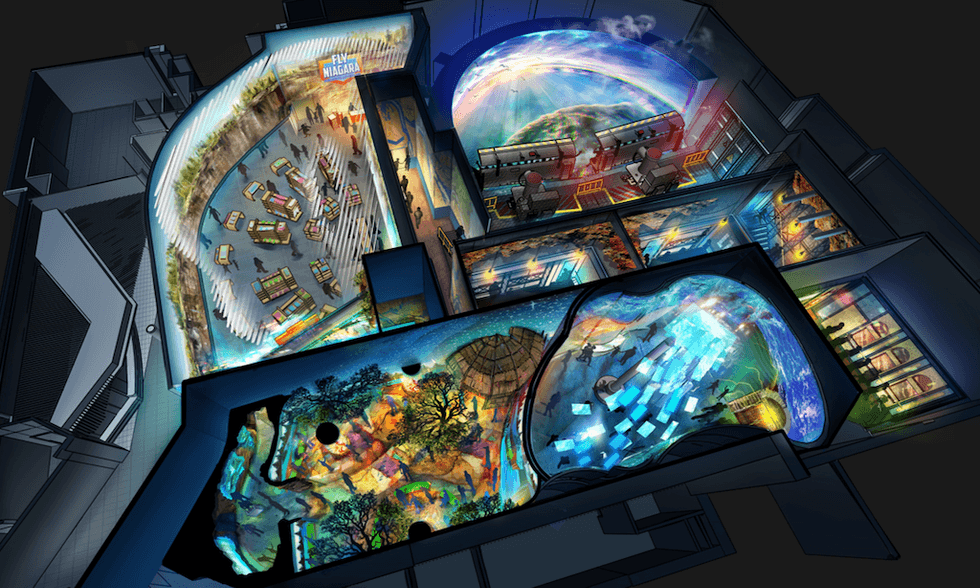 Niagara Takes Flight renderingImage credit FORREC
The result is not simply a visual presentation but a multisensory journey in which motion, spatial orientation, and atmosphere combine to create deeper emotional engagement and lasting memories.
3. Story framework: creating a cohesive learning journey
Among the different elements that shape the “How We Learn” layer, storytelling stands out as one of the most powerful design tools.
In many edutainment environments, however, storytelling is often treated as a decorative layer rather than a structural element of the experience.
Stories often appear only as brief background narratives, thematic decorations, or marketing descriptions in presentations. While these elements can add atmosphere, they rarely shape the visitor's actual learning journey.
For storytelling to meaningfully support learning, it must become part of the structure of the experience itself.
A well-designed narrative framework can:
- Guide visitors through the environment
- Give purpose and continuity to activities
- Provide emotional meaning through characters and consequences
- Transform collaboration into shared missions
- Encourage imagination and experimentation through play
When storytelling functions this way, individual activities stop feeling like isolated learning stations. Instead, they become moments within a larger journey.
A child, or even an adult, enters the environment with a purpose, moves from one challenge to the next, and experiences discoveries that feel earned. Social interaction, sensory cues, spatial progression, and environmental design all become part of the narrative logic of the space.
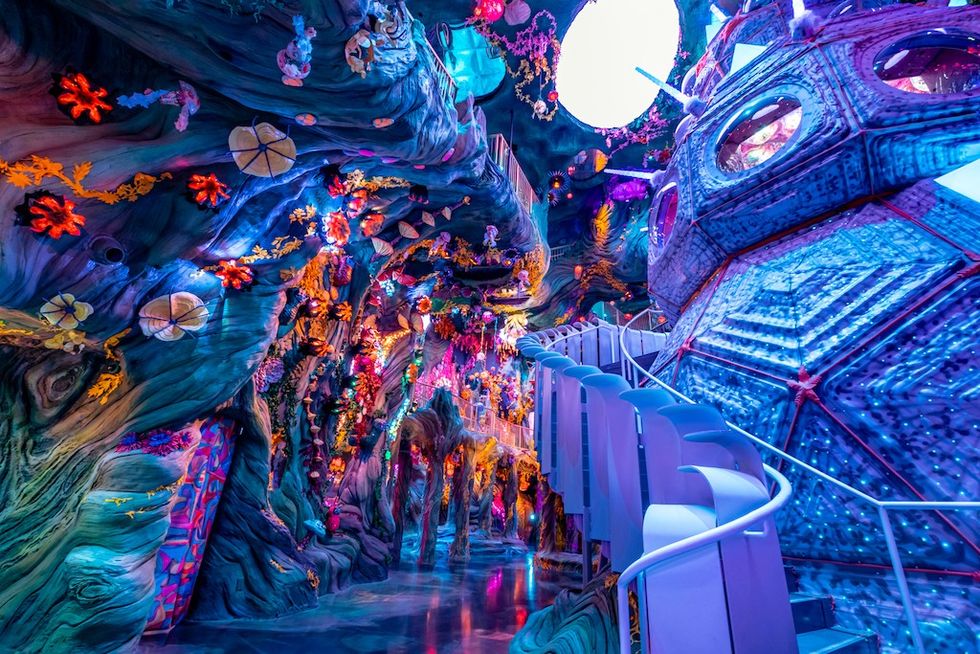 Convergence Station, Denver Image credit Meow Wolf
Experiences created by Meow Wolf illustrate how storytelling can structure exploration as a continuous journey. In these immersive environments, visitors move through interconnected spaces where hidden passages, objects, and media elements reveal fragments of a larger fictional narrative.
Rather than following a fixed path, guests gradually uncover the story through exploration and interaction with the environment.
Escape rooms offer another clear example of narrative functioning as the structural framework of the experience.
In scenarios such as Escape from Twenty Thousand Leagues, developed by Puzzle Break, participants enter a fictional submarine environment where they must decode clues, test ideas, and solve interconnected challenges to progress through the story. Success depends on communication, collaboration, and creative interpretation of the environment.
While the experience involves physical interaction and carefully designed puzzles, it is the narrative structure that connects each challenge into a coherent journey, transforming problem-solving into a meaningful learning experience.
In this context, learning is no longer presented as information inside themed containers.
It becomes an experience the child actively lives through.
The future of edutainment
The future of edutainment will not be defined only by new technologies or by adding more STEM activities. It will depend on how thoughtfully we design the architecture of learning itself.
By aligning human capacities, why we learn, knowledge domains, what we learn, and experience design, how we learn, experience designers can transform fragmented activities into meaningful learning journeys.
The next challenge is translating these principles into accessible formats that work at smaller scales and with lower budgets.
In doing so, neighbourhood edutainment centres can move beyond themed fragments toward cohesive learning experiences, creating environments that children can feel, remember, and return to.