As the location-based themed entertainment industry moves beyond chasing bigger screens and better sensors, a new opportunity is emerging: designing experiences where technology fades into the background and human behaviour becomes the driving force.
At the forefront of this shift is S1T2 (Story 1st, Technology 2nd), a creative studio based in Australia and New Zealand with work spanning APAC and the Middle East.
S1T2 designs immersive and interactive experiences that bring story, space and technology into close conversation. Across physical environments and digital worlds, the studio is interested in how audiences participate, connect and collectively shape what happens next.
Working at the intersection of experience, art, and technology, S1T2 aims to create experiences that explore new modes of storytelling and new ways of being together.
Whether it’s presence in an immersive space or actions in an interactive world, the ambition of this team lies in creating experiences where many perspectives meet to shape what comes next.
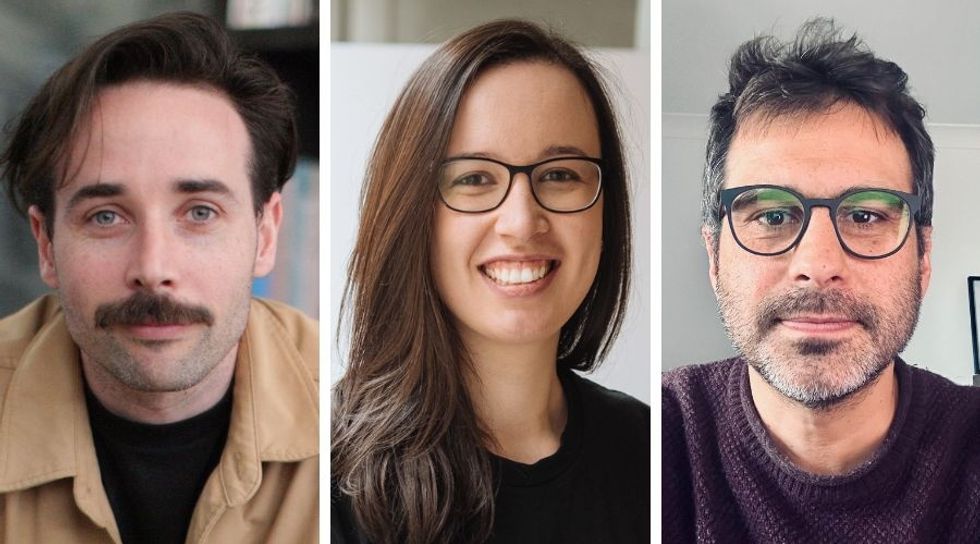
L to R: executive creative director and co-founder Christopher Panzetta; Aiyana Merlo, lead creative strategist, and Jarrad Vladich, production director
Images courtesy of S1T2
The studio is led by executive creative director and co-founder Christopher Panzetta, who speaks to blooloop alongside Aiyana Merlo, lead creative strategist, and Jarrad Vladich, production director.
S1T2’s portfolio spans museum exhibitions, built environment, themed entertainment, and beyond. A variety that demonstrates how the universal languages of storytelling scale seamlessly across different environments.
As the S1T2 team prepares to head to IAAPA Asia in Hong Kong, they are eager to explore the trends and shifts shaping the next generation of story-based interactive and immersive experiences.
By focusing on human behaviour rather than just the underlying technology, S1T2 is pioneering frameworks that transform immersive spaces from simple canvases for delivering content into dynamic playgrounds where audiences can discover themselves and each other.
From storytelling to storymaking
At the heart of S1T2's philosophy is a vital distinction: the evolution from storytelling to storymaking.
In traditional storytelling, meaning is pre-determined and delivered to a passive audience. In storymaking, meaning emerges organically from what audiences do, feel, and discover together.
"In storytelling, we give meaning to our audiences," Panzetta says. In the spatial and immersive sectors, however, the paradigm is shifting. "Our job now is to create the conditions where a story can happen, where visitors can create their own meaning.”
S1T2’s recent collaboration with Museums Victoria, Antopia, shows this idea in action. This story-driven immersive experience explored the complexities of an ant colony, not through a linear narrative given to visitors, but through a story built by those visitors themselves.
The experience encompassed a 1,000-square-metre space with five distinct ‘rooms’, powered by Unreal Engine and a constellation of responsive technologies. But all were driven by a single, simple mechanic: using your own personal pheromone trail to help keep the colony alive.
"Wherever you walk, you collect ants, and then you pass them off to different tasks," Panzetta explains. “It’s one small action. But how does that play out in a collective space? How do all your actions come together to create this larger outcome?"
"It almost gives license to a more playful existence when you're in a space, because you know it's a safe place to test and see what means what... ensuring that visitors come away with something important or resonant to them.”
Simple canvases become dynamic playgrounds
The location-based entertainment industry has seen a clear trajectory of development over the past few years.
Following the pandemic, the increasing desire for spatial immersion led to a boom in cinematic, projection-based experiences with rich visual and aural landscapes.
Yet while these delivered a sense of being enveloped in a world, they often lacked the crucial element of responsiveness: "We as humans, we are so used to inhabiting a space, and we're used to that space reacting to us," Panzetta explains.
Audiences are also experiencing tech fatigue with disconnected gimmicks. "We're moving past the point where each of these individual technologies is a novelty. Audiences are looking for more," says Merlo.
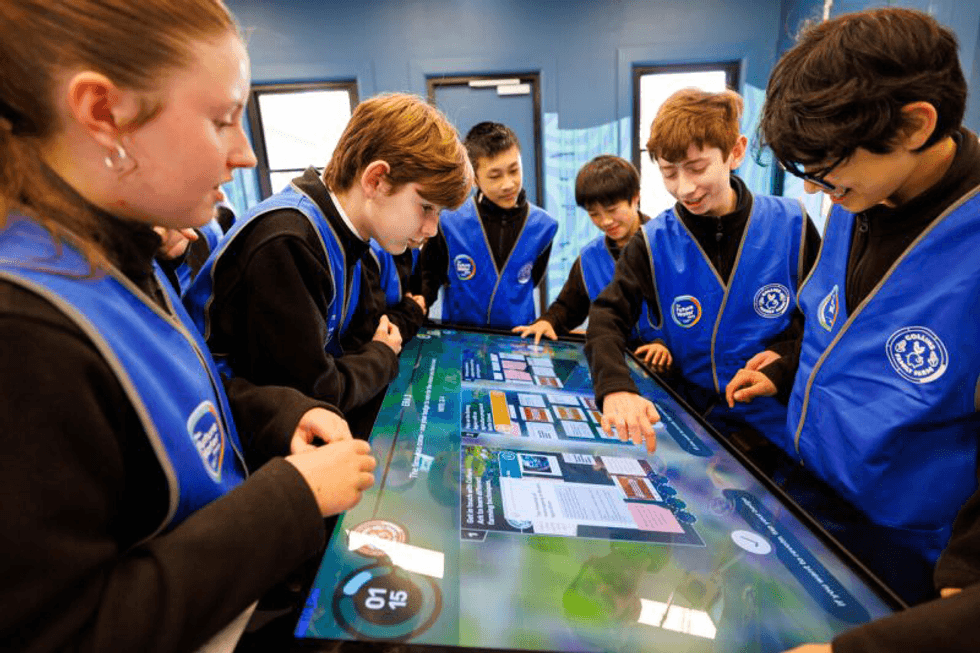
Young visitors interact with S1T2's Future Water Story exhibition, created in partnership with Melbourne Water
Image courtesy of S1T2
The magic happens when these once-isolated technologies interact as a cohesive system, enabling nuanced, invisible interactivity that responds naturally to human presence.
"We can bring to life these dream worlds and experiences that weren't possible with the tools we had previously," says Panzetta.
"Now we can deliver much more resonant experiences… experiences that people want to return to and ask how things might be different each time.”
Opening the door to different kinds of stories
As we develop experiences as playgrounds, we might just open the door to new ways of telling and experiencing stories.
For the Melbourne Museum, S1T2 created TYAMA, a multisensory experience that blended physical and digital worlds, allowing visitors to experience the environment through the senses of nocturnal animals.
Inspired by First Peoples’ storytelling, the project relied heavily on collaboration with First Nations creators.
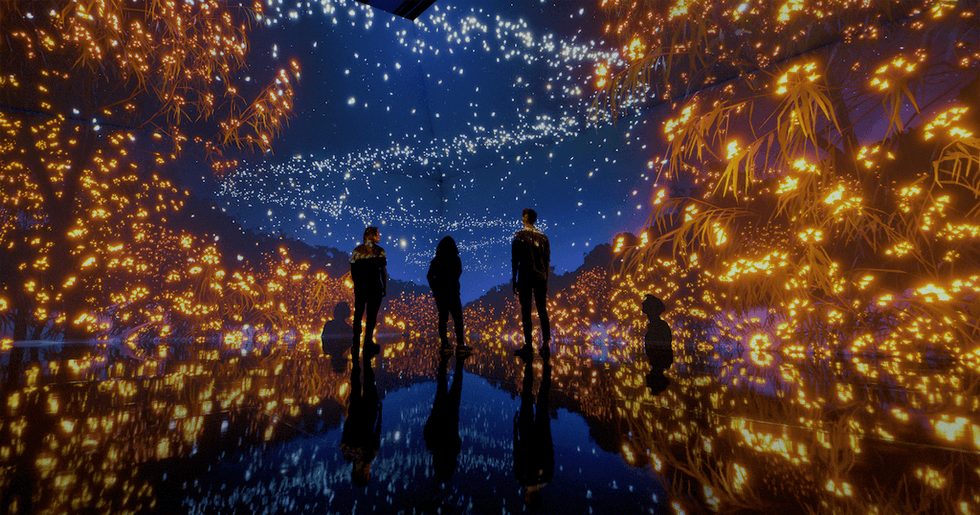
In TYAMA, a collaboration with Melbourne Museum guests could experience the environment through the senses of nocturnal animals
Image courtesy of S1T2
"Immersive storytelling opens up a language palette that we've found many First Nations artists find much more comfortable, natural, and expressive than traditional approaches," Panzetta says.
Instead of a traditional linear narrative, the story was told through behavioural mechanics. "What does it feel like to be a moth? What does it feel like to be a bat?” he explains. “What if when you clap, you could see the impact of those sonic waves?”
Merlo points out that while traditional forms like the novel allow us to step into the shoes of other humans, immersive physical spaces could allow us to genuinely model the sensory experiences of entirely different species.
A challenge or an opportunity?
Despite advances in technology, some operators still view interactivity as a risky, expensive, and overly complex gimmick. However, S1T2 argues that technological hurdles, such as unstable tracking software, are being swiftly overcome.
"The platforms to create these experiences are more accessible and economical than ever," Panzetta notes, pointing to out-of-the-box perpetual tracking systems.
The real challenge today, as S1T2 sees it, is in the pervasive myth that interactive experiences must be wildly complex and offer unlimited choices.
"There seems to be a perception often that quantity is better than quality, like 'I want 450,000 permutations of the character, and choice is everything. In reality, actually people want less choice, they want meaning."
Merlo expands on this: “People want agency. If you have too much choice, that actually removes agency.”
Instead of infinite options, audiences need constrained agency: two or three deeply meaningful choices that they can fully comprehend.
"The clearer you are to someone about what you can and can't do, or what the rules of the world are, then they can forget about it and just play," Panzetta advises.
Aligning interaction to intent
Aligned with the principle of ‘mechanics as metaphor,’ he explains that S1T2 aims to design experiences where the guest’s physical action mirrors the story's emotional or thematic intent.
Take S1T2’s project at Dubai Expo 2020, Become a Guardian of Al Wasl.
Using more than 250 projectors on what was the world's largest projection plaza, guests used interaction pods to create and launch their own futuristic avatar onto a colossal canvas above.
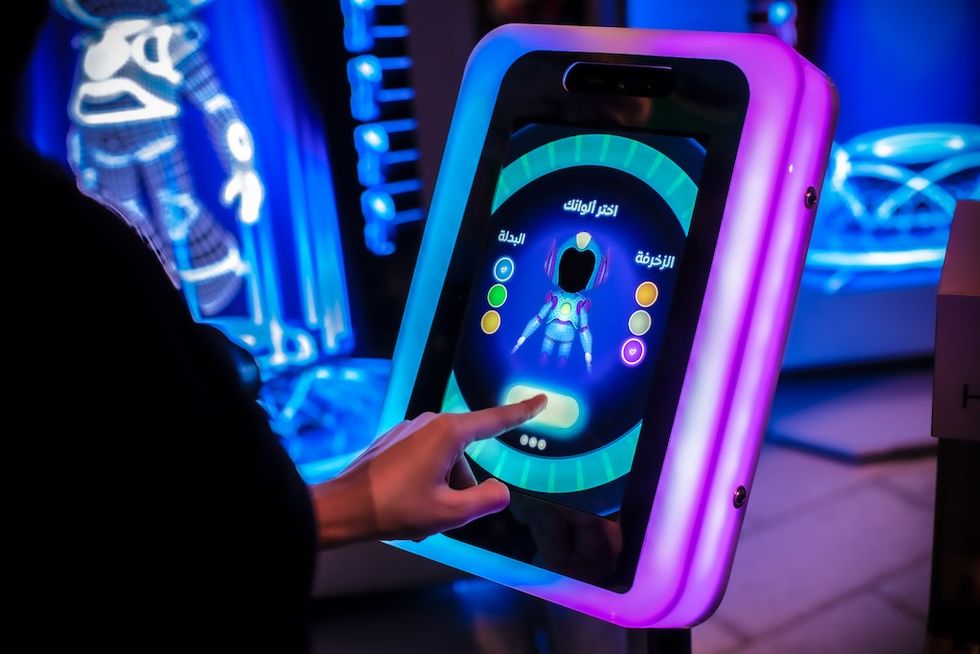
For Become a Guardian of Al Wasl, facial recognition technology was a tool that helped visitors connect personally with the story
Image courtesy of S1T2
Panzetta explains that early development experimented with allowing visitors to ‘build’ their own customisable avatar. However, the team quickly pivoted to facial recognition.
“It might seem like that reduces choice, and it does,” Panzetta explains. “It removes choices that get in the way of agency - of seeing yourself on this giant canvas, and as part of this huge collective story.”
And it was in seeing your real self, rendered larger-than-life as part of the unfolding story above, that the magic of the experience was found. In the merging of individual identity with a breathtaking communal story that connected families from across the globe in a shared moment of wonder.
Main character energy, or not
A major misconception in the industry is that every guest wants to be the main character. "We assume that everyone wants to be the hero all the time, where it's not the case; people are there to be part of something bigger than themselves," says Panzetta.
He compares this to watching the evening fireworks at a Disney park. "You are there as one small piece watching that showcase. If you were the only one standing there alone, it would be a totally different feeling to having thousands of people around you.”
An interactive experience doesn’t have to rely just on active decisions of guests. There could be as much power in building an environment that passively responds to a crowd's noise levels or physical volume.
Observing others interact also helps lower the barrier to entry for more hesitant guests, unlocking inhibitions and inviting deeper participation, Merlo adds. “It's a lot easier to sing together on a dance floor than it is to sing on a stage in front of a microphone.”
Co-presence and the crowd
As more of our daily lives are dictated by screens, feeds, and digital echo chambers, the cultural value of shared, physical experiences has surged. People are hungry for authentic human moments that cannot be replicated on a smartphone.
"Human moments that you create together become more important than ever, because that is the only authenticity we can really count on," says Panzetta.
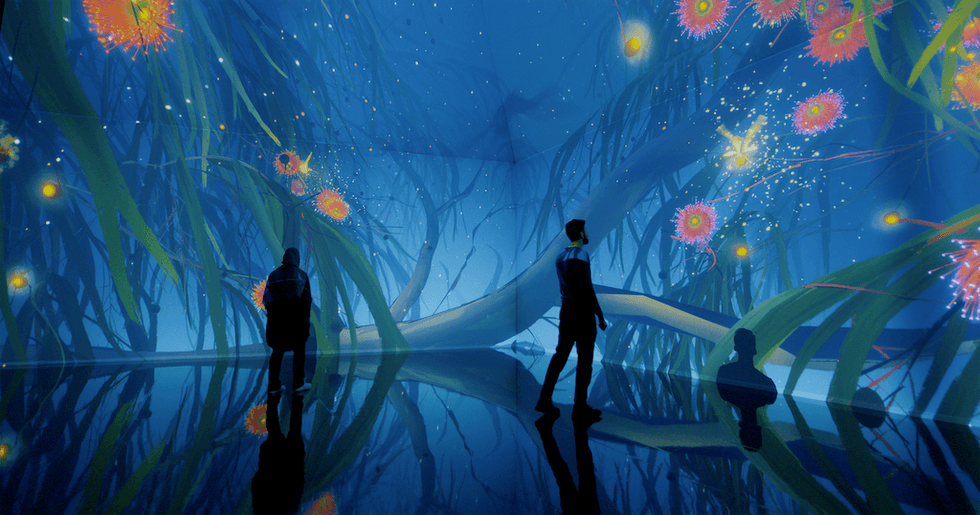
TYAMA is an example of an immersive experience that offers shared moments of connection
Image courtesy of S1T2
In an era when generative AI can produce instant digital content, physical co-presence offers a grounding reality. "We just want to spend time together. We want to be human, and these are great places to facilitate that.”
These physical spaces also break down the silos of our digital lives. "You're getting vastly different people in the room... strangers who are not 100% like you," Merlo adds.
"It's this really interesting point where you can foster connections that you wouldn't otherwise be able to foster, and you can create a sense of unity…that comes from the fundamental humanness of ‘We are all people existing in this space.’"
When crowds become collaborators
Operationally, the LBE industry often treats crowds as a logistical hurdle to be managed for throughput. S1T2, however, sees the crowd as an untapped medium.
“The most magical moments aren’t just when you see something magical on the screen,” says Merlo. “It’s when you do something to make that magical thing happen and turn to the person next to you to say, ‘Did you see that too?’”
In their journey to understand and refine the medium of copresent storytelling, S1T2 have looked to leverage frameworks such as Nina Simon’s “me-to-we” design.
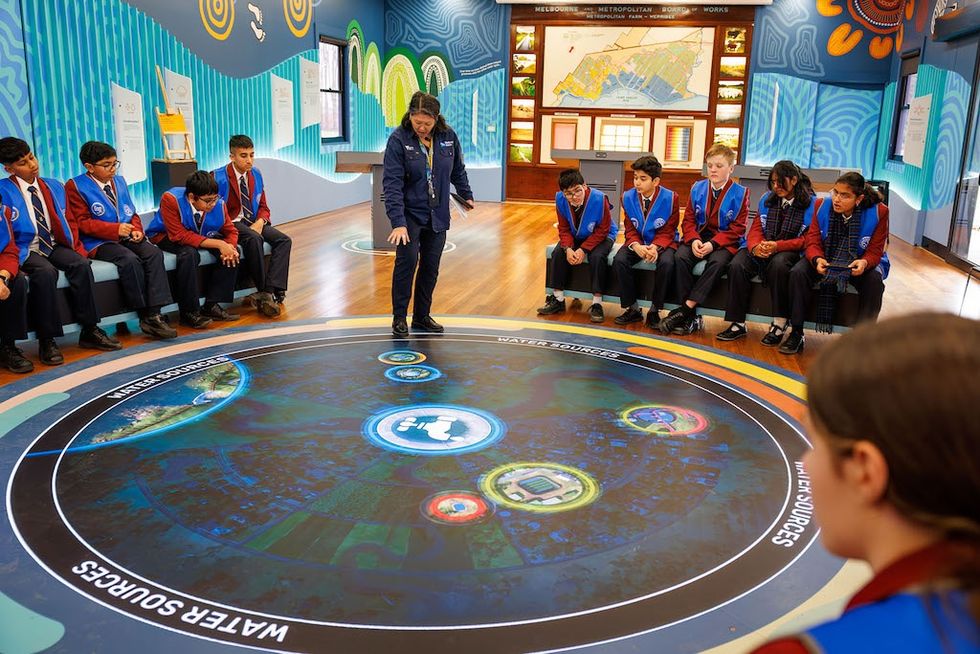
Future Water Story engages a group of students in a debate
Image courtesy of S1T2
Future Water Story, created in partnership with Melbourne Water, is one of S1T2’s collaborative learning installations. Here, groups of up to 30 students are empowered to work together to manage a fictional town's water supply in an uncertain world.
Using interactive touch tables and a large floor LED, the experience leans into, rather than away from, the behavioural dynamics and social friction among a larger group of participants.
"It's trusting your audience and allowing them the space to run with it," says Merlo. By empowering teenagers to make and debate difficult decisions, the experience transforms dry subject matter into an engaging social dynamic.
"It's always so rewarding when you've got high school kids arguing passionately about something like a specific water decision," Merlo says.
"We all want to create meaning; we all want to create a world that we want to live in, and these collective experiences are opportunities where we can experiment and play with how we do that.”
Building teams for the next generation of stories
Ambitious co-present experiences cannot be built by siloed teams working in isolation. Designing the physical-digital blend requires a convergence of disciplines.
To achieve this, S1T2 has curated a unique team of "nimble generalists," including talent from prestigious, large-scale studios such as Epic Games, The Mill, and Wētā FX.
"The ability of having a diverse team... enables you to solve lots of different problems," says Vladich.
"The team is built up broadly of design, strategy, creative technology, and visual art, and that's an incredibly powerful combination when it comes to solving projects that rely on spatial design, visual design, experience design, and some reasonably challenging technological hurdles.”
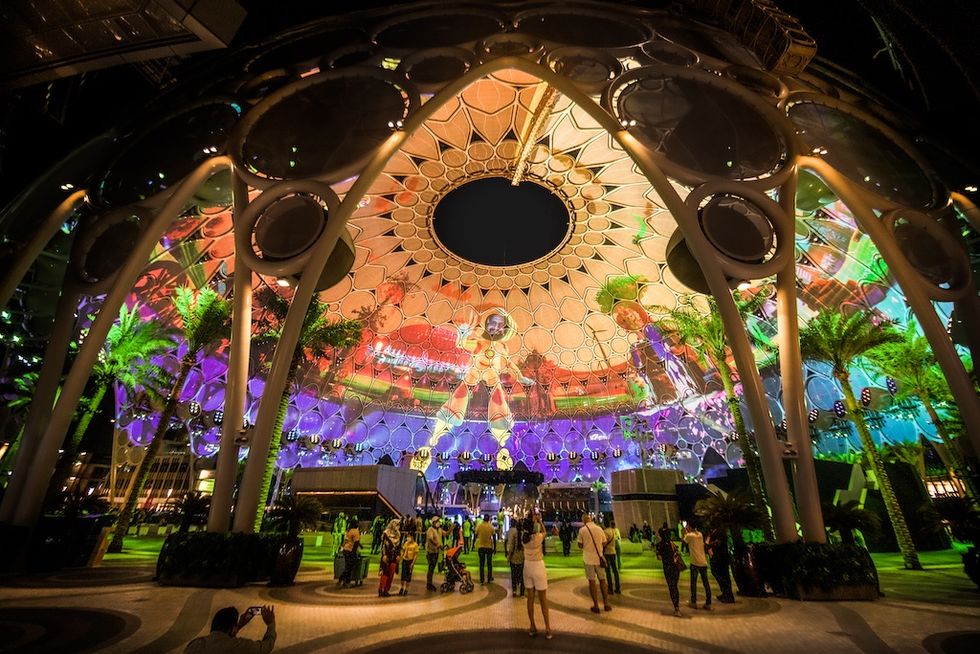
Personal 'Guardian' avatars appear on Al Wasl Dome during Expo 2020 Dubai
Image courtesy of S1T2
Crucially, S1T2 avoids segregating these talents. Technical directors sit alongside creative strategists from the very start of the discovery phase right through to delivery. "Cognitive diversity in the room is everything," Merlo says.
"The interesting stuff happens when different perspectives collide… when the creative has the idea, and then the tech goes, 'Well, that's insane, but it made me think of this…'"
This collaborative friction ensures that S1T2 designs for a diverse public by default and stretches the boundaries of what the work can be.
"We never want to only have one perspective," she adds.
Looking ahead to IAAPA Expo Asia 2026
As S1T2 looks toward the future, the team is excited to explore these topics with the wider themed entertainment industry.
In the coming weeks, they will be attending IAAPA Expo Asia in Hong Kong to connect with operators, attractions, and creative partners.
"We're coming to IAAPA... to learn, to understand more about the design conventions, what the problem spaces are, what the opportunities are," says Panzetta.
With immersive and interactive technology having reached a point of stability, and audiences beginning to understand the conventions of these mediums, S1T2 is ideally positioned to help the industry elevate its most valuable IPs into responsive, living worlds.
Panzetta recalls a conversation with an industry veteran regarding S1T2's entry into the LBE space:
"He said, 'You guys must feel like you've been walking through a forest and you've just come to a clearing, and like, oh, here's my people,' because all the things we've been trying to do... the themed entertainment space really understands the importance of storytelling.”
For S1T2, the goal in Hong Kong and beyond is simple: to find partners who share their values and ambition to push the potential of story.
The team is ready to collaborate, eager to learn, and fully equipped to help the industry build the next generation of experiences; spaces where the technology fades, leaving only the shared magic of human storymaking.
To arrange a meeting with the team at IAAPA Expo Asia in Hong Kong, please get in touch by email.