On 26 June 2026, the National Geographic Society opened the National Geographic Museum of Exploration (MOE) at its global headquarters in Washington, D.C. This $300 million project revitalises the organisation's nearly 130-year-old campus and is the largest expansion in the Society's extensive history.
The development has increased the museum's public space from approximately 20,000 square feet to over 100,000 square feet, transforming the visitor journey.
Designed to immerse visitors in the work of National Geographic Explorers, the sustainably built museum uses interactive technology and storytelling to bring exploration to life.
To understand the strategy, vision, and execution behind the attraction, we speak with Jill Tiefenthaler, CEO of the National Geographic Society, and Emily Dunham, chief campus and experiences officer.
Curiosity, connection, and care
For more than 138 years, National Geographic has inspired generations through science, exploration and storytelling. The museum builds on that legacy, creating an experience that lets visitors step into the world of National Geographic Explorers.

Jill Tiefenthaler, CEO of the National Geographic Society
Image credit Rebecca Hale/National Geographic
The MOE, Tiefenthaler explains, “gives us a bold new platform to share our mission to illuminate and protect the wonder of our world with the public.”
Visitors will learn about the questions the Explorers are tackling and find out how they’re solving some of the planet’s greatest challenges. By creating emotional connections with the natural world, the Society hopes to mobilise visitors.
"We’ve seen time and again that when people experience the wonder of our world, and the extraordinary people working to understand and protect it, they’re inspired,” says Tiefenthaler.
“Curiosity becomes connection, connection becomes caring, and caring leads to action.”
The MOE mixes traditional exhibitions with immersive technologies and experiential storytelling. Tiefenthaler says the brand has a long history of embracing new storytelling formats :
"National Geographic has shared Explorers’ stories with the world since our founding, but we’ve never been defined by one medium. We’ve constantly evolved to meet people where they are, from the iconic magazine to the launch of our TV specials and channels, to social media and now streaming.
“The Museum of Exploration is the next chapter in that evolution.”

Emily Dunham, chief campus and experiences officer at the National Geographic Museum of Exploration
Image credit Mark Thiessen/National Geographic
Dunham says the challenge wasn't simply to build a bigger museum, but to rethink what a museum experience could be.
"From augmented reality that brings animals to life in our courtyard, to smart glass that makes the two-story high front entrance of the museum into an immersive ocean experience every evening, the MOE is offering an experience that visitors can’t get anywhere else."
For example, before guests even step inside the Pavilion entrance, the museum's outdoor courtyard features six ecosystem planters representing environments ranging from tropical forests to polar areas.
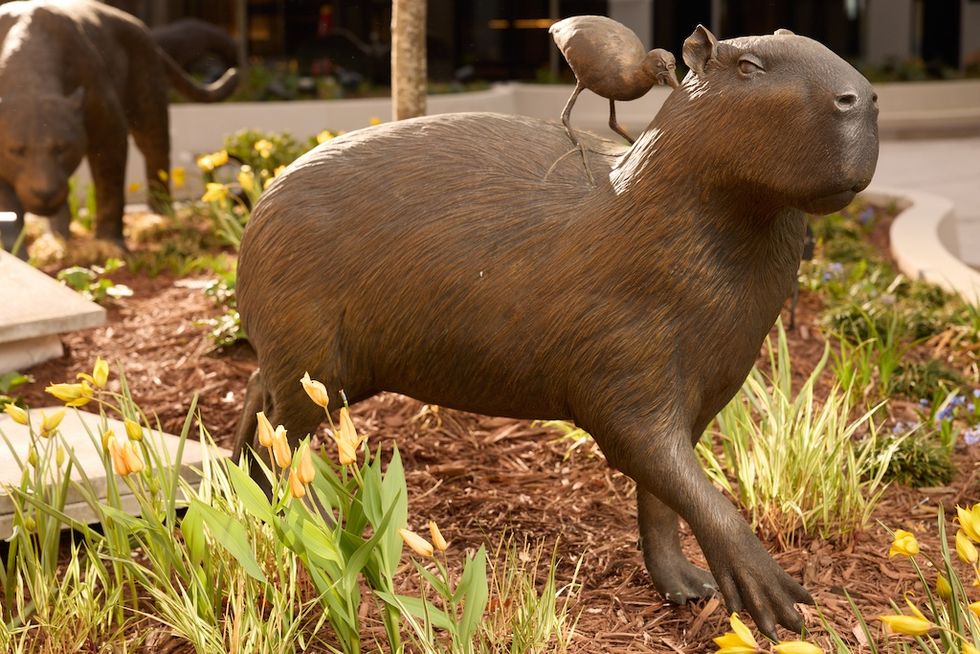
A bronze sculpture of a capybara standing at attention in the MOE courtyard, while a wattled jacana searches for insects on its back. In the background, a bronze sculpture of a jaguar watches hungrily.
Image credit Rebecca Hale/National Geographic
These are enhanced by immersive natural soundscapes, animal tracks, and bronze wildlife sculptures, including an emperor penguin and a Japanese giant salamander.
During the day, the courtyard offers Into the Field AR, an advanced AR experience accessible via a mobile app.
Putting Explorers at the heart of the experience
Though technological innovation is a major draw, the true core of the museum remains the people driving science and storytelling.
“It’s really the stories of National Geographic Explorers that are making an impact on visitors," Dunham says.
"Every exhibition in the museum is designed to surface their work and their impact, but we are also bringing Explorers to the museum in person regularly to talk directly to visitors as part of our robust public programming efforts.
“Where else can you learn about reintroducing wolves to Yellowstone from the person who led the project? Or ask questions of a group of National Geographic photographers who have covered stories around the world?"
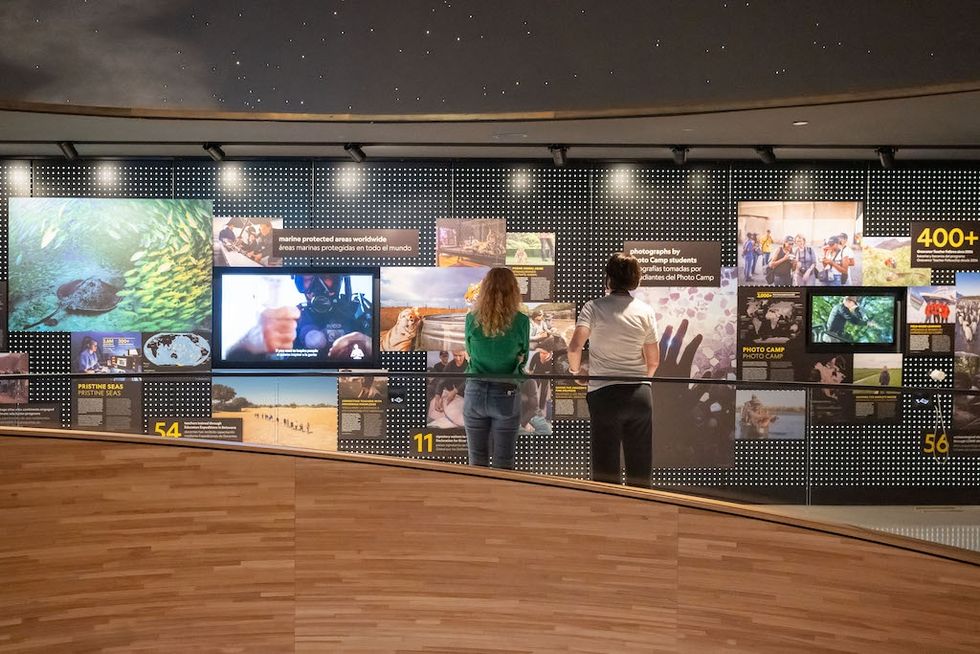
Rolex Explorers Landing at the National Geographic Museum of Exploration
Image credit Joy Asico-Smith
Instead of just recreating expeditions, the team worked with National Geographic Explorers to understand what discovery feels like, from the realities of fieldwork to the instances that changed their perspective.
“We asked our Explorers questions like: What inspired you? What surprised you? What did you hear, see and feel in that moment?"
These firsthand perspectives informed the creation of spaces like Rolex Explorers Landing, which traces the journey from an Explorer's initial spark of curiosity through to their global impact. The Explorers shared personal field gear, research tools and stories that have never been told publicly.
"We hope that visitors leave with new knowledge, yes, but also feeling curious, inspired and empowered to see themselves as explorers in their own lives,” says Dunham.
When technology disappears
Dunham describes the museum’s design philosophy as creating "invisible technology" - the kind that disappears so visitors become immersed in the story rather than the technology itself.
“Whether you’re enjoying the Wonders of Our World: Ocean in our courtyard at night or standing inside the Jack and Laura Dangermond | Esri Geoverse, every piece of technology was chosen because it helps visitors experience something they simply couldn’t through a traditional exhibition alone."
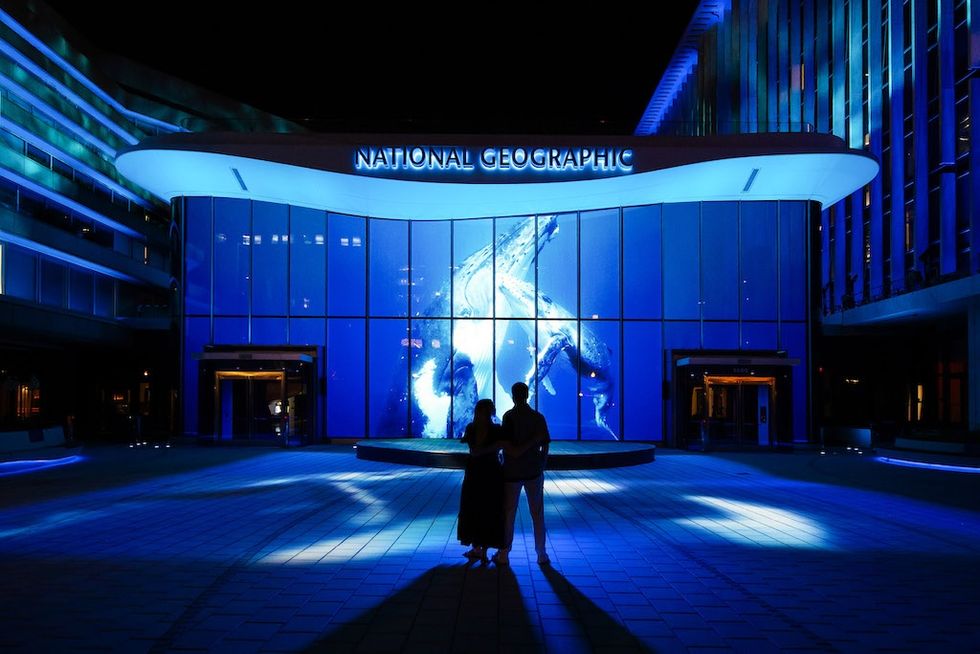
The immersive nighttime experience ‘Wonders of Our World: Ocean’ at the National Geographic Museum of Exploration
Image credit Moment Factory
Developed with digital media studio Moment Factory, the Wonders of Our World: Ocean evening courtyard experience transforms the facade into an expansive projection surface.
Through projection mapping, interactive floors, dynamic lighting, spatial audio, a 45-foot LED wall and the world’s largest installation of smart glass, visitors are surrounded by the beauty and power of the ocean.
“It took an extraordinary team of creatives, architects, engineers and technology experts to bring it to life, but if we’ve done our job well, visitors aren’t thinking about any of that. They’re simply immersed in the experience.”
Her favourite part, she adds, is watching the audience. “You hear the collective gasps. You see people pointing things out to one another. Children look up in amazement, and adults do too.”
The Jack and Laura Dangermond | Esri Geoverse follows the same principle. By combining 270-degree projections, spatial audio and interactive media, it transports visitors into the field with the Explorers to see geographic tools in action.
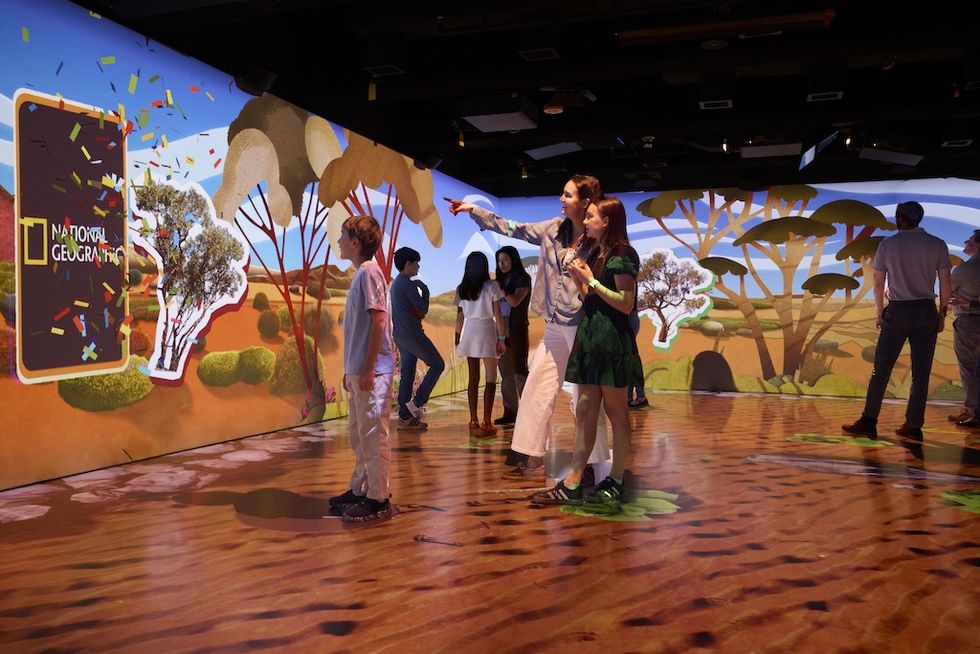
Learning meets adventure at the Jack and Laura Dangermond | Esri Geoverse at the National Geographic Museum of Exploration, featuring rotating shows for students, families and everyday explorers of all ages.
Image credit Rebecca Hale/National Geographic
“Whether they’re high in Peru’s cloud forest or standing on the banks of the Okavango, the space’s technology fades into the background, and the story takes centre stage,” adds Dunham.
“That’s always been our goal. If visitors leave talking about the Explorer they met, the place they experienced or the way the museum made them feel, more than the technology itself, we’ve succeeded.”
Balancing heritage and present-day storytelling
Visitors are able to explore The Archives, an interactive exhibition celebrating the people, maps, and photographs that built the National Geographic brand. This historical exhibition is paired with immersive spaces that represent the future of how the National Geographic Society continues to share stories.
"Throughout the MOE, visitors experience our evolution firsthand,” says Tiefenthaler. “They encounter the groundbreaking work of today’s Explorers, while also discovering the trailblazers who helped shape National Geographic, like Jane Goodall, Bob Ballard and Sylvia Earle.
"For me, that’s the balance: honouring where we’ve been while continually finding new ways to inspire the next generations. The stories evolve. The technology evolves. But our mission remains the same."
This respect for photographic legacy is highlighted in the museum's Exhibition Gallery, which debuts with Photo Ark: Animals of Earth, led by National Geographic Explorer Joel Sartore.
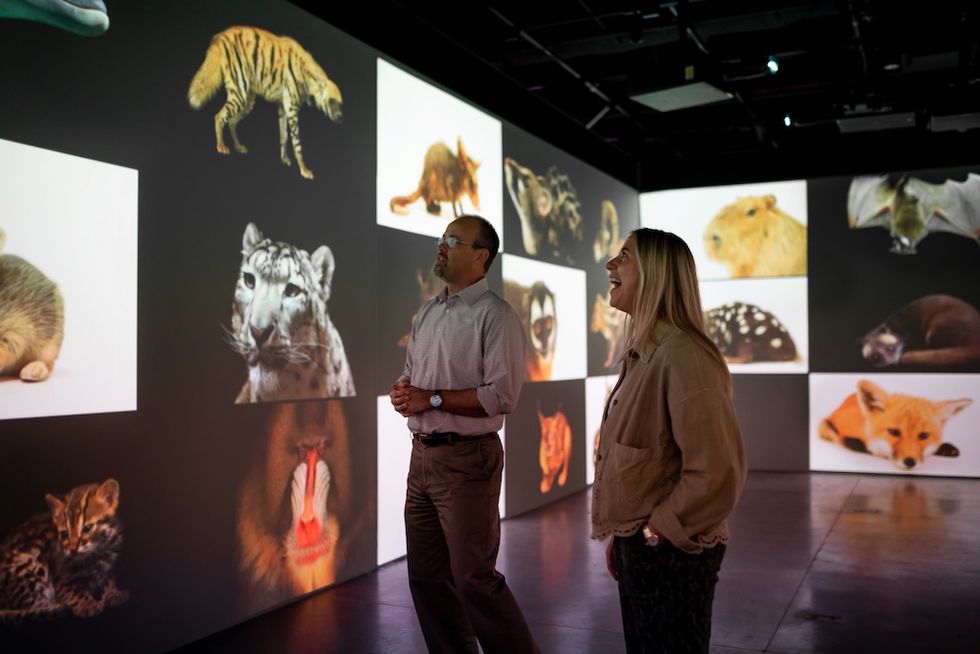
Photo Ark: Animals of Earth is the inaugural exhibition in the Museum’s Exhibition Gallery. This powerful showcase features wildlife photography by renowned National Geographic Explorer, photographer and founder of the Photo Ark, Joel Sartore, and aims to inspire urgent action to protect the world's at-risk species.
Image credit Moment Factory
It's a fitting debut because it illustrates the museum's central aim: using immersive storytelling that connects visitors emotionally with science and conservation.
Approaching its 20th anniversary, the Photo Ark project has documented over 18,000 species to draw attention to the global extinction crisis. The exhibition engages visitors directly with endangered animals through large-scale projections and sensor-based interactives.
Tiefenthaler says:
“Photo Ark represents the very best of what National Geographic does: using storytelling to inspire people to care and ultimately, to act. Biodiversity loss is one of the defining challenges of our time, and Joel has an extraordinary ability to make that crisis deeply personal.”
By removing distractions and placing each animal against a clean background, Sartore invites visitors to focus entirely on the individual before them, creating a moment of connection.
See also: NeoPangea creates interactives for National Geographic’s Animals of Earth
The museum also features an exhibition titled In Focus: Photographs of National Geographic, displaying iconic brand images such as George Shiras' groundbreaking nighttime wildlife photos and Ami Vitale's portrait of Sudan, the last male northern white rhinoceros.
MOE’s Learning Launchpad
Education is a core pillar of the Society's mission. A wider partnership supports the National Geographic Learning Launchpad, funded by a $15 million gift from Cengage.
This interactive area for children serves as the first stop for student groups. It features an introductory corridor, an activity room, and the Geoverse designed to teach geographic thinking, creative problem-solving, and the "Explorer Mindset".
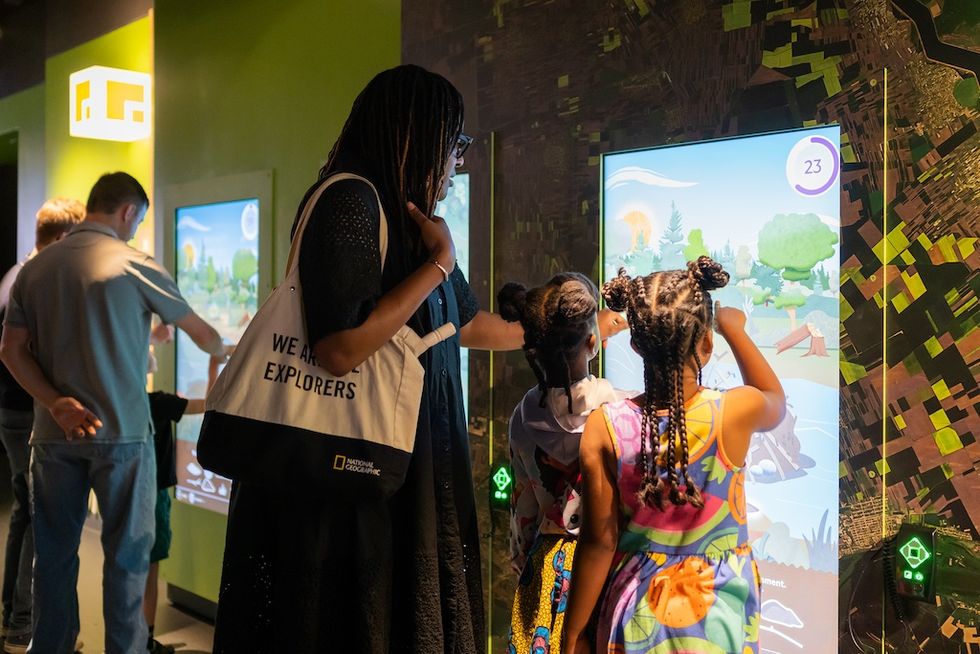
The National Geographic Learning Launchpad, powered by Cengage Group, is designed for learners, educators and the young-at-heart. Here, geography isn’t just something you read about in a textbook — it’s a way of thinking.
Image credit Joy Asico-Smith/National Geographic
Tiefenthaler says it is more than an education space; it’s an incubator for future explorers:
“We wanted to design something special for school groups that brings learning to life and gets students excited about geography.
"Through hands-on interactives centred on five principles of geographic inquiry, the Learning Launchpad encourages young people to ask bold questions, think geographically and see themselves as explorers."
Exploration, she adds, begins long before you set off on an expedition:
“It begins with curiosity that’s nurtured through education. The Learning Launchpad helps cultivate that curiosity and what we call the Explorer Mindset: the confidence to investigate, solve problems, embrace new perspectives and make a positive difference in the world.”
See also: Trivium Interactive crafts experiences for National Geographic Museum of Exploration
Making everyone feel welcome
Accessibility was a foundational principle for the design team, not an afterthought.
The MOE integrates captioned media, visual descriptions, bilingual signage, tactile photographs, Braille messages, and American Sign Language (ASL) throughout the guest experience.
"Our audacious mission to illuminate and protect the wonder of our world requires all of us working together,” says Tiefenthaler. “That belief is at the centre of the museum. From day one, the team set out to create an accessible, inclusive space that welcomes everyone.”
The goal, says Dunham, was to make sure that every guest feels at home. “To achieve that, we utilised the principles of inclusive design from the very beginning of the project. Accessibility isn’t a checklist; it’s a way of thinking about every aspect of the visitor journey.”
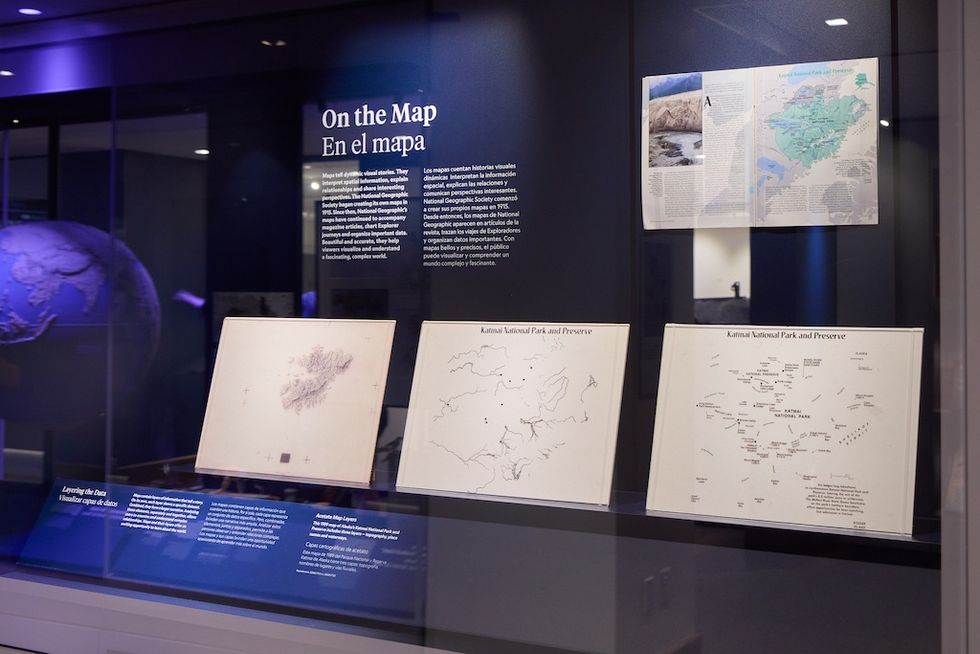
Step into The Archives and discover the legacy of exploration and storytelling that defines National Geographic. By blending traditional displays, spotlighting legendary expeditions, and innovative media immersing visitors in storytelling, MOE invites them to experience iconic moments of discovery firsthand.
Image credit Rebecca Hale/National Geographic
For instance, the MOE provides museum content in two languages. By offering all exhibition and wayfinding signage in both English and Spanish, as well as Spanish subtitles on all media, it offers a cohesive experience to Spanish-speaking visitors.
In addition, American Sign Language (ASL) translations are featured in all museum media with dialogue, and tactile elements are integrated throughout the exhibitions, from Braille labelling and tactile maps to floor indicators and accessible keypads for touchscreens. There are also audio descriptions of images and media.
The team was also intentional about the sensory aspect. “We offer sensory-friendly resources like adjustable controls for brightness, volume, and colour on touchscreens, as well as designated quiet spaces and sensory kits.”
“By embedding these features into the fabric of the museum, we ensure that every visitor can connect with the stories and see themselves as explorers."
Sustainability at the Museum of Exploration
Sustainability was treated with equal importance. The project pursued LEED Platinum certification using rigorous eco-friendly building methods and waste reduction efforts.
"We knew that the National Geographic Society had a proud legacy of sustainability to live up to. In 2003, our headquarters were the world’s first existing building to achieve LEED certification," Dunham says.
"To carry this forward, sustainability was the blueprint, not an ‘add-on’. Like accessibility, sustainability is woven into every stage and aspect of this project."
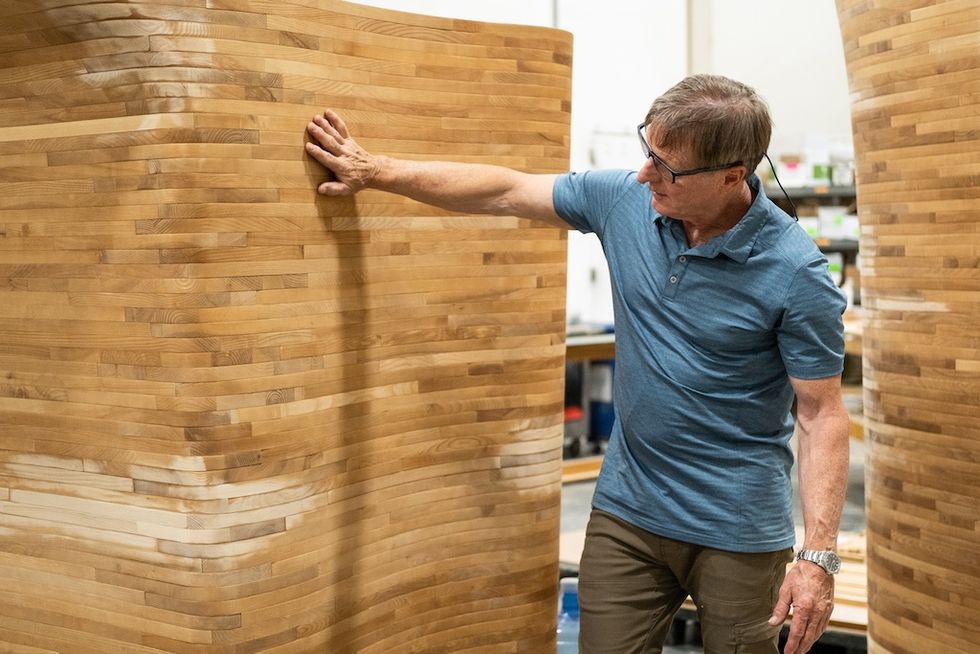
The wood millwork for the Pavilion at the Museum of Exploration was sourced from a family farm in New England where the emerald ash borer, an invasive beetle from Asia, is steadily decimating ash forests. To get ahead of the beetle's spread, the farm had to fell all of its trees. The National Geographic Society decided to build the millwork from these ash trees instead of another species that would have otherwise come down for no other purpose.
Image credit Cassidy Motahari/National Geographic
Marble that was removed from the 17th Street building’s historic facade is living a second life in the Trek area of Rolex Explorers Landing.
The ashwood that greets visitors as they step into the museum’s Pavilion was sourced from a family farm in New England, whose ash trees were in danger of being decimated by the invasive emerald ash borer.
“By using this wood, we gave a purpose to trees that had to be felled to slow the beetle’s destructive spread."
She adds:
"Even what you don’t see matters. Visitors will see the plants inside the museum, but they won’t see the 45,000-gallon cistern that reclaims rain to water them. They also won’t see the reclaimed rainwater travel through our plumbing on the way to flush the campus’s toilets!
"The museum proves that a state-of-the-art experience and a low carbon footprint can, and must, go hand-in-hand."
Creating a spark
When considering what visitors will take away from the experience, Dunham talks about one of her favourite exhibitions, the “Spark” section of Rolex Explorers Landing.
“It celebrates the moment in an Explorer’s life that sparked their journey. For Jane Goodall, it was a storybook with chimpanzees in it. For Explorer Tati Besada, it was a water bottle that washed up on the shore, inspiring her to dedicate her life to solving plastic pollution in our oceans.
“For many people, the Museum of Exploration will be their spark moment. I hope that someday, we welcome an Explorer into our community who looks back and remembers visiting the museum and deciding they wanted to be part of it one day."
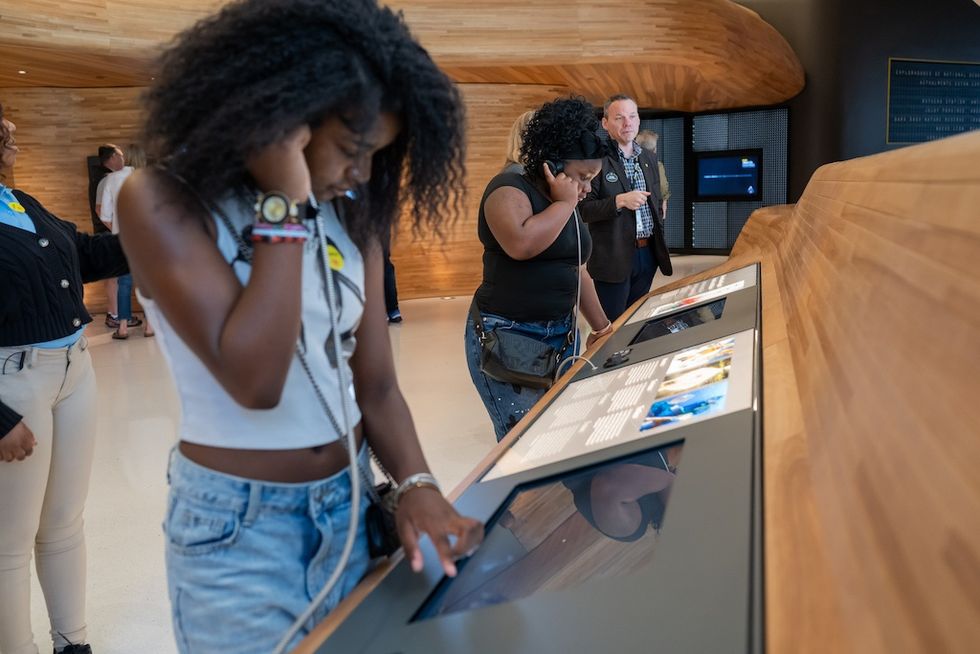
Rolex Explorers Landing at the National Geographic Museum of Exploration.
Image credit Joy Asico-Smith
As the museum launches into its first year of operation, both leaders have a clear vision of what long-term success will look like for this $300 million investment.
Dunham says that the museum wants to become a cultural keystone in the nation's capital:
"As one of Washington, D.C.’s newest cultural destinations, I hope the museum becomes a major, must-see attraction for tourists and local community members alike. I hope that people don’t think of it as a place to visit once, but as a place that continually sparks curiosity and rewards repeat visits."
"When I think about success one year from now, or even ten years from now, I think about a growing community," Tiefenthaler adds. "One of the things I love most about the National Geographic Society is the incredible community we’ve built: our Explorers, supporters, partners and everyone who believes in our mission.
“My hope is that the museum grows that community by introducing more people to our Explorers and their work, and to the National Geographic Society as the mission-driven nonprofit that makes so much of that work possible.
“If visitors leave feeling inspired to make a difference in their own communities, then the museum is a resounding success. Because ultimately, the museum isn’t just about celebrating exploration; it’s about inviting more people to become part of it."