Think of theme parks, and most people think of roller coasters – the highlight of many visits, to thrill, dare and get the pulse racing. However, when we look at the history of roller coasters, they were first seen in the frozen regions of Russia in the 17th Century.
Named the 'Russian Mountains,' the first roller coasters were made of ice, cut into hill shapes supported by wooden structures. The slopes rose to 80ft at a 50-degree angle. So popular were these roller coaster slides with the upper class that even Catherine the Great built them within her own grounds.
However, these Russian Mountains did not have the looping tracks and high speeds of modern roller coasters. Rather than an exhilarating experience, they were more like picturesque rides with a gentle drop. Still, they set the stage for the creation of roller coasters as we know them today.
History is not entirely clear about when the first wheeled roller coaster appeared. Some believe it was commissioned by Catherine II, while others say it was in Paris using an English design. Roller coasters have evolved over the ages, influenced by numerous inventions and designs.
Thanks to mechanical lifts, track systems, and other features, roller coasters advanced in sophistication throughout the 19th century.
Early roller coaster history
Roller coasters soared in popularity worldwide from the late 1800s. At this time, they were built of wood. A few of the original wooden roller coasters are operational today.
The oldest is Leap the Dips, found at Lakemont Park. The Pennsylvania, US-based structure has entertained visitors since it opened in 1902.
Other still-operating original wooden coasters include the Scenic Railway at Luna Park Melbourne, which opened in 1912 and is the world's oldest continuously operating roller coaster. Meanwhile, Rutschebanen at Denmark's Tivoli Gardens dates back to 1914.
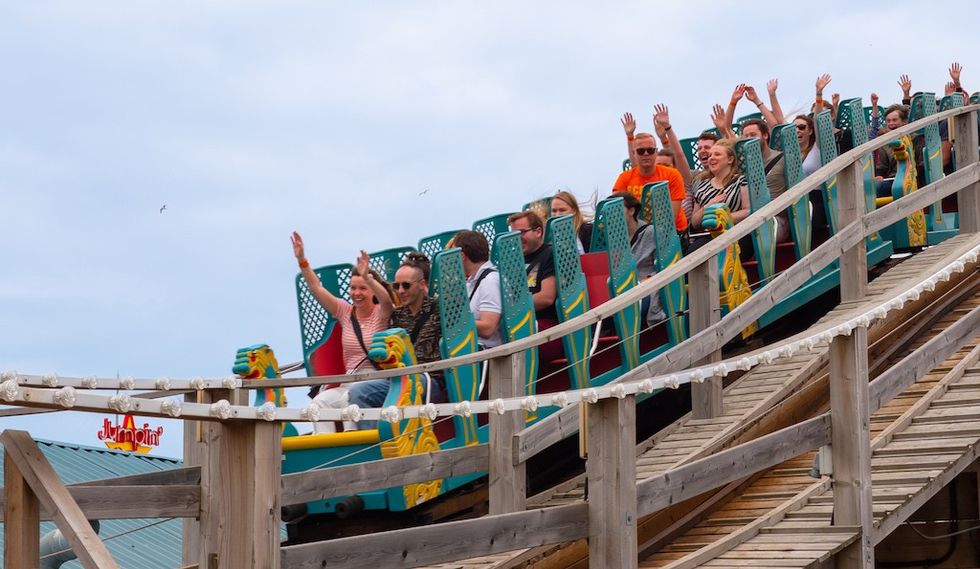 Scenic Railway at Dreamland Margate
The Scenic Railway at Dreamland Amusement Park in Margate, Kent, is the UK's oldest roller coaster, dating back to 1920. A unique feature is the brakeman perched on a stool in the middle of the train, who operates the train. This gives a different ride every time.
The Scenic Railway achieved Grade II listed status in 2002, preventing its destruction. However, a fire destroyed part of the structure and the workshop housing its original hand-carved trains in 2008. Thanks to the Heritage Lottery Fund and Sea Change grants, repairs were made.
Dreamland announced in January 2026 that its Scenic Railway would "take well-earned retirement from operation as a ride".
The park added: "This is not the end but a new beginning.
"We are committed to developing a new long-term vision that will not only showcase this remarkable Grade II* listed structure but reimagine its purpose, so it can continue to be enjoyed by future generations in a fresh and meaningful way."
A coaster slump
The Great Depression had a huge impact on amusement parks and, consequently, roller coasters in the USA. By 1939, the number of amusement parks had plummeted from approximately 1900 to 245. Thus, many roller coasters fell into disrepair.
The economic slump resulted in widespread financial hardship, lower consumer expenditures, and a drop in leisure activities. Amusement parks struggled to stay profitable and draw crowds. Riding roller coasters and visiting amusement parks were just out of reach for many.
As a result, fewer people visited parks, and several had to close permanently.
The financial burden also made it difficult for amusement park owners to maintain and upgrade their roller coasters. This caused several coasters to deteriorate.
In an attempt to cut expenses and appeal to customers on a tight budget, parks started favouring simpler, more affordable coaster designs. Many parks also began recycling materials to construct new attractions or reuse old rides.
However, despite these difficulties, roller coasters did not completely vanish during the Great Depression. Certain amusement parks were able to withstand the financial downturn by providing reduced entrance costs. Others implemented creative promotional techniques to draw guests.
For those who could afford it, roller coasters remained a source of fun and escape, albeit on a smaller scale than before.
As the economy slowly recovered, so did the number of parks and their roller coasters. A genuinely famous one to rise is The Beast at Kings Island in Ohio.
This wooden roller coaster was designed and manufactured in-house for approximately $3 million. At 141 feet high and 7 400 feet long, the ride opened in 1979 as the world's tallest, fastest, and longest wooden roller coaster.
According to Guinness World Records, The Beast is still the world's longest traditional wooden laminated track roller coaster. In 2022, the park extended the ride track by 2 feet, from 7,359 to 7,361 feet, solidifying its grip on this record.
The birth of steel roller coasters
But the roller coaster was becoming different; at this point in history, new steel structures were appearing.
The invention of steel roller coasters was a pivotal moment. This metamorphosis enabled the roller coaster to be more complex and daring in design. Roller coasters now had loops, corkscrews, and more daring angles.
Arrow Development Company, established in the 1940s by Ed Morgan and Karl Bacon, is frequently credited with creating one of the first steel roller coasters.
Since steel support structures and tubular steel tracks provided several benefits over conventional wooden coasters, Arrow started experimenting with them. Steel coasters proved easier to clean and more long-lasting. Plus, they allowed for more intricate and exciting patterns.
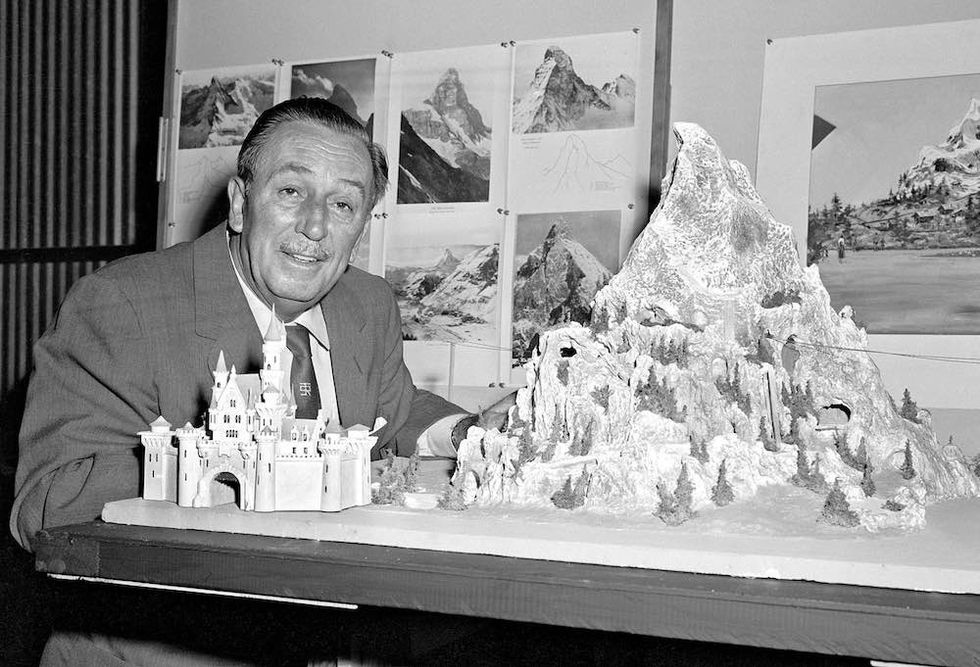 1958: Walt Disney reviews a model for the Matterhorn Bobsleds
With a tubular steel track and a distinctive ride vehicle like a bobsled, Arrow debuted the Matterhorn Bobsleds at Disneyland in California in 1959.
The coaster showed the possibilities of using steel instead of wood for roller coaster construction. This was a big change from the customary wooden coasters.
The Racer's debut at Ohio's Kings Island in 1972 marked yet another significant milestone.
John C. Allen of the Philadelphia Toboggan Coasters (PTC) created the Racer, the first contemporary steel roller coaster with a complete circuit and tubular-steel track. This made steel coasters more well-known and opened the door for further technological developments in roller coasters.
Advances in engineering and design led to larger, faster, and more intricate steel coasters in the 1970s and 1980s.
By inventing innovations like inversions, launches, and hypercoasters, businesses like Arrow Dynamics, Intamin, Bolliger & Mabillard (B&M), and others pushed the envelope of what was possible.
Steel roller coasters are now the main feature of amusement parks worldwide. They provide excitement-seekers of all ages with a variety of thrills. Steel roller coasters continue to push the boundaries of height, speed, and excitement, offering riders heart-pounding experiences and memorable thrills.
With each daring ride, visitors clamoured for more thrilling roller coasters. Designers continued to rise to the challenge towards the end of the 20th century.
A new chapter in roller coaster history: today's innovations
Ride designers have continued to develop and push the limits of engineering, design, and innovation in the twenty-first century, and roller coasters are still evolving.
Riders can now stand as they take the daring ride. They can also sit, with their feet dangling and 'fly', restrained only by over-shoulder restraints and seat belts. They experience roller coaster rides where G-forces take them to the limit.
Roller coaster technology has advanced significantly, enabling more intense and exhilarating ride experiences.
Because of the widespread use of launch systems, magnetic propulsion, and computer-controlled components, coasters can now go faster and execute more intricate manoeuvres.
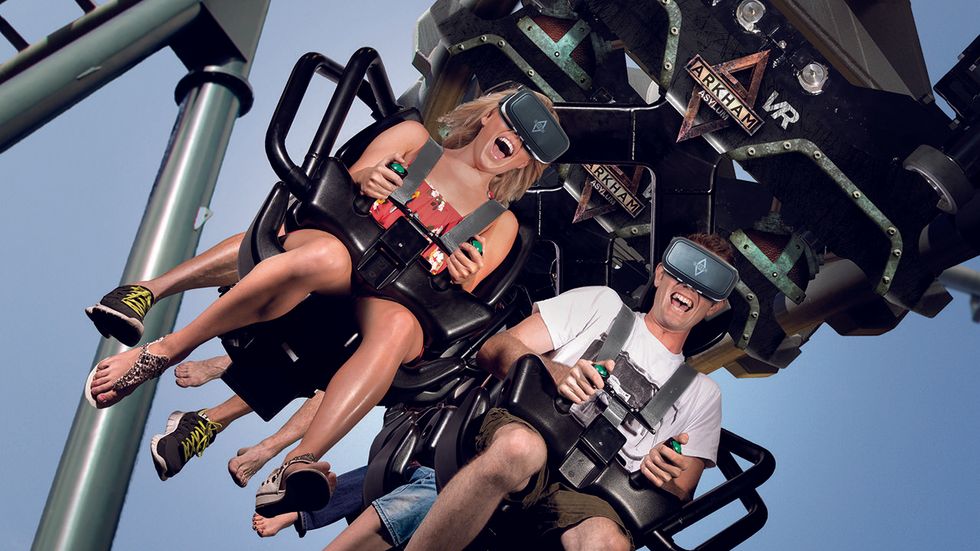 Warner Bros. Movie World, Arkham Asylum VR Coaster
A few roller coasters have even integrated VR technology. This enables passengers to experience a different reality by donning VR headsets while riding.
Virtual reality coasters offer a captivating experience; nonetheless, they have encountered challenges with throughput and operating efficiency.
Storytelling and theming have also become more prominent throughout roller coaster history. The themed coasters' lavish scenery, special effects, and multimedia components enhance the ride experience by immersing riders in richly designed worlds.
Examples are Guardians of the Galaxy: Cosmic Rewind at Walt Disney World and Hagrid's Magical Creatures Motorbike Adventure at Universal Orlando.
As environmental issues have gained prominence, theme parks and roller coaster manufacturers have also sought methods to create more environmentally friendly and sustainable rides.
This entails recycling resources, employing eco-friendly building techniques, and utilising energy-efficient lighting.
Hybrid designs
Creating roller coasters that blend aspects of steel and wood coasters has become a prominent trend in roller coaster design. Usually constructed with a steel track atop a wooden support system, these hybrid attractions combine the classic wooden coaster sensation with the smoothness of steel coasters.
Twisted Colossus at Six Flags Magic Mountain in California is an example of a hybrid coaster. The ride originally opened in 1978 as Colossus.
In 2014, after more than 36 years in operation, Six Flags closed the ride, and Rocky Mountain Construction (RMC) converted its wooden track to steel, allowing for the addition of inversions and steep drops. Twisted Colossus then debuted in May 2015.
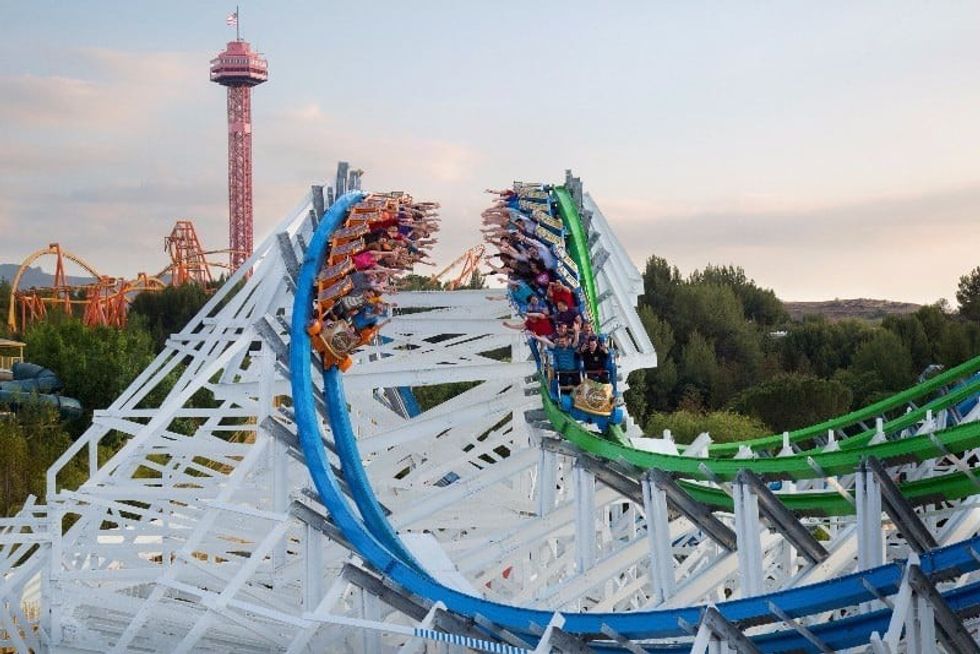 Twisted Colossus
In fact, RMC is renowned for its wood-and-steel hybrids. This includes its I-Box coasters, where the track is entirely made of steel and can be on wooden supports. Zadra at Energylandia is an example of a ground-up coaster with I-Box.
Meanwhile, Hakugei at Nagashima Spa Land in Japan is an example in which the original support structure from a pure-wood coaster serves as the main structure of the new coaster.
Record breakers
In recent history, manufacturers and operators have been constantly competing to create the world's tallest, fastest, and longest roller coaster.
Formula Rossa at Ferrari World Abu Dhabi was the world's fastest at 149.1mph until the opening of Falcons Flight at Six Flags Qiddiya in Saudi Arabia in 2025 (155.3 mph). It now ranks second, with Cedar Point's new Top Thrill 2 (120 mph) in third and Red Force (111.8 mph) at PortAventura's Ferrari Land in fourth.
Previously highly ranked fast coasters include Kingda Ka at Six Flags Great Adventure in New Jersey (demolished in 2025) and the now-closed Superman: Escape from Krypton at Six Flags Magic Mountain, both of which reached top speeds over 100 mph.
When it comes to the tallest coasters, the same names come up.
Before their closures, Kingda Ka (456 feet) was in first place, and Superman: Escape from Krypton (415 feet) was in second. Now, Falcons Flight is at the top at 534.8 feet, with Top Thrill 2 coming second at 420 feet. Red Force (367.3 feet) stays in third place.
At 13,943 feet, Falcon's Flight is also the longest by quite some margin, knocking the 8,133.2-foot-long Steel Dragon 2000 at Nagashima Spa Land off the top spot. Formula Rossa (6,805 feet) is third.
More new rides
When it comes to the most eagerly awaited new rides, UK coaster enthusiasts were treated to Hyperia (pictured, top) at Thorpe Park in May 2024. With a top height of 236 feet and a maximum speed of more than 80 mph, it is the UK's fastest and tallest roller coaster.
Elsewhere in the UK, the much-loved Nemesis coaster at Alton Towers reopened in March 2024 as Nemesis Reborn. This followed a retracking and refurbishment project.
Germany's Europa-Park opened Voltron Nevera in April 2024. At 1,385 metres, it is the longest multi-launch coaster in Europe. The ride's 105-degree launch is the steepest in the world.
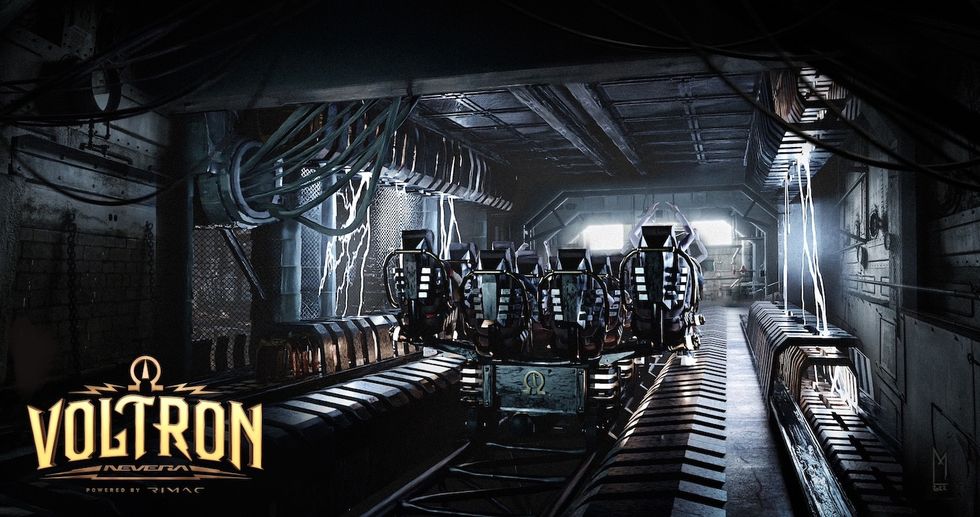
Riders also enjoy several LSM launch tracks, including one at 55.9 mph, a maximum height of 106.6 feet, a unique turntable element, and seven inversions.
In Australia, a highly themed new Vekoma coaster, Jungle Rush, is now open at Dreamworld. This includes forward and backward sections, 12 airtime moments, and the world's first "inclined turntable."
In the US, Flash: Vertical Velocity at Six Flags Great Adventure marked the first arrival of a Vekoma Super Boomerang coaster in North America.
Meanwhile, Universal opened Epic Universe in May 2025, with rides including Stardust Racers, a dual-launch steel coaster featuring two 5,000-foot tracks and an inverted cross. The coaster reaches a height of 133 feet and a speed of 62 miles per hour.
The park also features the Mine Cart Madness coaster, which simulates jumping over the gaps between broken tracks.
In the Middle East, as well as the record-breaking Falcons Flight, Six Flags Qiddiya City is also home to Iron Rattler, the tallest and largest Vekoma tilt coaster in the world.
The history of roller coaster design shows us that ride designers are both imaginative and scientific. They understand physics, particularly forces. They must understand what will give the greatest G-force experience while ensuring passenger safety.
Where will the roller coaster take us next?