
If the previous question I posed for this emerging category is whether it can sustain itself, the next one is more interesting. Not just whether it can last, but what it would look like if it did.
If this category is going to mature, and I think it will, it has to become something more than a series of well-designed places people try once and then move on from. It has to become something people come back to without needing to think too hard about why. This forces a slightly uncomfortable question.
Are we designing attractions? Or are we trying to design an ongoing experience?
During my conversation with Rick Briggs, CEO of FuzionGamz, and Matt DuPlessie, founder and CEO of Level 99, Matt described how video games have evolved from linear, tightly controlled environments to open, exploratory ones where the player has much more agency.
The video game comparison illustrates what he sees as the future: moving away from telling the guest what to do, toward creating a space where they decide what they want to do, how long they spend on something, and what they come back to.
That feels more than a design decision. Guest empowerment changes the relationship with the experience. We move from something you visit to something you participate in.
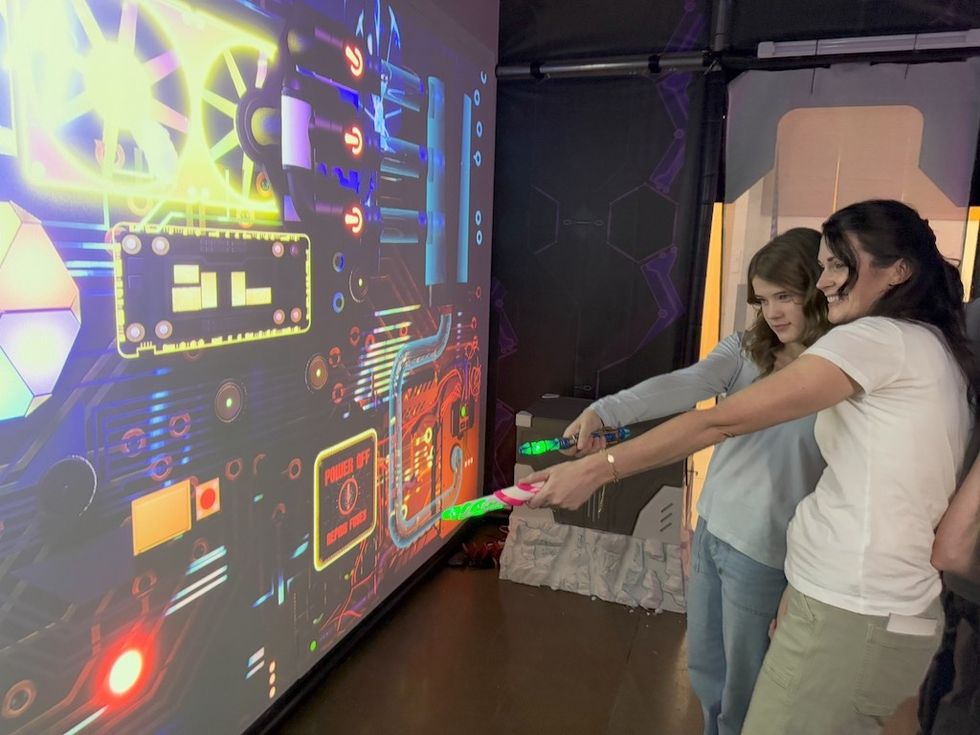 A mother and daughter work together to complete a challenge at FuzionGamzImage courtesy of FuzionGamz
If everything is structured, directed and finite, then it’s something you complete. You work through it, enjoy it, and at some point you’ve done it. Even if you do it well.
If, instead, there is choice, variation and enough depth that you don’t feel finished; that when you come back you continue rather than restart, and your progress carries forward. It’s a very simple idea when you hear it, but it completely changes the experience.
As Rick says: “It is no longer something that is delivered to you. It is something you interact with and shape over many visits.”
Both Level99 and FuzionGamz are entertainment ecosystems built to “remember you”; both let players leave, come back, and pick up where they left off.
The importance of agency and progression
Designing in ‘continuity’ is a completely different way of thinking about the experience. Because that’s not a structured, programmed progression - it’s something the experience is inviting.
Matt described the shift away from linear design very clearly, moving from telling people “do this, then this” towards environments where there are 50 things to do in a venue, and you decide the order, the pace, and what you repeat.
He said that at Level99, most guests see only around 40% of the content on their first visit.
That surprised me. Because it means the experience is deliberately designed so you have more to do than you can get to in one visit.
That is a very intentional answer to the repeatability problem. It isn’t just about scale - it changes the nature of the visit. It’s no longer a question of “was that good enough to do again?” It becomes “I didn’t finish that.”
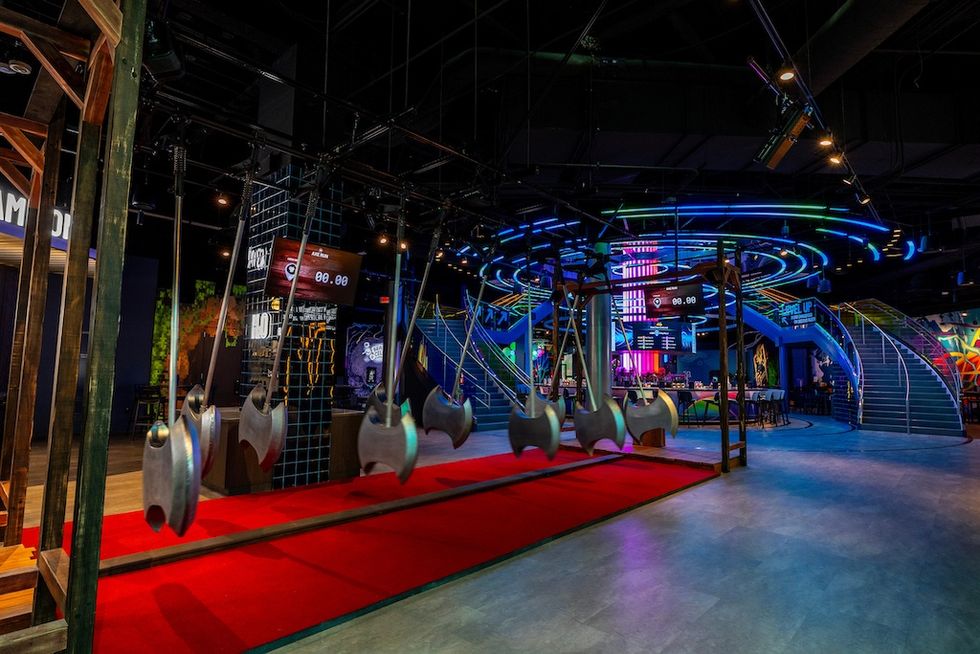 Axe Run is one of the challenges at Level99, often inviting spectatorsImage courtesy of Level99
We talk about immersion, storytelling, technology, scale, but I’m surprised that, as an industry, we don’t talk much about what actually brings someone back. It’s whether the experience creates a sense that there is more to it than what you saw the first time, if there is more for them to achieve.
I think how much agency people are given within these environments matters.
In more traditional formats, we are very good at guiding the guest through experiences to ensure throughput; we shape the pace and every view and interaction. That works very well for certain types of attractions - but importantly, that control creates completion, and completion makes it harder to justify coming back.
It’s not just participation, it’s shared participation
There is also something very physical in how Rick talks about these environments; he described the way people move through FuzionGamz space, and how others can watch, react, laugh, and encourage. That it becomes, at the same time, something you are doing and something other people are part of.
FuzionGamz and Level99 both let people play collaboratively while still scoring individual points.
Because even when there is progression, even when systems carry forward, the reason people actually come back may be much simpler. They enjoyed playing together
None of this is to suggest that the answer is simply “give guests agency” or “give people more to do - together.” There is a balance to be found between coherence and openness.
Too much structure, and the experience becomes finite. Too little, and it risks feeling unfocused.
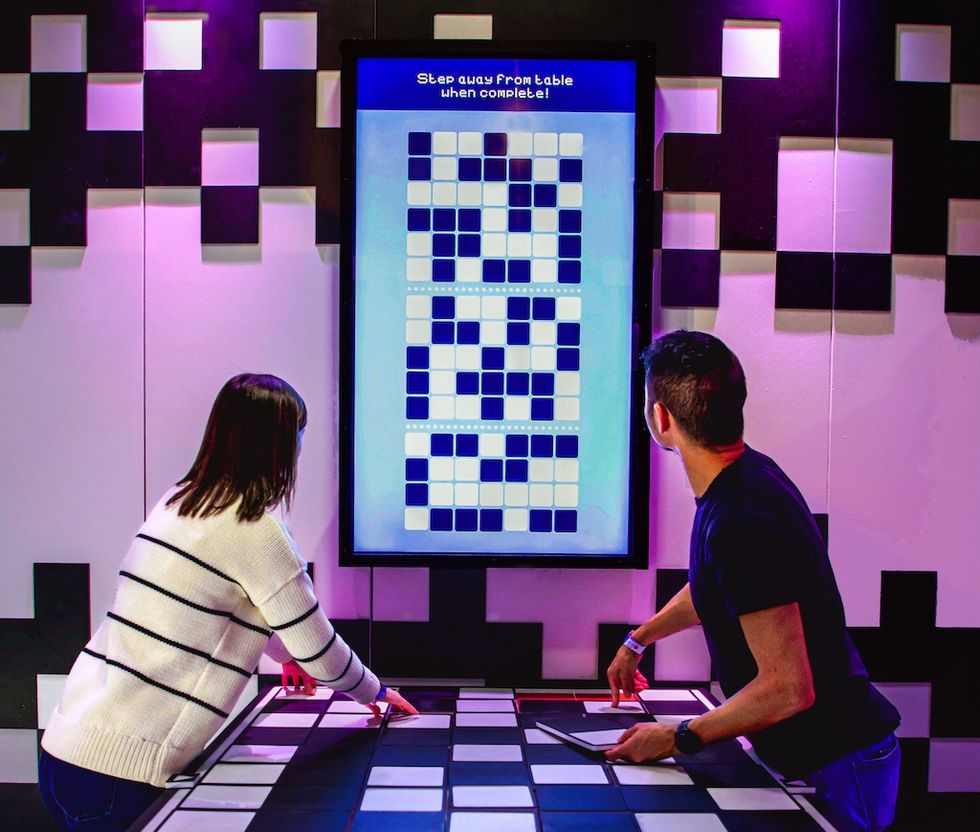 8-Bit Binary at Level99, inviting shared participationImage courtesy of Level99
If I step back from all I learnt from Rick and Matt - progression, agency, scale, content depth - it starts to feel as though the category is moving away from being “a collection of experiences” and towards being something closer to a system of engagement.
If this category is going to deliver on the promise that people see in it, it has to move away from being defined by a single visit to provide a reason why the second visit feels different from, or a continuation of, the first, which I think will focus on the ‘social’ part.
Rick explained, “A few decades ago, as attraction designers, our goal was to create memorable experiences. But we have now transcended that. The goal isn't to just create a memorable visit—it's to create a game or experience that guests want to make part of their lives.
"Every session deepens their progression, strengthens their social connections, and opens new reasons to come back.”
See also: FuzionGamz: reality meets gaming in a dynamic interactive adventure
What success might actually feel like:
These experiences are often described as competitive, but I don’t think that is what will ultimately define them. If anything, the competition is the initial layer that gives people something to focus on.
What actually drives return is not the outcome of a game, but the experience of being in that environment again with people you choose to spend time with.
So perhaps the shift is not just from passive to interactive, or from analogue to digital. Perhaps it is also a change from something you do once to something that becomes part of how you spend your time with others.
That is no small distinction, because if that happens, this category stops being a trend and starts behaving like something much closer to a habitual social behaviour.
And that is a very different kind of business altogether, and a very nice one to own.
This is the third in a three-part series, following on from More than a buzzword: the real reason competitive socializing is here to stay and Competitive socializing has a repeatability problem