Combining the immersion of VR with the physicality of themed environments is an ongoing challenge for location-based entertainment (LBE) operators. The challenge isn't just creating an immersive experience but delivering it at a scale and throughput that works commercially.
Hololabs Studio believes it has developed a way to address that challenge. At this year’s IAAPA Expo Europe in London, the Canadian creative technology studio is introducing a ticketed, guided, multi-room experience that combines physical sets with mixed reality.
The studio brings experience across game development, LBVR and major theme park attractions, including Mario Kart: Koopa’s Challenge at Universal Studios Japan, and Mario Kart: Bowser’s Challenge at Universal Studios in Hollywood and Orlando.
The new format is designed to tackle what Hololabs Studio describes as the “three-cornered problem” of location-based entertainment: balancing immersion, capacity, and an attraction's physical footprint.
Hololabs Studio president Mike Wozniewski and VP of creative Brett Gaylor speak to blooloop about the thinking behind the format, the company’s experience in large-scale attractions and the development of its approach to immersive entertainment.
A new attraction format
At the core of Hololabs Studio’s new offering is a flexible, walk-through attraction format. Rather than being a single, fixed game, the format is a modular framework designed to accommodate different intellectual properties and thematic skins.
The attraction is designed as a ticketed, guided experience that moves groups of guests through three distinct rooms, each representing a different phase of the narrative and physical journey.
The demonstration skin being brought to London, called Abyss MR, is based on Abyss: Vault, Hololabs Studio's cooperative science-fiction VR experience for two to six players. Guests begin their adventure by walking into a themed, physical show set, styled as the interior of a submarine.
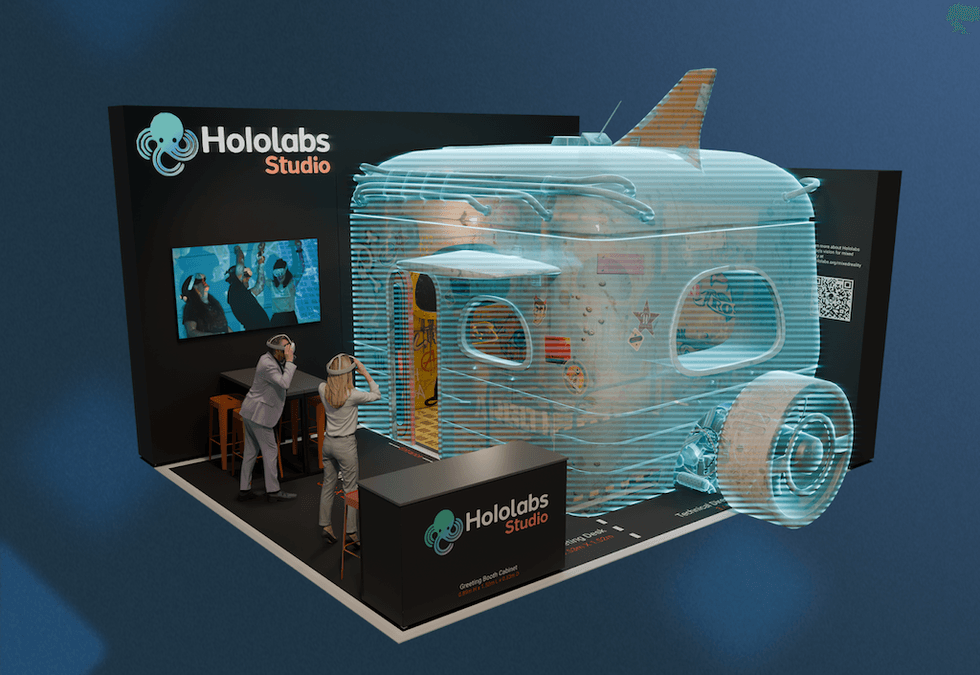
Rendering of the Hololabs Studio booth at IAAPA Expo Europe
Image courtesy of Hololabs Studio
Inside, guests can touch and interact with physical props and controls. "One of the items in the submarine is a VR headset, themed to belong in the world, and guests are instructed to put it on before continuing through the rest of the attraction," explains Wozniewski.
Through the headset's pass-through cameras, the real and the virtual are combined. While the physical walls of the room provide structure, the headset “fills in” the details, rendering the exterior of the submarine, virtual steam rising from physical vents, and a real-time ocean outside a submarine window.
While the experience at IAAPA Expo Europe will demonstrate this first space, the eventual format will see guests move from this room, once they are oriented and the narrative is established, to a second room, an open space dedicated to free-roam VR.
The moment they cross the threshold, the pass-through camera deactivates, moving the players into an immersive digital environment where they see full-body virtual avatars of themselves and their companions.
In this room, Hololabs Studio's game design elements shine. Because they are in a completely virtual space, they are no longer restricted by the room’s physical boundaries. Through clever spatial design, guests can traverse large digital environments, scale vertical ladders, or slide down zip lines.
The experience culminates in a third room designed to deliver a cinematic climax while physically positioning the guests for exit and headset removal.
"It concludes with a seated finale and a motion base, and then they can take their headsets off. That final room can also be themed, where the seats are in an escape pod, for example," Wozniewski adds.
Operating essentially like a compact 4D cinema, the finale room uses motion, vibration and synchronised media to provide a physical conclusion before guests exit into a themed retail or food and beverage space.
Rather than waiting for a group to complete the entire experience before sending in the next, Hololabs Studio uses a "stacking" flow.
"Every guest would go into [the mixed reality space], and then they alternate into virtual reality spaces to optimise for throughput," Gaylor explains.
Balancing immersion, capacity and footprint
The multi-room format has been developed around what Hololabs Studio describes as the “three-cornered problem” of location-based entertainment.
Operators must balance three competing requirements: high throughput, a small physical footprint, and a high degree of immersion and interactivity, to keep people coming back for more.
Achieving all three is a challenge. For example, a traditional free-roam VR arena can offer high immersion within a relatively small footprint. Still, its throughput is limited by the number of players that can occupy the space at once.
Conversely, a high-throughput dark ride can accommodate large numbers of guests but may require a significantly larger physical footprint and typically offers less individual guest agency.
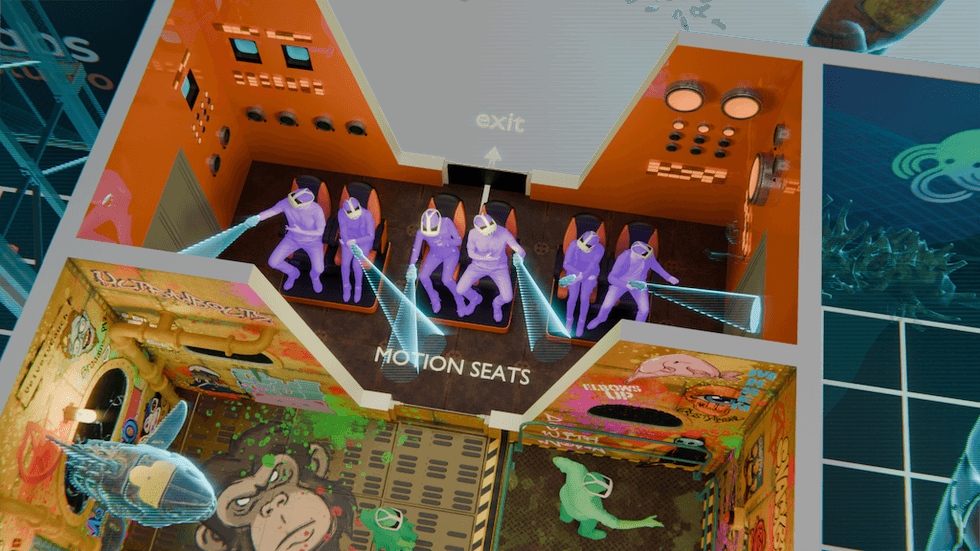
Operating like a compact 4D cinema, the finale uses motion, vibration and synchronised media to provide a conclusion
Image courtesy of Hololabs Studio
"Everyone's battling with this," Wozniewski says. "We think we have a solution that elegantly accommodates all three.”
The studio has combined its game-design expertise with theme park operational logic. By dividing the guest experience into a sequence of rooms, Hololabs Studio aims to stack groups of players, increasing throughput while using a compact physical footprint and incorporating mixed-reality elements.
"This is a format that we've tuned, and we've modelled. We have calculations of the revenue per square metre, and the return on investment that someone could see if they are an operator or someone with an IP that wants to create something like this.”
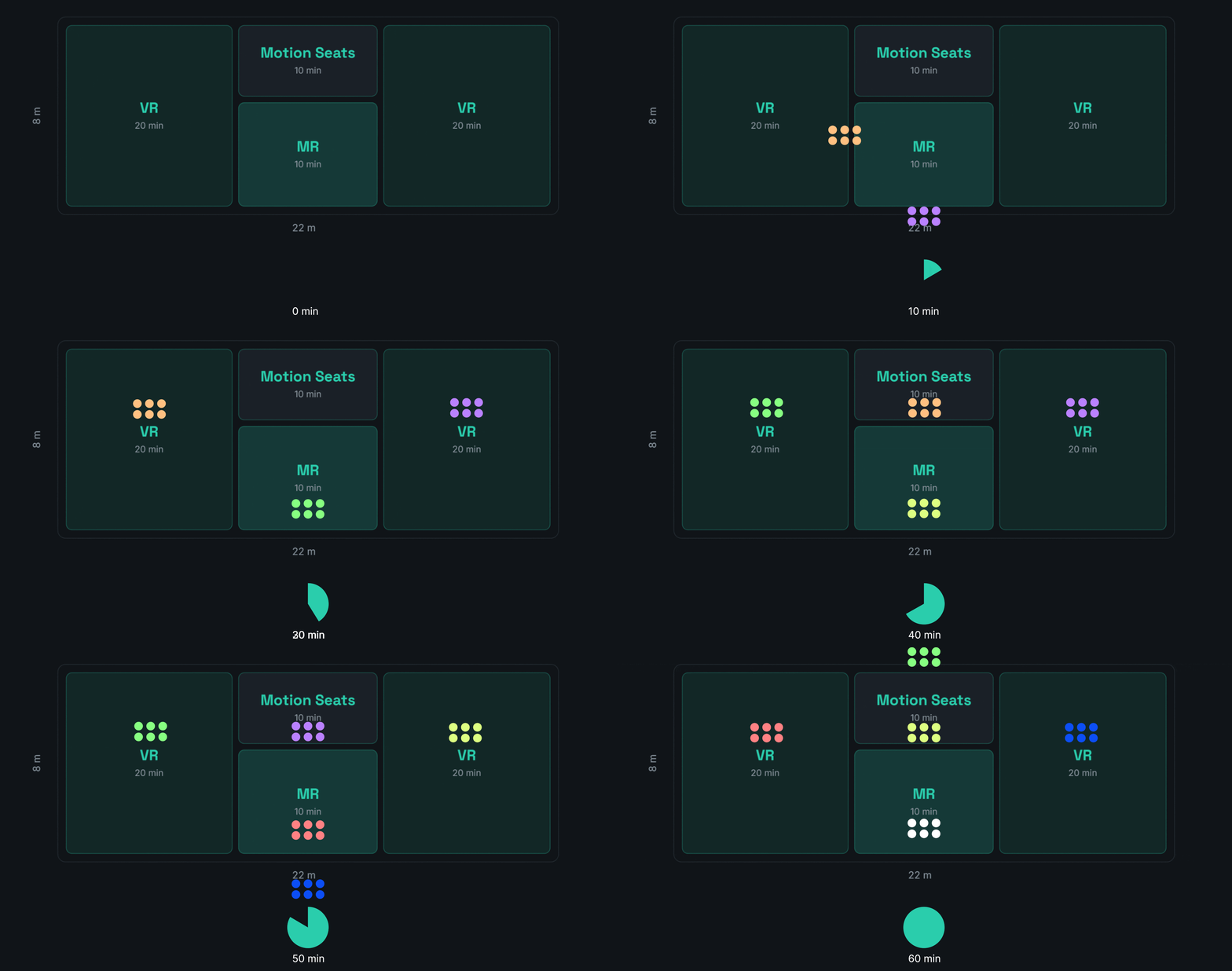
Demo of the room flow for the experience
Image courtesy of Hololabs Studio
The standard layout is designed for retail environments, entertainment centres or as an anchor within a larger park development. Hololabs Studio says its guest flow allows the format to accommodate a high throughput within a compact footprint.
From game development to theme parks
Hololabs Studio has spent the past 15 years working at the intersection of gaming, software engineering and location-based entertainment.
The Canadian creative technology studio brings together former AAA game developers and systems integration specialists, with experience on projects including Universal's Mario Kart rides.
Over time, the studio has evolved from digital game design into physical-world installations that connect software with show sets, ride systems, projection, audio, lighting, and practical effects.
"A lot of us come from game development," says Wozniewski. "There's a lot of former AAA game developers at the company, and then we got into theme park development at a pretty high level, working on Mario Kart for Universal Studios."
That project helped the team to understand the operational demands of world-class attractions.
Hololabs Studio contributed gameplay, interactive media, and key elements of the technical architecture, helping to realise a ride that blended physical dark ride vehicles with augmented reality headsets, projection mapping, and real-time interactive elements.
Working on an e-ticket attraction of this scale presented Hololabs Studio with technical challenges around integrating game technology into a major theme park attraction:
"That was a perfect attraction for us to work on because Mario Kart is a video game, and we just dove right in and worked on the gameplay.
"We helped everyone figure out how to bring in game-ready assets because traditionally, theme parks work with pre-rendered media that is very heavy, and a different approach was needed for assets that could react in real time.”
"We've learned a lot over the years about how to integrate into big theme park projects," Wozniewski adds.
"There are dozens of vendors doing disparate things, and a normal game development company might not know how to incorporate triggers for special effects or embed practical effects, lighting and audio in the show sets, how to incorporate that all into one cohesive experience that's shared between multiple people and rooms.”
"We're seeing more story-driven VR experiences now that eschew pure gaming to reach broader audiences. People who grew up with video games expect certain levels of interactivity in their experiences now," says Bob Cooney, a leading consultant in location-based entertainment and VR.
"Hololab's experience designing high-throughput gamified attractions puts them in a unique position to blend deeply immersive environments with game mechanics that drive repeat visitation."
Hololabs Studio's experience gives a broad understanding of how digital technology can work alongside physical environments. Its projects have included mobile and augmented reality experiences designed to enhance physical models, as well as permanent and touring museum exhibitions such as The Education of Ursula and JellyBloom.
Across these projects, the company has focused on integrating technology into the wider visitor experience, rather than treating it as an attraction in its own right. This approach also informs Hololabs Studio's thinking about immersive technology in location-based entertainment.
Lessons from LBVR
Hololabs Studio began applying its video game development experience to the growing location-based virtual reality (LBVR) market.
The company saw parallels between the social nature of LBE and the group experience of visiting a theme park, leading it to develop Abyss: Vault, a cooperative science-fiction adventure for two to six players on compact free-roam platforms.
"As game developers, we've made games for consoles like Xbox and PlayStation," Wozniewski says. "But finally, we found this free-roam VR category where you can make a game for a group of friends or family, and it's physical. They go to a location.
"It felt very close to that theme park vibe, and so we really enjoyed making Abyss: Vault.”
As Abyss: Vault was deployed on platforms including Spawnpoint, SynthesisVR and Vex in Europe, North America, and Asia, the team also gained a closer view of some of the practical constraints facing LBVR.
Hardware has historically presented operators with a choice between high-end systems that require more equipment and standalone headsets with more limited processing power.
Gaylor points to the impact this can have on both the operation and the visitor experience:
"Previously, virtual reality has had some headwinds in the market and with operators because either you have to have these bulky sets of equipment for the resolution to be high enough to stream from gaming PCs.
“Or, it's been on standalone headsets which have the same sort of processing power as a phone, and so the quality of the graphics is quite low, the performance of the devices can have a lower frame rate, and so that can lead to things like motion sickness.”
The team also identified a creative challenge. While theme parks have long used physical environments to shape a visitor's journey and support storytelling, Wozniewski says some LBVR experiences have placed greater emphasis on straightforward combat mechanics.
"A lot of them, you put on your headsets and basically just stand back-to-back shooting hordes of zombies that are coming at you. And so, interactivity has been there, but maybe it hasn't been done in the best way," Wozniewski says.
For Hololabs Studio, this raised a broader question about who LBVR experiences are designed for. Wozniewski argues that the audience for location-based entertainment is broader than the traditional gaming demographic.
"It's actually lots of families and diverse groups of friends going out, and so we're really trying to make experiences that resonate with all audiences.”
New hardware, new possibilities
Hololabs says recent advances in headset hardware have helped make this type of multi-room format possible. For the new format, the studio has partnered with Pico and has developed the experience for the upcoming standalone headset, Space Pro.
"We were excited to work with the Hololabs team because they were already looking to pushing the Mixed Reality boundaries of our current hardware," says Sean Robinson, Director of Enterprise Sales & Channel, NA, PICO XR.
"We knew they were the right creators to take an unreleased product and build a novel spatial experience that exploits all of its capabilities and performance."
"What we need for the mixed reality is high-resolution pass-through," Gaylor notes, "so that when the guest is looking at the physical set, they're seeing it at a resolution where marrying the virtual onto it won't feel jarring, so that it actually feels completely mixed.”
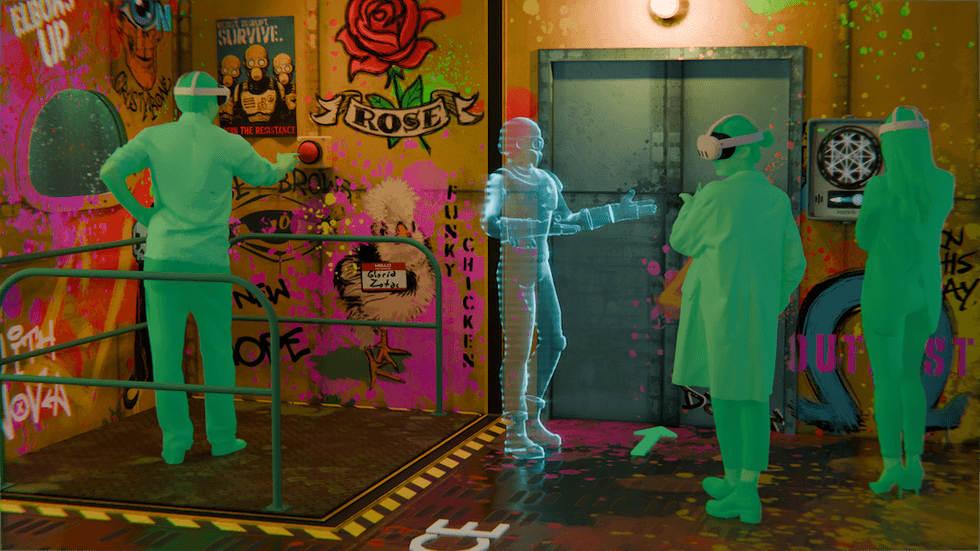
The new immersive format from Hololabs Studio uses Pico's latest headset
Image courtesy of Hololabs Studio
"The newest VR headsets featuring full colour passthrough video of the real world, aka mixed reality, are enabling an entirely new class of experiences. The blending of the real and virtual really fools the mind into thinking it's all real," says Cooney.
"Because you can see the other people you're in the experience with, these experiences are inherently more social. It also eliminates any potential motion sickness, which in a high volume environment is critical."
The new class of standalone headsets provides this ultra-high-resolution pass-through camera, coupled with massive on-board processing power that eliminates the need for streaming or tethers.
“All the processing is happening on the device rather than being streamed. That allows the guests to be able to have that free-roaming experience" says Gaylor.
This on-board processing is important to the format's operation, allowing guests to move freely without a tethered system.
Rendering real-time environments directly on the headset can also reduce reliance on streamed content and minimise latency, an important consideration for VR comfort. For operators, the approach removes the need for backpack PCs and cable tethers, potentially simplifying the operational workflow.
"The market is growing such that these kinds of formats are becoming possible and profitable, and audiences are starting to respond, and say, 'Yes, these are attractions that we find exciting.’”
Designing for interaction
While technology provides the platform, the core focus is on the quality of the interaction itself. For the Hololabs Studio team, interactivity isn't about simple point-and-click or shooting mechanics; it is about giving guests genuine, cooperative agency that drives the narrative forward.
"Theme parks are mainly pre-rendered media; it's the same story every time," Wozniewski says. "There's an opportunity to make things much more interactive and give guests agency so that they can change the experience on the fly. That's what we're all about: how do you present a goal but offer different paths to achieving that?”
Achieving this level of interactivity within a high-throughput, timed environment is not straightforward. If a game is too complex, guests may get stuck, throwing off the schedule of the multi-room format. If it is too simple, it fails to engage.
"We had to make sure that we weren’t setting the bar too high for folks who were having that first VR experience," Gaylor says.
"So, we had to grapple with challenging research questions: how can we both make this engaging for experienced players while being accessible and not alienating for new players? It had to be intuitive in the way that you would work through the story.”
To bridge this gap, Hololabs Studio focuses on social cooperation.
"We wanted to make something where you and I both needed to interact together in a really intentional way to drive the story forward," Gaylor says.
"With Abyss: Vault, we adopted a central light mechanic. To proceed through the story, guests needed to combine their coloured lights in a specific way. You might have a blue one, I would have a red one, and together we would make a magenta sensor go off, or we would be able to attack an enemy that has a magenta sensor.
“Trying to design gameplay where collaboration is actually central to the experience is really important.”
Hololabs Studio also uses spatial and mechanical design to create a sense of scale within a constrained physical footprint.
"To have the guests move through a large space, designers have often created large spaces in the real world, within a warehouse or incredibly large square footage. We tried to take what we learned from compact spaces and show how you can make a guest feel like they are moving through a large virtual world through clever spatial design.
“For example, if a guest sends a moving platform to another player, and then that player gets on the moving platform, and then in the virtual environment controls that moving platform, they can traverse a very large space. A six-by-six metre environment can actually feel like 60 by 60 metres because they have moved quite a bit around the virtual environment.”
Interactive elements such as virtual zip lines, moving platforms and climbing ladders allow the virtual journey to extend beyond the physical dimensions of the room.
Taking the format to IAAPA Expo Europe
At IAAPA Expo Europe in London, Hololabs Studio is bringing a physical, functional “vertical slice” of the format to the show floor.
Visitors to the booth can step inside a physical set representing part of a submarine, put on a Pico headset and experience how physical controllers, surfaces and high-resolution digital pass-through work together.
The studio is presenting the format as a platform that can be adapted for different games, brands and intellectual properties. Alongside the physical demonstration, Hololabs Studio will showcase floor plans, layout designs and financial models for the format.
The layouts also incorporate operational flow, themed retail and food and beverage, reflecting Hololabs Studio's approach to secondary spend.
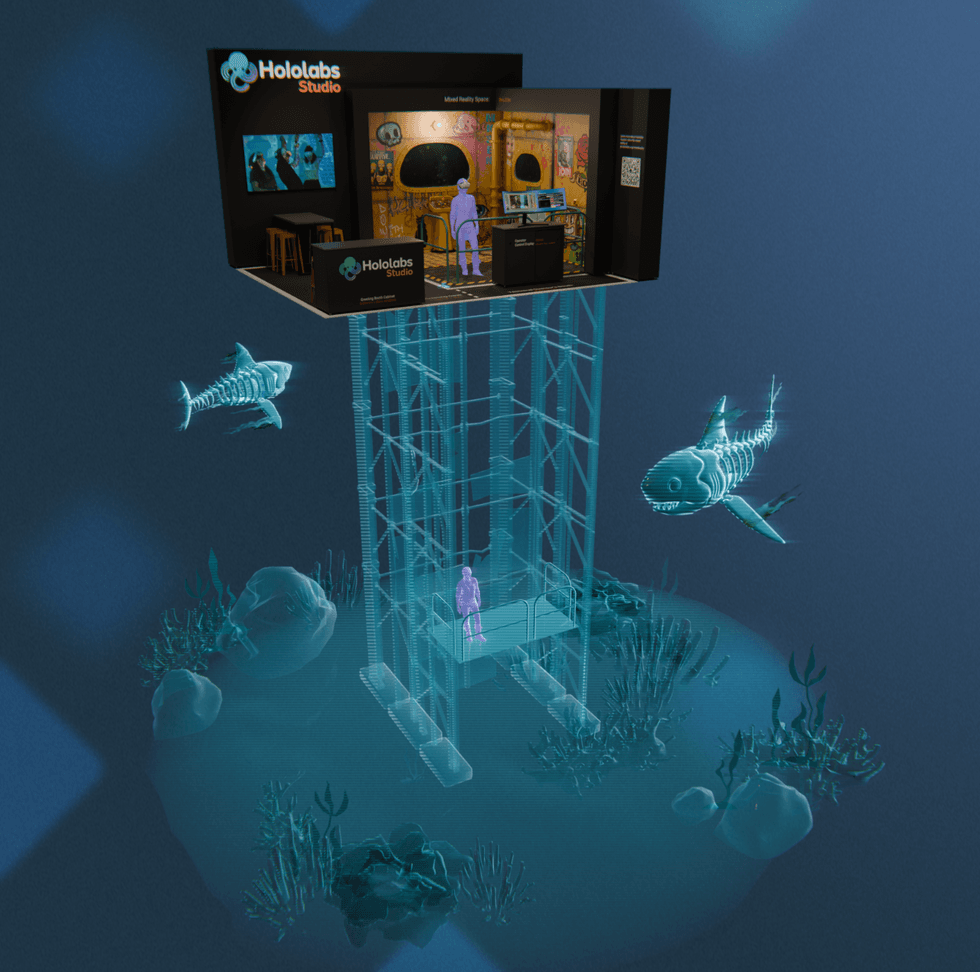
Visitors to IAAPA Expo Europe 2026 in London can discover a preview of the new format
Image courtesy of Hololabs Studio
The format's flexibility means it can be tailored to different brands, IPs, or local markets. While the IAAPA Expo demonstration features the studio’s own sci-fi Abyss IP, Hololabs Studio already has multiple alternative concepts in development.
"Ultimately, we want people to hire us to build such an attraction for them," Wozniewski says.
“In this space, there are opportunities for collaboration, partnerships, co-productions, co-development. We're interested in people coming to IAAPA who either have the venue or have the IP; one part of the puzzle that would make these things become a reality. We are the solution for the format, the technology, the design and the interactivity.”
The format brings together the systems integration of a major theme park attraction with the social interactivity of a real-time game engine, while reducing the physical footprint required to deliver both.
The IAAPA demonstration will show operators how the combination of physical sets, mixed reality, and free-roam VR can create a scalable, commercially focused location-based entertainment format.
Meet the Hololabs Studio team at IAAPA Expo Europe at booth #N4515. The trade show floor is open from 22 to 24 September at the ExCeL London. Meetings can be booked in advance here.