
Losonnante, a company transforming the way visitors connect with sound in public and cultural spaces, has shared how its immersive sound experiences harness bone conduction technology to enhance the visitor experience.
Osteophony, better known as bone conduction sound, is the transmission of sound through bones and other solid parts of the body, rather than through the air.
Losonnante’s technology is designed to optimise sound transmission through solid surfaces while minimising airborne sound.
With this, visitors' hands are transformed into headphones when they place their elbows on a sound-emitting surface. As they cover their ears, they are invited to listen intently in a deeply personal, immersive experience that surpasses traditional bone-conduction headphones.
Richer, impactful sound
Usually, when we hear a noise, it travels through the air into the ear canal, causing the eardrum to vibrate. These vibrations are transmitted to the ossicles, the tiny bones in the middle ear, and then on to the inner ear, where the vibrations are converted into nerve signals and sent to the brain.
In contrast, bone conduction audio transmits sound waves directly to the inner ear via the skull, bypassing the outer and middle ear.
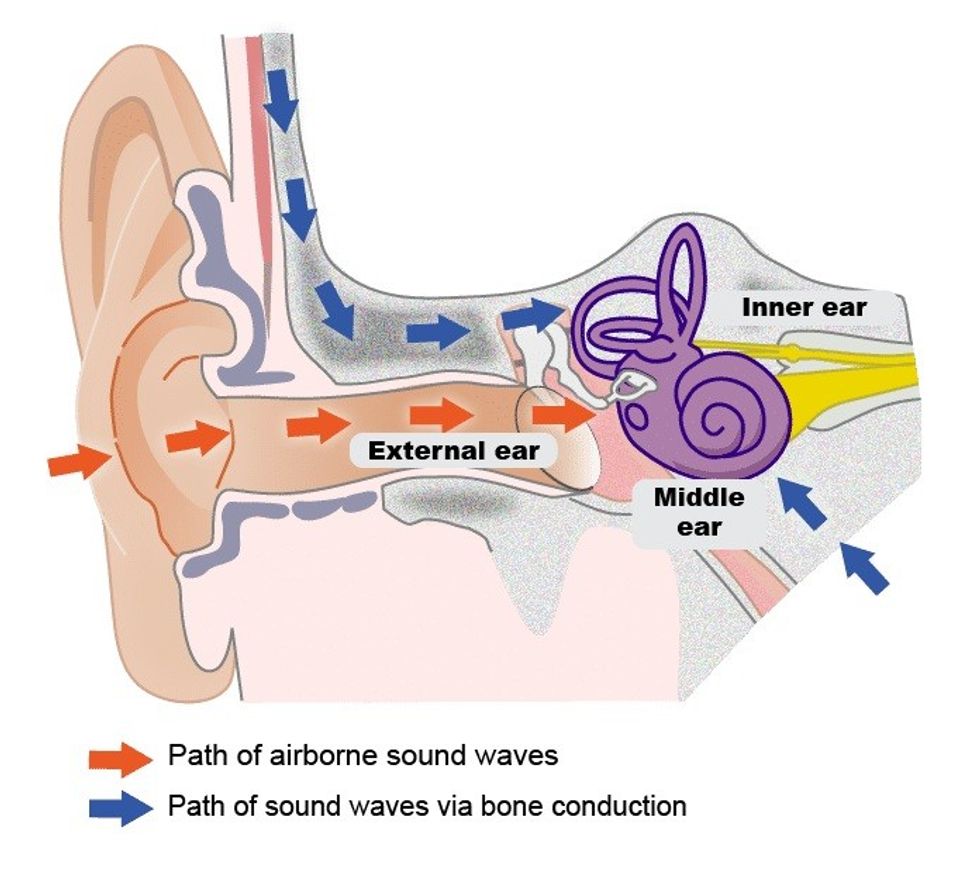
"When we speak, the sound of our voice reaches us in two ways: through the air, into our ears and through the bones in our jaw and skull, directly to the inner ear," says the company.
"What we hear is a blend of both. If you block your ears and speak, you’ll hear your voice purely through bone conduction. It sounds noticeably different, fuller and deeper than it does in a recording, because sound travels almost ten times faster through bone, and lower frequencies come through more strongly.
"This is why our recorded voice often sounds higher-pitched and unfamiliar, it’s missing the bone-conducted part we’re used to hearing."
Designed for visitor attractions
With recent innovations in sound filtering and signal processing, bone conduction has advanced significantly.
The benefits of the technology now include:
- Enhanced learning. Studies suggest that we learn more quickly when information is transmitted using bone conduction learning techniques.
- Exceptional clarity. Clear audio, even in noisy environments.
- Full immersion when users cover their ears. Alternatively, users can leave their ears uncovered to stay aware of their surroundings.
- Prolonged listening. Bone conduction removes strain on the eardrums.
- Space and depth. A richer, more immersive sound experience is created by delivering slightly different sounds to each ear.
- Underwater use. Bone conduction does not rely on air to carry sound, broadening its potential applications.
Harnessing these advancements, Losonnante’s accessible audio technology has been created specifically for museums, heritage sites, and immersive sound installations.
See also: How emerging tech is enhancing the museum experience

While many devices let users hear ambient sound, this technology blocks it entirely by prompting users to cover their ears. This fosters a more immersive experience, ensuring nothing from the outside is heard, maintaining privacy and respecting others. It also allows each person to explore the space at their own speed.
As a result, Losonnante is an ideal option for museum audio terminals, cultural institutions, and designers aiming for an innovative, immersive sound experience to enhance visitors' experience.