Do you remember the last time you felt paralyzing fear while visiting a theme park? You may have been a child at the time, or it could have been just last week on a trip out with family or friends.
Everyone has that one ride that they swear they’ll never ride again, or sometimes it’s a ride that they’ve been too afraid to ride for years and still haven’t been able to work up the bravery to give it a try.
The funny thing is that this particular fear-inducing ride is likely very different for everyone.
If you rode it when you were younger, the experience likely was something that left a profound and unpleasant memory, something that left you with a dark pit in your stomach and a feeling of dread.
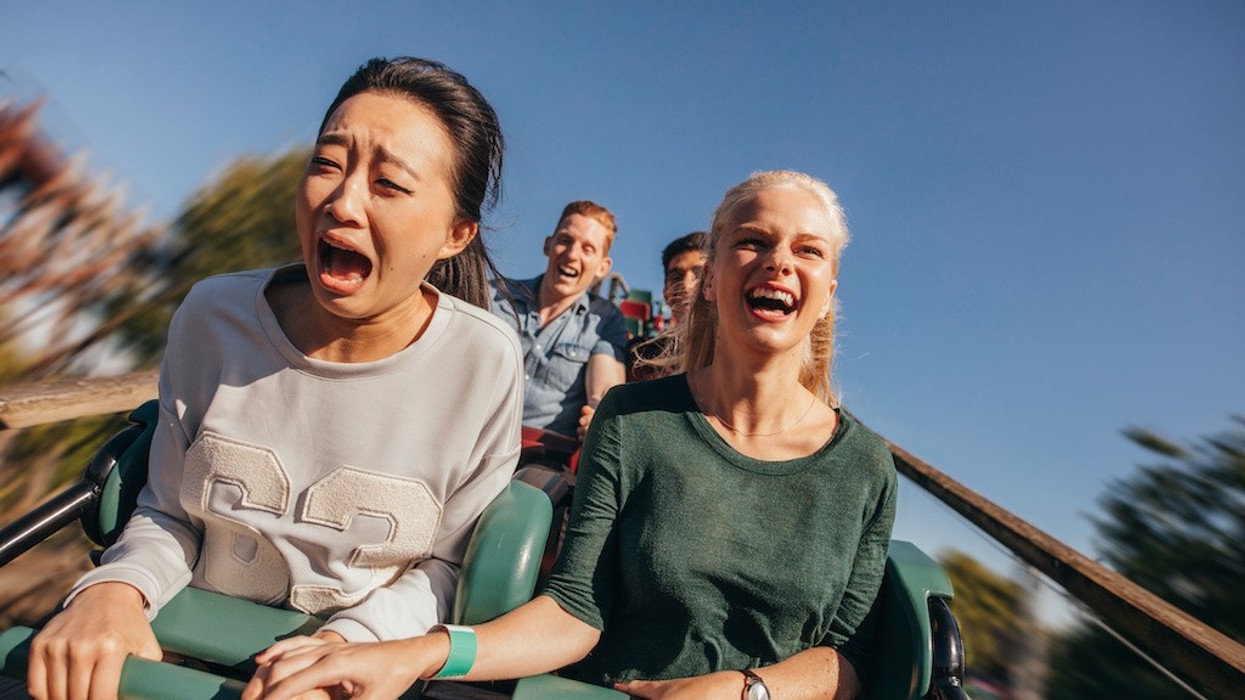
Perhaps it was something that left you dizzy or feeling unsteady, with your legs shaking uncontrollably as you departed the station. Perhaps it was just a bit too much spinning or looping, making you feel like you were about to lose your lunch.
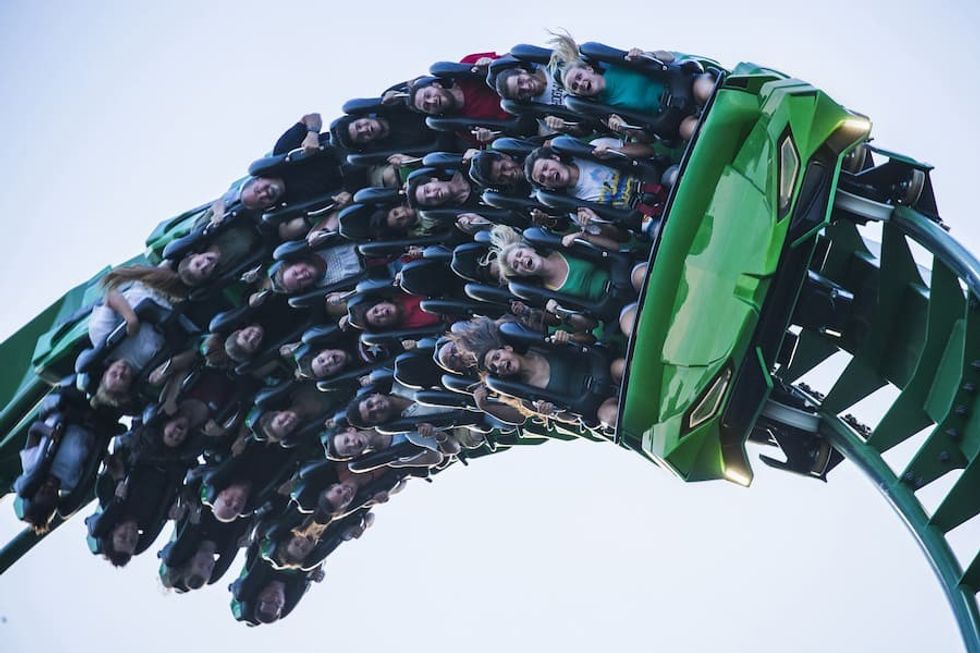 The Incredible Hulk Coaster, Universal Orlando
For other attractions that you’ve yet to experience, it really can come down to a general fear of the unknown, perhaps mixed with some other unpleasant memories or experiences elsewhere.
Dark rides are a great example: for some, a slow-moving experience through the dark, past unknown terrors can provoke a stronger fear response than the high-speed launching roller coaster next door.
Fear comes in all different forms, and when it comes to theme park rides, it ultimately depends on how each rider feels just thinking about an attraction.
Statistics play no real part in this either, other than perhaps as a way to psychologically plus the experience in the mind of the rider beforehand. It isn’t unusual for a rider to have successfully ridden other attractions that could be faster, taller or more extreme, while still being a bit fearful of that one special one that haunts their memories.
So what exactly makes a ride scary to one person and not to another?
What makes a ride scary?
The real answer lies at a sort of floating intersection point among several concepts in your mind. This is where the concepts of psychology, advanced perception, anticipation, sensory manipulation, and, when you really get down to it, storytelling, all play a role in the experience.
At the heart of it all, theme park designers are not just building crazy machines. They are often attempting to design fear itself.
Keep in mind one thing, however: just because something looks scary doesn’t mean it will be. At the end of the day, the goal is to provide safe thrills. To ensure that no matter how tall, how fast, or how scary an attraction really is, guests know that no one is really ever in danger.
Fear is all in your mind!
This is exactly how your brain works. The sensation of fear arises as a purely psychological reaction at first, long before any true threat of physical danger. The human brain does not need “real danger” to produce the sensation of fear; it only needs the perception of potential danger.
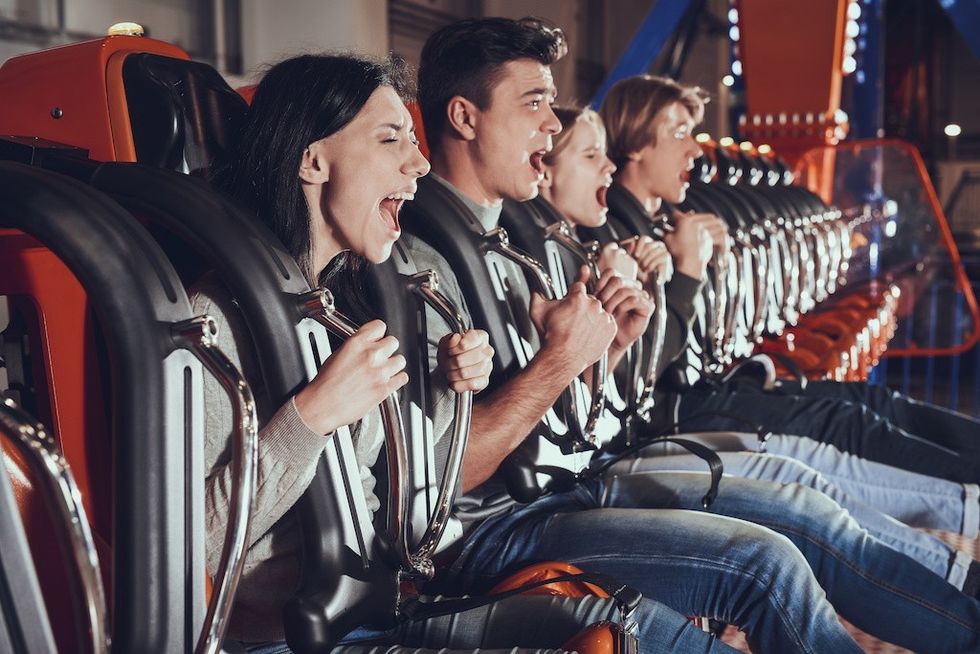
At its core, fear is a survival response. Your brain is constantly scanning for threats, assessing risk, and deciding whether you’re safe. Thrill rides exploit this system—but they do it in controlled, intentional ways.
This is why a well-designed thrill ride can be perfectly safe, and yet still feel utterly terrifying. The rational side of your brain will understand that you have been secured in by a restraint system designed by engineers to feature double or even triple redundant systems.
However, that little dark section of your brain that is always scanning for danger will respond with intense “danger” impulses far more quickly than the rational logic side of the brain can keep up with.
As such, the most frightening rides are usually the ones that keep your emotional brain in control longer than your rational one.
From a psychological point of view, good attraction designers know that the best place to start creating these uncomfortable sensations that lead to unease and eventually fear is long before the ride even begins… in the queue.
A masterclass in designing fear
The designers of the first Twilight Zone: Tower of Terror at Walt Disney World could probably host a master class in designing fear, as everything about the attraction just screams at you to stay far away from it.
The building's design, as seen from afar, clearly shows signs of severe damage from where lightning struck. You can see where the structure had been scorched and blackened by the lightning, and where portions of the building’s front have been vaporized, exposing rooms and doorways to the interior.
The garden queue looks semi-peaceful on the surface, despite passing through an open steel gate that still bears a large “KEEP OUT!” sign. But the greenery along the garden path towards the Hollywood Tower Hotel is slightly overgrown, and the fountains along the way are cracked and completely drained.
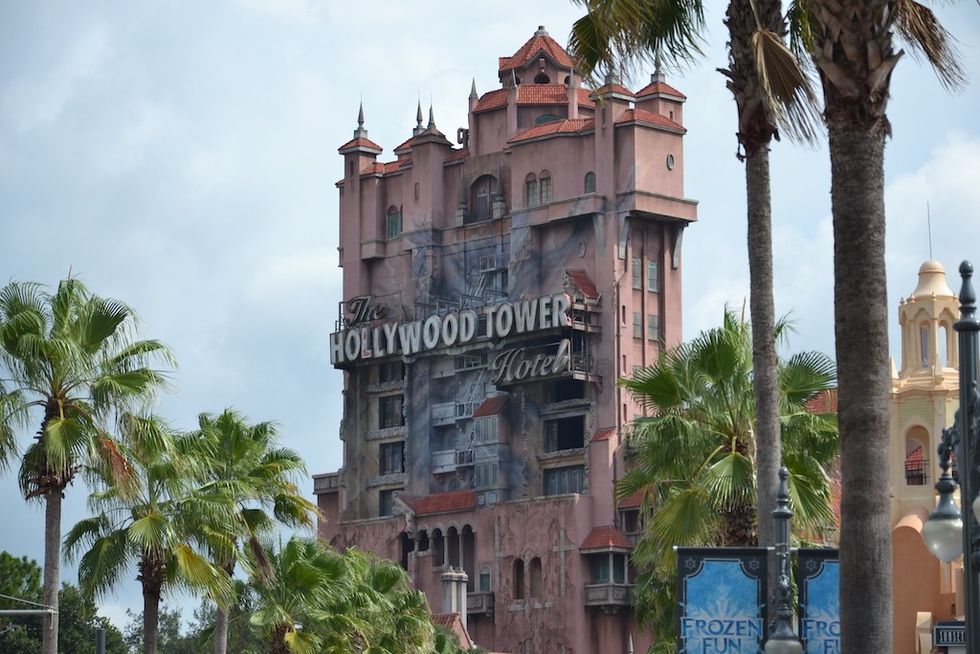 Twilight Zone: Tower of Terror Image credit Simon de Bruijn
Occasionally, there are screams and strange sounds heard from far above, as riders on the attraction are briefly hauled to the very top of the tower, where the doors open to the outside world and pause to let that terror set in before plunging them into the void.
You can’t really see what is happening from down below while in the queue, but you can hear the screams and noises that sound like breaking cables and the warping of reality before those screams are suddenly silenced forever by the closing of the elevator shaft doors.
All the while, the haunting music is piped through the garden queue, quiet at first, but it gets louder the closer you get to the hotel lobby entrance.
The lobby is a place where you could probably spend an hour exploring if they let you, appearing to be a scene trapped in time from the moment of the incident, a treasure trove of antiquities and artifacts, covered in cobwebs as far as the eye can see.
Yet the designers don’t let you linger here for too long… they don’t want you to get too comfortable, so it’s off into the library-themed pre-show room where you encounter a disturbing bellhop character.
Building suspense
Here you are introduced to the true story of what happened on a night so long ago, when lightning struck the tower and forever changed the fate of several guests who just happened to be in the elevator at the time, who vanished and were never seen again.
Lightning and thunder effects vividly recreate the incident right before your eyes, as a bookshelf slides aside to reveal a hidden door into a dark maintenance corridor through the hotel’s crypt-like boiler room, leading towards a special maintenance lift operated by another eerie bellhop.
Crackling wires and the hum of a struggling electric system fill the air as the doors to your elevator open, waiting to take you on your own special trip into The Twilight Zone.
Everything about this experience is set to keep you moving further and deeper into the heart of the darkness at the center of the attraction, to create a sense of fear and dread about what is to become of you, long before you have even been strapped into your seat.
Of course, at that point, you are in for a whole new set of experiences as your elevator slowly moves up, pauses at an empty floor to let the creepy atmosphere sink in, then continues up… and out… into The Twilight Zone itself.
Like any great ride, the experience itself is paced to tell the story. Starting off slow, along with paused moments of complete stillness to create that feeling of anticipation… a little bit of fear of the unknown.
Even unthemed roller coasters can use this to heighten the thrills. A little bit of an extra-long pause before an insane launch, or the holding breaks that grab the train teetering on the edge of a beyond-vertical plunge on a dive coaster.
Anticipation is one of the most powerful tools available to attraction designers. When your brain knows something intense is coming, but doesn’t know exactly when or how, it fills the gap with thoughts from your imagination. And quite often, your imagination is worse than reality.
The more time your brain has to anticipate, the more fear it can generate.
Scared of heights?
If the fear involves falling, then things get even more amplified. Humans are hardwired to fear falling. It’s one of the most primal fears that we have, as your basic survival instincts tell you to avoid it at all costs.
So, the perception of height remains one of the most effective fear triggers in theme parks. Standing at the top of a tall structure activates the same instinctive response, whether you’re on a cliff or a coaster.
However, height alone isn’t enough, as just how exposed you are to falling is just as important. Are your feet dangling? Are you in a seat with open, exposed sides? Are you enclosed in any kind of structure, or do you feel completely exposed and vulnerable?
At that moment, you really feel the dread about what is coming and know that there is nothing you can do to stop it.
I have a confession to make. I love roller coasters and thrill rides. I love the speed, I love the G-forces and other sensations, but the thought of falling scares the hell out of me.
I’m not afraid of heights by any means… tall stadiums, observation towers, even a walk across a catwalk high in the air doesn’t bother me at all. Unless I don't feel secure! Put me 12 inches up on a wobbly foot ladder with nothing to grab onto to change a lightbulb, and I may start begging to get down.
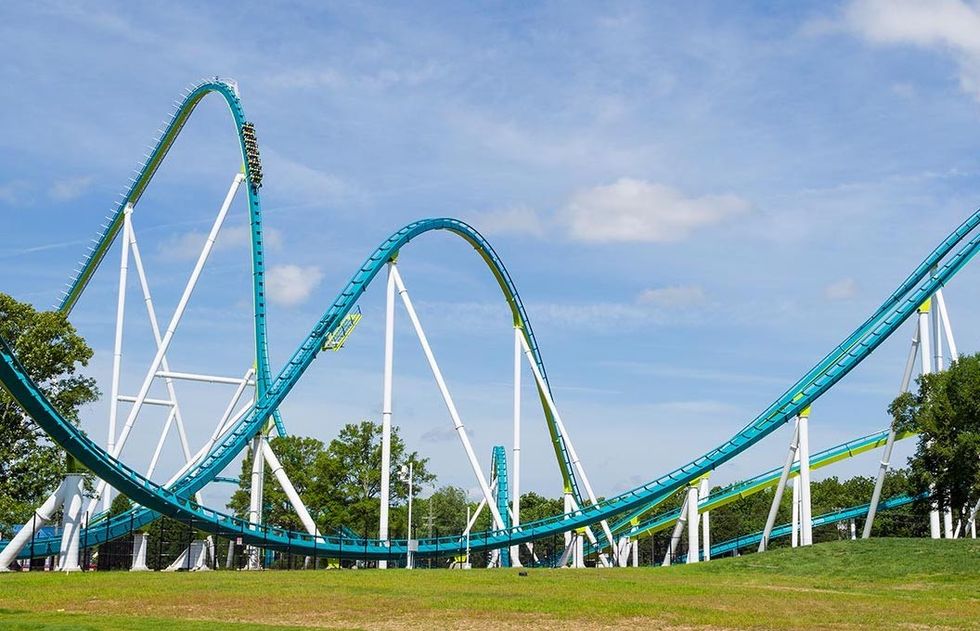 Fury 325 at Carowinds
I love taking rides on big coasters like Fury 325 at Carowinds or Pantherian (formerly Intimidator 305) at Kings Dominion, but on the way up the lift hill, I’ll start to freak out. We’re so high, I don’t even want to look sideways or down towards the ground… the fear is very real at that point.
Even if I’m putting on a brave face, I’ll be grabbing on to whatever handles I can find with a death-grip that tightens the higher we go. Until we peak… then something changes, as if a switch has been flipped.
Just as I hit the top of the lift and start that roll forward and down, my hands explode out and go up in the air, and I just enjoy the thrill of the fall down that first drop and through the rest of the ride. You see, it isn’t the fall itself that is scary. It’s all the long moments that lead up to it.
Give in to the joy
I had a conversation with the late Stan Checketts (founder of S&S) about this very concept once. Stan said he liked to try to design his ride vehicles without handles for riders to grab.
From a design point of view, he knew the riders were safely held in place by the restraint system itself, but the lack of any clear “grab bar” for them to grip created a great bit of mental unease about the entire experience.
Take a look at the Space Shot tower, the first attraction that really put S&S on the global thrill ride map, and you’ll see that those over-the-shoulder restraints are completely smooth and lack any place to grab onto while you call for your mommy to come save you.
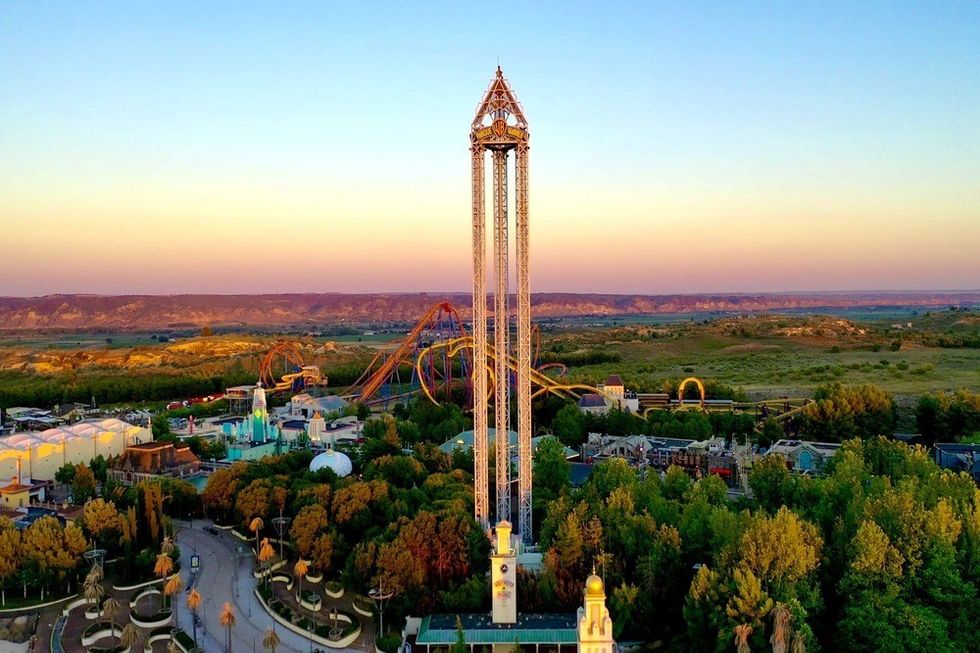 The Revenge of the Enigma drop tower at Parque Warner Madrid by S&S
Your arms are exposed, your legs dangling below you; there is no place for you to get a grip or try to brace yourself for the insane movements up and down the tower that you are about to experience.
The DNA of this design philosophy carried through to the restraints used on most of the S&S attractions that followed: the Turbo Drop, Sky Swatter, Screamin’ Squirrel, Sky Sling, and even some of the popular Screamin’ Swings.
Stan wanted the riders of his creations not only to be uneasy because there was no place to grab, but also to eventually give in to the joy of the ride and put their hands up, feeling like they were flying through the sky.
There is something to be said about the power of transitioning from being utterly terrified to feeling the pure bliss of the thrilling moment, suddenly without fear.
You might even say that at that moment you feel like a hero.
In the process of conquering your fear, you have become something much more, done something you did not think possible. You truly feel like you have evolved, and upon observing the landscape, you are ready to pick out the next thrill ride to conquer.