At Alif – The Mobility Pavilion, created for Expo 2020 Dubai, Wētā Workshop depicted the adventures of the Giants of Mobility, Al-Bakri, Ibn Battuta, and Ibn Majid, using intricately detailed settings and realistic sculptures.
Told from the perspective of a young Bedouin girl and explorer Al Kindi, the narrative guides visitors from the ancient Silk Road to the edges of space.
The company’s integrated creative and fabrication teams merged cinematic storytelling with advanced manufacturing to deliver the project at the highest standards, on schedule, and to inspire millions both during Expo 2020 and beyond at Expo City Dubai.
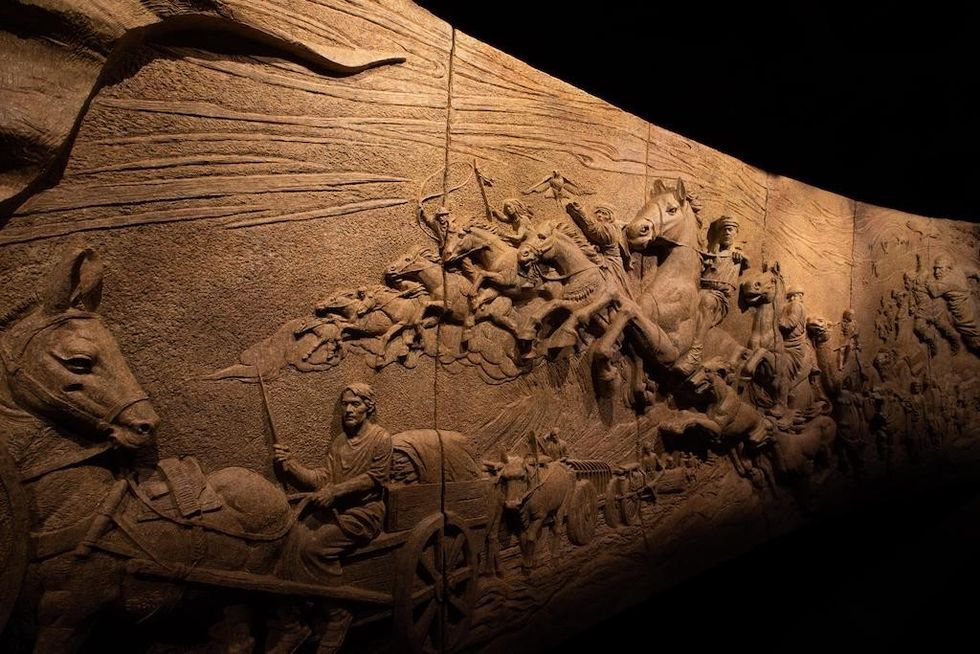
It created 11 large-scale exhibition zones for the pavilion, including a sculpted wall relief over 52 metres long, large-scale, hyper-detailed “bigature” figures, and a vertical sculpture with over 1,000 individually crafted butterflies.
To learn more, blooloop speaks to creative producer Jason Aldous, head of creative leadership Rik Athorne, and senior creative director Andrew Thomas.
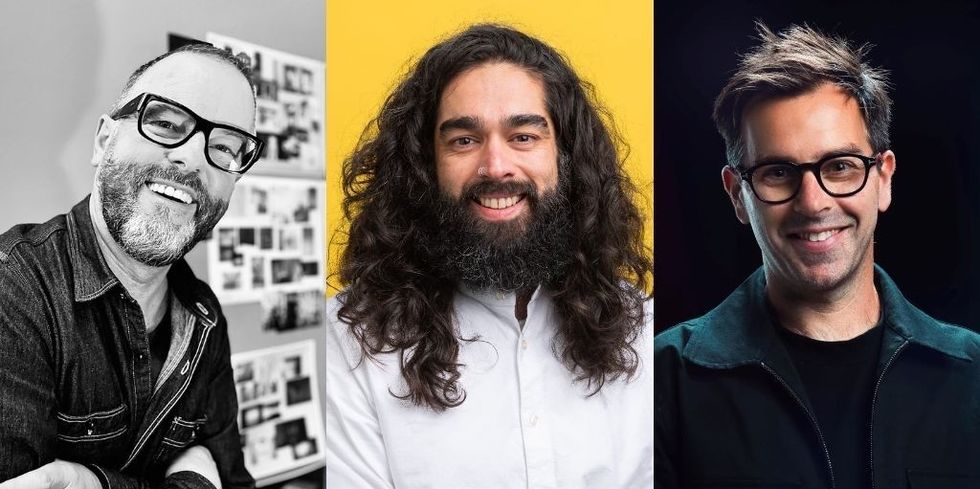 Andrew Thomas, Jason Aldous and Rik Athorne
Together, they examine how this project showcases Wētā Workshop’s expertise in cultural storytelling, its focus on creating emotional bonds, and its ability to provide seamless concept, design, and manufacturing under one roof.
A journey from the Silk Road to space
Alif – The Mobility Pavilion narrates an expansive story from the Silk Road to the far reaches of space. For Wētā Workshop, one of the first challenges was integrating such a broad historical and futuristic narrative into one cohesive visitor journey.
“Here at Wētā Workshop, we love finding the intimate within the epic, whether that’s working across film, TV, game development, immersive experiences or world expos,” says Athorne.
The studio is best known for its work in the film industry, particularly on fantasy or sci-fi films, such as The Lord of the Rings and Avatar, as well as many other much-loved productions. “When we started working within the immersive experiences space, we wanted to bring our learnings from working in film and layer that into our immersive experience design work.
“So, when starting on the Alif Mobility Pavilion, we aspired to bring a 'cinematic' design approach to the ideation and creative development work for the experience.”
Just like in a great movie, the team wanted the audience to meet incredible characters (on a large scale) and experience amazing locations within a sweeping narrative told across three acts.
“This included a musical score which links and evokes the desired emotion within the story we wanted to tell.”
Aldous adds that they kept themselves open to a non-chronological narrative:
“Charting a singular discovery through its journey is often, but not always, a straightforward activity. However, we were taking a global view of mobility, spanning different time periods - the past, present, and future.
“We took opportunities, such as bringing together Al-Bakri, Ibn Battuta, and Ibn Majid, who were centuries apart, and placed them at the same table, which is tied altogether through a strong thematic thread.”
The three Giants of Mobility
Wētā Workshop focused on Al-Bakri, Ibn Battuta and Ibn Majid as prominent figures in Dubai’s mobility history.
“While what we landed on was not a specific historical scene, presenting these three characters within the same space helped to convey a more holistic depiction of mobility,” says Aldous.
“Al-Bakri, though he never left Andalusia, travelled through the knowledge he shared. Ibn Battuta travelled far over land, and Ibn Majid was a famed seafarer known to share his mobility with others.”

The endless detail of the bas-relief also exemplified this, as inventions often occurred at multiple times and in various locations.
“We didn't want to acknowledge these stories as particularly singular. These stories have been positioned to intrigue and inspire, beyond a simple retelling or recollection.
“These principles were applied throughout the entire experience.”
Wētā Workshop and cultural authenticity
It was important that the famous ‘giants of mobility’ were represented with both respect and creative flair. For the team, cultural authenticity came from taking the time to get to know the United Arab Emirates (UAE), its people, and its culture, explains Athorne:
“Having the opportunity to creatively collaborate with the Expo leadership team and all the project partners, we had the privilege of spending time there and getting to immerse ourselves in UAE culture, the cities, the food, the desert, the people, nature, art, and history.
“This was the first time we as a company had ever worked in the UAE, and early on, we observed how there was a bold but humble worldview in this region.
“One of our expo colleagues shared what it was like to grow up in this part of the world, being part of Bedouin culture and seeing the bold visions of incredible cities and infrastructure rising from the desert.”
This approach to building and creating was hugely inspiring for the team, he adds. “It gave us the motivation, desire and inspiration to create a worthy and meaningful experience that celebrates many of the values we saw firsthand in this part of the world.”
They also collaborated closely with the Expo 2020 Dubai team and their subject-matter experts, including Dr Hayat Shamsuddin, senior vice president of Expo 2020 Dubai Arts and Culture, and the Barker Langham Museum Consultancy.
This assisted in guiding the stories relevant to the region and visitors, as well as exploring the extensive details they could draw upon.
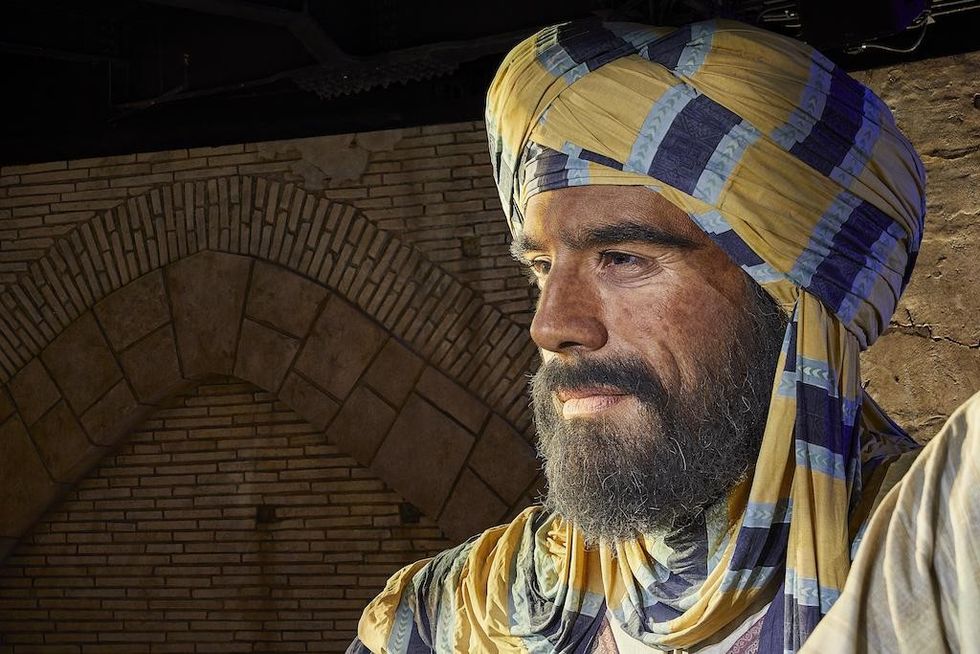
“For a figure such as Ibn Battuta, no imagery from that time exists, so we had to invent a likeness, research what he would have worn, and re-imagine a specific moment based on what was known and recorded about his journeys,” says Aldous.
“The usage of certain textiles and dyes, the trade routes through the region, and traditional garment history all helped us to inform the character design to make these figures plausible, rich, detailed, and engaging.”
Offering a human lens through which to explore the topic
The Bedouin girl and Al Kindi offer a very human lens through which visitors experience the pavilion.
Discussing how these characters became so central to the emotional impact of the piece, Thomas notes that, working closely with the Expo teams, it became apparent that the story they wanted to tell about mobility was, in fact, a profoundly human one:
“It’s about people connecting with people. Connecting minds and enabling new mobility. The Pavilion presents a human story of progress, which is why the characters are such an important part of the experience.”
Al Kindi is the 2:4 human-scale scholar looking out from the House of Wisdom (Bayt al-Hikmah), a renowned centre of learning and scholarship during the Islamic Golden Age, playing a crucial role in the translation and preservation of knowledge.
Aldous says: “It was important for us to depict stories of mobility and the Expo themes of ‘Connecting minds, Creating the Future’. We needed to show local stories. Al Kindi was born in Kufa and had a huge influence in the field of mathematics, which led us to this imagined scene.”
The scene is a moment of contemplation, looking out at the stars.
“We can all relate to this dreaming, imagining a tangible connection to the stars. They are a form of mobility from a navigational aspect and represent the prospect of future space travel.
“You could say the stars become our destination.”
Daring to dream
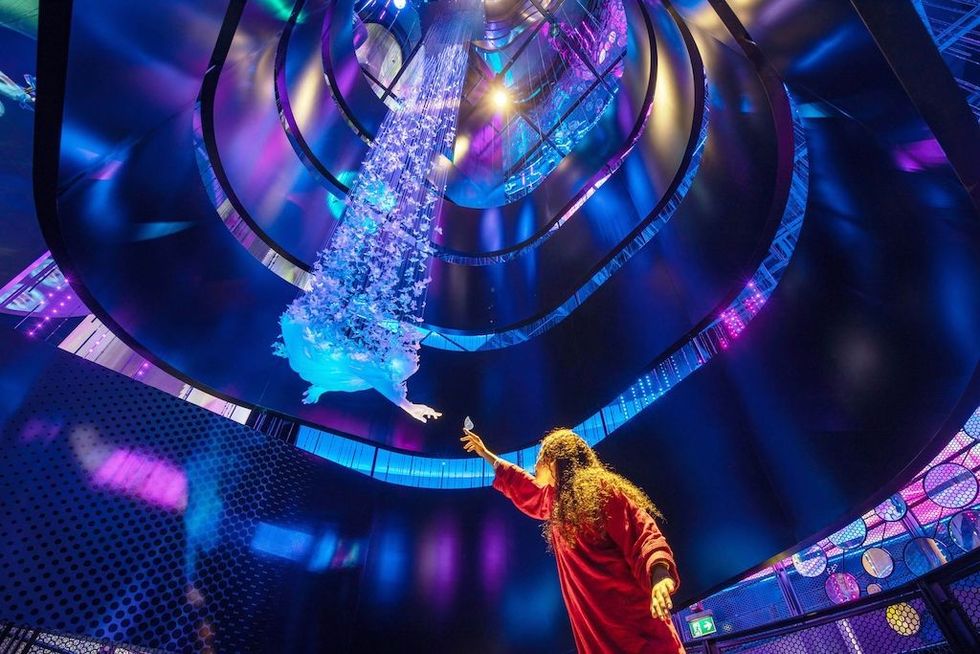
Meanwhile, the Bedouin girl, Shamsa, is the first person the visitors see as they enter the experience. The scene is set as a timeless desert, providing a calming and grounded moment for visitors entering from the bustle of Expo City.
“At the start, she’s in a very contemplative position and reaching for the stars underneath the butterfly sculpture. At the end, she’s depicted as reaching for and connecting with the future,” continuous Aldous.

She’s depicted at 1:1 human scale at both points, a hyperreal figure, a moment of grounded human connection. “We want visitors, especially young people, to feel like they can dare to dream and make that imagined future a reality. To do this, we created an intimate connection, a quiet moment which is easily relatable to visitors.”
Alif’s cinematic storytelling
Wētā Workshop drew on its expertise in cinematic storytelling to create an immersive and emotionally resonant pavilion.
“The breadth of cinematic techniques and blue-sky thinking is very familiar to us,” says Aldous. “We start with concept art and envision a scene or moment playing out.”
As the team moves beyond concept art, it employs the same techniques used in film production for special effects. “This includes sculpture, projection and audio as well as immersive technologies, all of which play a role in creating an engaging experience.”
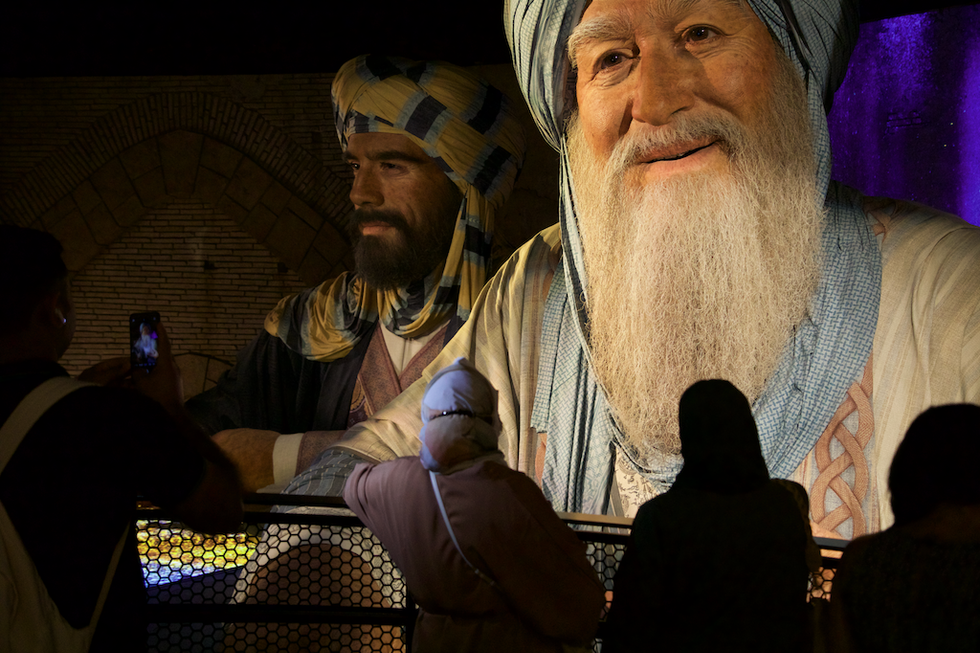
Depicting massive giants at an unreal scale is quite simply a show-stopping spectacle. “We achieve this through curating the story, the performance, or sculpture, theatrical techniques around it offer a level of depth to the viewer as they are drawn into the richer details, get inspired, and take away an emotional moment.”
However, he says, the immersive experience is a culmination of everything coming together. “When you build a truly immersive moment - the artwork or sculpture, together with the projection, sound and lighting – this means that the audience won't notice the techniques, they will simply experience it.”
Wētā Workshop rises to the challenge
From sculpted wall reliefs over 50 metres long to “bigature” figures and a thousand individually crafted butterflies, the scale and detail of Alif are remarkable and presented challenges that pushed the Wētā Workshop team.
“Dubai is accustomed to going big,” says Aldous. “We needed to go bigger than ever before, while still seeking to maintain the authenticity and emotional engagement needed in a story-driven visitor experience.
“We were fortunate to have the incredible building designed by Foster + Partners for Alif.
"It's a truly unique building form that offered numerous possibilities for how the visitor journey could utilise scale, journey, rhythm, and the push and pull of vast and intimate spaces to create a visitor experience that delivered incredible scale, depth of content, and impact.”

The bas-relief fitting into this building presented a unique challenge – one that the team enjoyed solving, adds Aldous:
“A traditional bas-relief may take place in singular panels, although they may wrap around rectangular forms at times, too. The journey through the Alif Mobility Pavilion required the bas-relief to follow the arc of the building exterior, as well as to descend to follow the ramp down to the level below.”
Additionally, the building form is also tapered. “It was a really long stretch of sculpture, along a very complex curve. Added to this is the fact that it is a bas-relief with a heightened level of depth, perspective, and illusion.
“We needed to run a lot of digital and physical processes to have the relief installed as a continuous sculpture.”
An integrated approach
One of Wētā Workshop’s strengths is delivering concept, design, and manufacture under one roof. This was a significant advantage on a project of this complexity, says Aldous.
“Almost every project we work on benefits from our comprehensive range of disciplines and expertise. Being able to propose ambitious ideas and have the knowledge and R&D to support them helps us push the bounds of creativity with the assurance that we can deliver on what is conceptualised.
“This is also a two-way street where experience and new research in production and fabrication can also inform the realm of thinking for the blue-sky creative team.”

The multi-year project began in 2017 and navigated a pandemic before opening in 2021. When it came to keeping the creative vision consistent over such a long and unpredictable timeline, he says that working with Expo 2020 Dubai was an ideal situation:
“The client approached us with ambitious thinking and a clear vision. While we did have one of the most significant pavilions, Expo 2020 Dubai had the entire Expo. Their vision and leadership were crucial to the whole experience being completed, and we were thrilled to be able to play a role in this.”
In addition to collaborating with the Expo 2020 Dubai team, Wētā Workshop also worked closely with partners such as MET Studio and Magnopus.
“Collaboration is a huge part of Wētā Workshop's repertoire. With a background in film and TV, we've been fortunate enough to work with many of the world's most visionary directors.
“Through this process, an artistic intent can become a shared vision with all involved working to a common goal. In the realm of immersive experiences, collaborating with another studio is a great way to spark new ideas and explore different realms of creativity.”
The legacy of Alif – The Mobility Pavilion
The pavilion has become a permanent attraction at Expo City Dubai, meaning that the project had a lasting legacy.
“As with all projects we're involved in, we're focused on providing the highest quality result, while balancing budget and timeframe,” says Aldous.
“We understand that for the visitor, their time spent engaging with our experiences is very real, and not something to consider temporary or fleeting — we're creating memories that will last a lifetime.
“When it came to the lasting nature of the Alif Mobility Pavilion, this became a bonus, that visitors for years to come will be able to experience this space.”
Reflecting on the project, and if there is a particular detail, moment, or design element in the pavilion that he personally feels most proud of, Aldous says, with so many unique aspects of the Alif journey, it is hard to choose. However, he adds:
“Shamsa, the Bedouin girl, is one particular character for me. Seeing her in the contemplative moment when visitors arrive at the pavilion helps to establish the tone and brings people into the experience.
“Shamsa became a powerful symbol of looking to the future, and to new horizons. When Shamsa reappears at the end of the experience, a connection is made between the past and the future, inspiring viewers to set their sights on the next horizon.”
A space for reflection and inspiration
Expo 2020’s theme was “Connecting Minds, Creating the Future.” The vision is for Alif to continue inspiring visitors—not just in Dubai, but also as part of the broader conversation about mobility and human progress.
“We hope that when people attend, and continue to attend for years to come, it takes them out of their everyday world and transports them to another time and place,” says Aldous.

He describes it as a place to engage, think, and dream, providing visitors with space as they spend time on this journey, interacting with these characters and reflecting on the incredible achievements humans have made in the world of mobility.
“We wish to inspire visitors to set out to do incredible things too – things which seemed unachievable – and continue to build on what was started many years ago by these giants of mobility.”