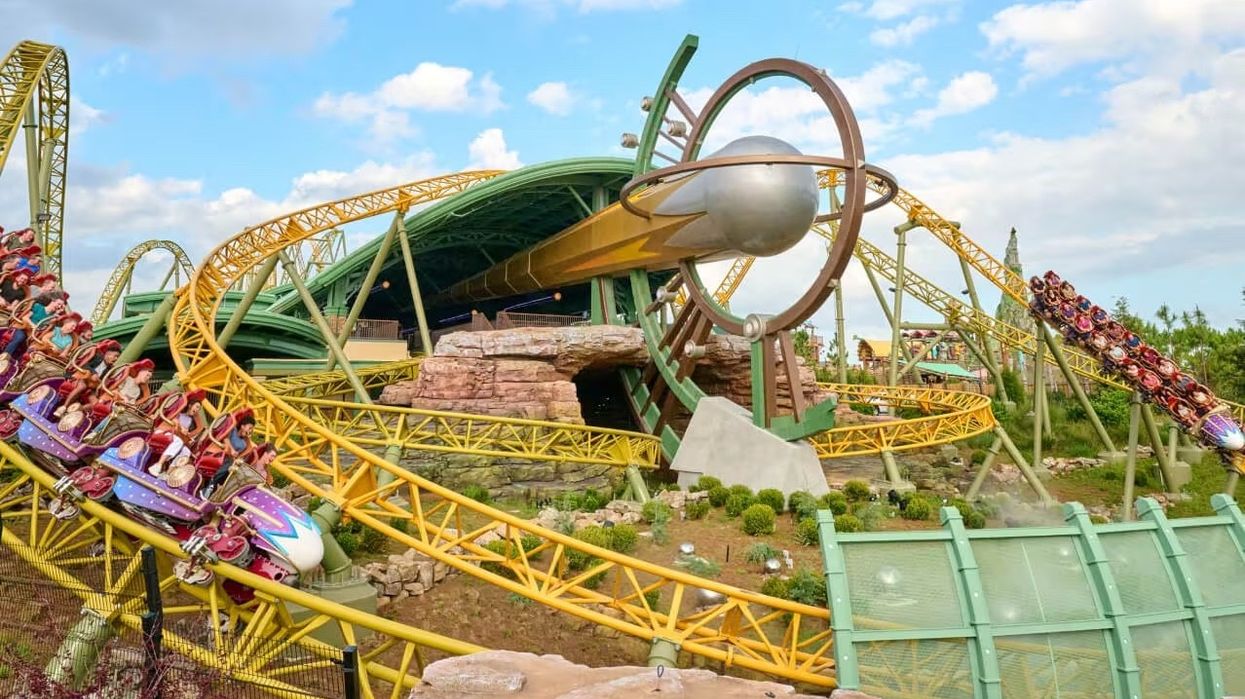

Universal’s Epic Universe is a stunning achievement, offering much to study and learn. On 2 March 2026, it will receive an unprecedented four separate Thea Awards.
Until now, no single attraction has won more than three Thea Awards in the same year. The previous record of three Thea Awards in one year was also set by Universal Studios, when it opened Diagon Alley.
After several visits to the new park, I’ve identified what I call the seven epic breakthroughs of Epic Universe. These are breaks from conventional wisdom in theme park planning, and they really work.
This doesn’t mean the old ways have stopped working, but it does show us some new and attractive options as we plan future parks and experiences for guests globally.
Epic breakthrough #1 - mastery of scale
The scale is spectacular, and yet it holds up at every level. And the detail is there, down to the smallest level. It holds up in master shot, medium shot, close-up, extreme close-up, and even touch! Few parks pass that test.
 Street view of Place Cacheé at Universal Epic Universe
For example, Place Cachée and The Ministry of Magic have been created in a scale that takes your breath away, and yet every detail is complete. This is more than a theatrical set. You feel like you are in the real place.
Epic breakthrough #2 - the individual lands are cul-de-sacs
In a traditional hub-and-spoke park layout, such as Disney uses for its castle-centered parks, each land connects with its neighbor so that you can walk directly from deep within Tomorrowland into the deep areas of Fantasyland without coming back out through the central plaza Hub.
Epic does not do this. Instead, you can only enter and exit each land through the portals, always returning to the central Celestial Park.
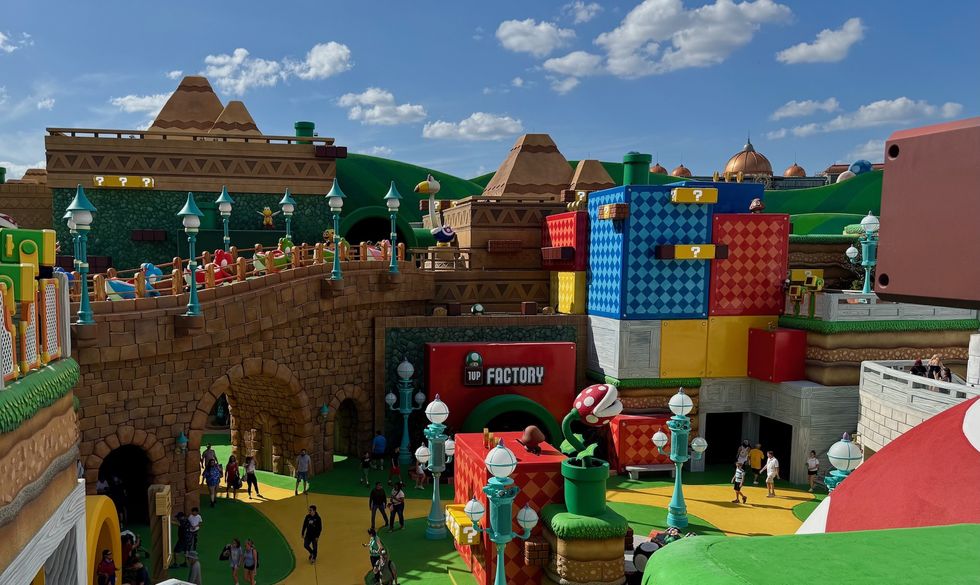 View from the top of Super Nintendo World, Universal Epic Universe
Thus, the full immersion effect is better because you can’t see into or out of the themed lands. You are fully in that story world or completely out. Celestial Park acts as a palate cleanser between immersive worlds.
Epic breakthrough #3 - the portals create sharp, abrupt transitions
This contrasts with the traditional, smooth, blended transitions used in Disney parks. (Designing Disney; Imagineering and the Art of the Show, John Hench, Page 79)
The sharp shock of transitioning from the neutral space of Celestial Park into one of the highly themed lands makes the full immersion theming of each land more vivid by maximizing the “plunge moment.”
It is during the initial plunge moment that any full immersion has its strongest emotional and sensory effect. The effect has been compared to diving into cold water.
The plunge moment is the strongest, after which the swimmer gradually becomes accustomed to the new environment (the cold water, the sensation of neutral buoyancy, etc.) By sharpening the plunge moment, the portals maximize the immersion, leaving a stronger memory of not just the plunge moment but the entire immersion.
For proof, stand just inside any of the lands, and eavesdrop on the guests as they emerge from the portal into the land. You will hear involuntary spontaneous exclamations, such as “Wow!” Yes, a literal “Wow!” All of us in this business always talk about creating “Wow moments.”
The portals at Epic Universe deliver on this elusive promise.
Epic breakthrough #4 - putting “park” back into theme park
That’s a clever phrase, but what does it mean?
Like a park, the themed lands have become attractions in themselves, filled with refreshing little discoveries everywhere. This changes how people enjoy their day.
Instead of a mad rush from one major attraction queue to the next, I observed guests slowing down and enjoying all the “unnecessary” details, as if they were on a stroll in a park.
No area exemplifies this more than the Isle of Berk, based on How to Train Your Dragon. The land itself is an attraction.
A repeat visitor can always find new discoveries, whether it is the Baby Night Lights, Snow Wraith (the Ice Dragon), or Grump the dragon, who is snoozing and snoring by Gobber’s forge and who, every once in a while, has to wake up and breathe fire to rekindle the forge.
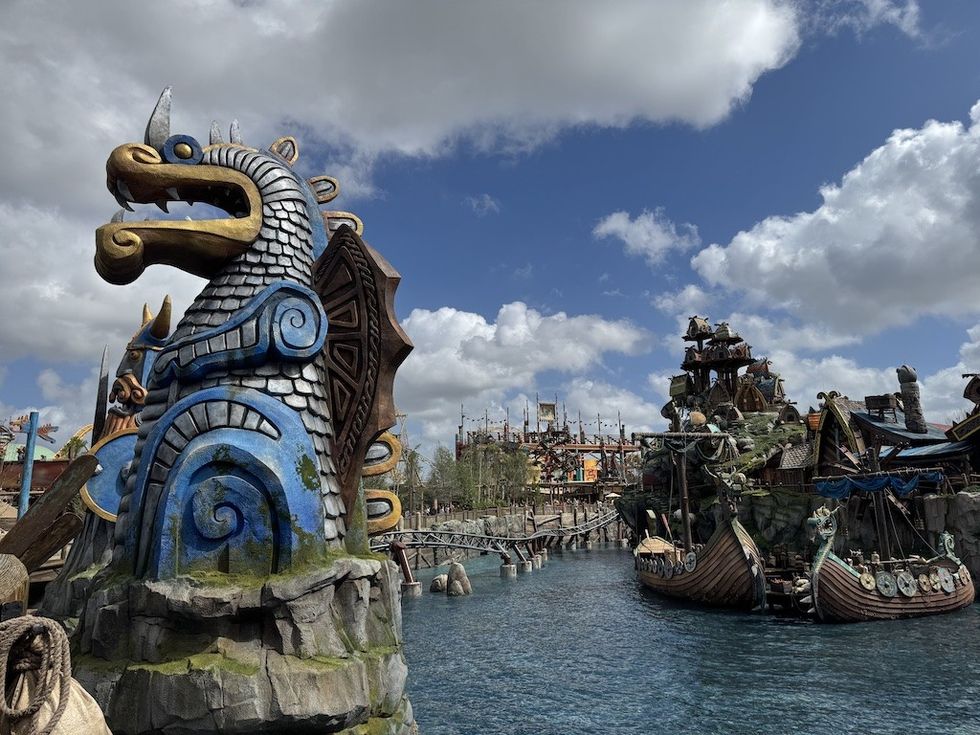 Isle of Berk at Universal Epic Universe
There is original dragon carving art everywhere, from tapestries to benches and even table legs.
Adding those details is hard. Disney legend Marty Sklar, Walt Disney Imagineering, once lamented that it was very hard to justify doing little things, like the Wishing Well or Snow White's Grotto. And yet, little things were so important to a guest’s enjoyment of a theme park. But only the big rides could prove their business case.
As a result, theme park operators tended to invest only in big things that generate both increased demand and increased capacity. Pleasant little discoveries generate no measurable capacity or demand, and so they generate no business case.
Epic is filled with delightful, unnecessary excellence. The following is a bit obscure, but it really proves the point: At a recent private event at the Isle of Berk, I was struck by the unnecessary excellence of a humble portable catering table used to serve food during events.
Below the table top, you would normally expect the usual aluminum chassis and wheels, hidden by generic black table skirting. Instead, it was held up by elaborately carved dragon art and was further graced with props. This, for the undercarriage of a portable catering table!
Everywhere you look, unnecessary excellence. The guests may not specifically notice these touches, but they feel them. And they like it.
These details put the park back in theme park. They certainly do add carrying capacity, repeatability, stay-time, and ticket value to the park, which the guests can feel and appreciate, even if we don’t yet have the metrics to measure and justify it.

Epic's F&B offerings are similarly remarkable. Who can resist smiling when served Burning Blade Cheddar Bites in the Burning Blade Restaurant? (They look exactly like charcoal brickettes.) Or the Hunter’s Garlic Stake, a pretzel shaped like a dagger.
Fun. Excellent. And unnecessarily so.
Epic breakthrough #5 - a new partnership with value engineering
It has been said that “value engineering is a process too often performed in your absence, in which people who are not engineers remove all value from your project.”
One of the first things professionals notice about Epic is that it seems to have totally escaped the usual ravages of value engineering. How the hell did they do that? The caring details, usually the first targets of value engineering, have survived, and they are everywhere. This again puts the park back into theme park.
Epic breakthrough #6 - merging giant scale media with sets, props, and figures in motion
This is not really new, but a next step up in an area of technical leadership that Universal has been pioneering for some years. It began with The Amazing Adventures of Spider-Man, expanded with The Bourne Stuntacular, and has advanced even further in the Ministry of Magic.
 Outside Frankenstein Manor in Dark Universe, Universal Epic Universe
The innovative blending of technologies achieves new levels of illusion, combining a real feeling of vastness and frantic high-speed action with great story making
See also: Interactivity & entertainment at Universal Epic Universe
Epic breakthrough #7 - the cross-silo integration of retail, F&B, and show
This is also a further stretch of an envelope that is not new, just better. It is personally interesting to me because my first job in this industry was as a magician in the magic shop at Disneyland. There, I was both an entertainer and a shop clerk, a very unusual combination, then and now. I demonstrated the magic and then sold it.
Traditionally, a person employed by the Retail Department is trained to operate a cash register and instructed to serve shoppers as a retail clerk, but they are not also part of the Entertainment Department. Actors and retail clerks are different creatures, with very different personalities and wages.
The traditional metrics that define success and excellence in retail often have a low tolerance for non-retail activities, such as entertainment or anything not directly related to sales per square foot.
 Monster make-up experience at Epic Universe
The idea of using clerk time or floor or wall space in a store to display props and settings that are not for sale seems crazy to the old-school retailer. “Instead of this movie prop display, I could have a rack displaying over fifty T-shirts!”
But, like Ollivander’s Wand Shop, Cosme Acajor Baguettes Magique (the wand shop near Ministry of Magic) and even the more modest Toothless Treasures, and other Epic Universe shops, cross the traditional walls of authority between departments, fully integrating retail and show.
It violates the traditionally separate silos of authority and confuses old-school retail metrics like sales per square foot, yet it serves the guest.
Plus, the employees have more fun too. And when the employees are having fun, so are the guests.
And so are the Epic’s creators. It’s fun to stretch the possible by breaking the invisible rules, especially when the public responds so positively to the result. It makes you think, what other rules are out there, ready for the rest of us to stretch or break with some fresh thinking?
That may be the most important takeaway from Epic.