China’s cultural tourism sector is entering a new phase of outward-looking ambition.
This was the underlying message at the 2025 National Cultural Tourism Brand International Communication and Exchange Conference (2025全国文旅品牌国际传播交流大会), held in Beijing as part of this year’s Beijing International Brand Week.
Under the theme “Understanding China, Coexisting Civilisations,” the event gathered more than 200 representatives from tourism boards, cultural organisations, enterprises and media institutions to examine how China can refine its global storytelling and strengthen the international presence of its cultural tourism brands.
While official speeches emphasised familiar themes such as cultural confidence and the role of tourism in shaping national image, the deeper narrative running through the conference was the shift from exporting cultural symbols to building mutual cultural dialogue.
As Su E, deputy director of the China Foreign Languages Publishing Administration’s Cultural Communication Centre, explained, China’s international communication must move beyond one-directional output.

Instead, it should seek “value resonance,” use globally intelligible narratives and foster an ecosystem where government, industry and creative sectors collaborate.
A new strategic framework for China’s cultural communication
The keynote speeches collectively outlined a strategy that now dominates China’s cultural diplomacy:
- Anchoring communication in cultural depth rather than surface-level motifs.
- Elevating storytelling as the core technique of international communication.
- Strengthening recognisable brand identities so that China’s cultural tourism products stand out in a crowded global market.
- Leveraging national soft power and industrial capacity to support cultural brands abroad.
Former Xinhua News Agency VP Yan Wenbin argued that international communication requires two things above all: compelling storytelling and memorable brand recognition.
The latter is now being systematised in China through the creation of identifiable names, symbols and content ecosystems that can sustain long-term visibility overseas.
Another recurring point was China’s transition from “going out” to “integrating in.”
As summarised in the newly released 2025 China Cultural Tourism Brand International Communication Development Report, Chinese cultural tourism brands are moving from isolated outbound projects to more coordinated, ecosystem-based internationalisation.
This reflects a sector-wide transformation from expansion to efficiency, and from cultural export to cultural engagement.
Technology-led storytelling: new cases in the spotlight
The conference also announced the 2025 “Top 100 Cultural Tourism Brand Globalisation Cases” and the “25 New Emerging Cases”, showcasing how Chinese organisations are using digital tools, immersive media and IP-driven models to enter overseas markets.
Among the most notable examples was the Ne Zha 5DVR project developed by Shenzhen Yinglian Technology and Xinhua News Agency’s new media teams.
The attraction blends large-space VR, holographic effects and interactive narrative design. Visitors can engage directly with characters from the Ne Zha universe and even influence the storyline.
The project’s flexible deployment model - usable in banquet halls, theme parks and tourism destinations - has positioned it as a scalable solution for cultural IP going global.
Another case is the Palace Museum’s centennial commemorative stamp, issued by the UN Postal Administration in New York, which is the first UN special edition dedicated to a single museum.
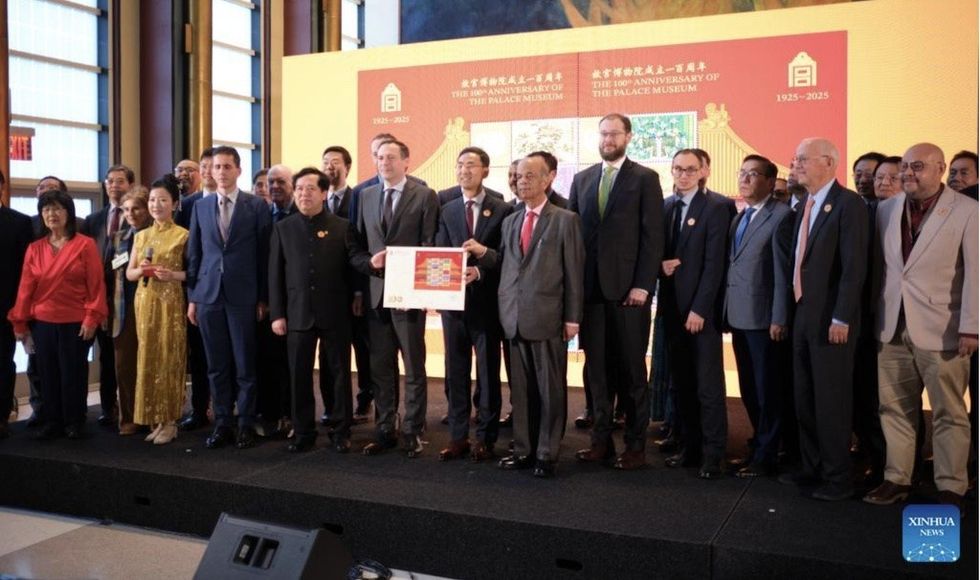 Guests display a commemorative UN stamp sheet marking the 100th anniversary of the Palace Museum at the UN headquarters in New York, May 2025 (Xinhua)
The accompanying Endless Vitality exhibition highlighted the museum’s initiatives in sustainability, accessibility and rural revitalisation, with UN officials participating in interactive activities.
Rethinking the global appeal of Chinese culture
This year’s conference made clear that China’s cultural tourism sector is experimenting actively at the intersection of digital media, branded IP, and immersive technologies.
The emerging strategy is not simply to project China outward, but to embed Chinese cultural narratives into global entertainment and visitor economies through formats that are adaptable, interactive and commercially viable.
As China continues refining its international communication framework, the next wave of cultural tourism brands is likely to be those capable of merging cultural depth, technological fluency and globally readable storytelling—an evolution already visible in the cases spotlighted at this year’s event.