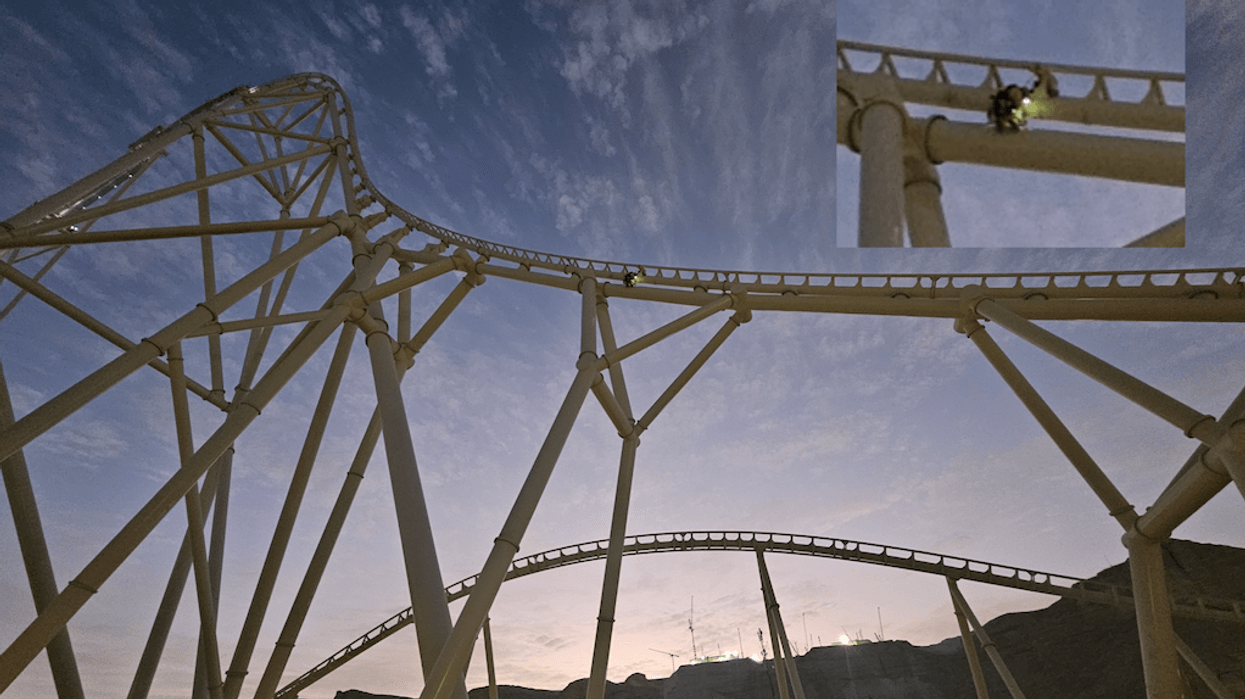

D-Tex Visual, a company focused on developing AI sensors for safety and maintenance in the theme park industry, has announced that installation of Bolt-iT on Falcons Flight at Six Flags Qiddiya City is underway, with the first phase now complete.
This is the initial product in a series of condition-based monitoring (CBM) detection solutions that utilise AI integrated into the sensor. Bolt-iT can be mounted to existing fixings, joints, and infrastructure without disassembly, maintaining the integrity of the original assembly.
Once installed, the technology detects nut or bolt rotation, bending, shear, stretching, changes in vibration levels, and the asset's triple-axis pitch and roll. 12 sensors at three locations are now in place, with a further 38 sensors to be deployed in the coming weeks, working around other activities at the park.
"Falcons Flight is a world's first coaster that presented unique challenges, particularly in monitoring and maintaining more than 4km of track across difficult terrain," says Francis De Ceulaer, vice president of maintenance at Six Flags Qiddiya City.
"The layout incorporates many hard-to-reach areas due to its record-breaking height and exit from the park to the cliff top. Add to this high-speed turns and daily temperature fluctuations, thermal expansion of the track was a real challenge we faced.
"We needed a method of continuously monitoring the track and the key fixings holding it together, but conventional products just didn't give us what we were looking for. The D-Tex Visual (DTV) Bolt-iT system is the perfect solution as it can be retrofitted without any cabling or interfering with the assemblies.
"We went through extensive functional testing with DTV, who created 1:1 scale replicas of the key areas we wanted to monitor, demonstrating the detection and notification of numerous anomalies long before they arrived on site at Six Flags Qiddiya City for the install.
"It has been a close collaboration, and the team at DTV has been very easy to work with. The sensors are now being installed at scheduled intervals along the track, and we look forward to our continued partnership."
Straightforward installation
The master and slave units, which receive data from the sensors, were first installed in the Six Flags offices and at the entrance, respectively, along with their roof-mounted antennas.
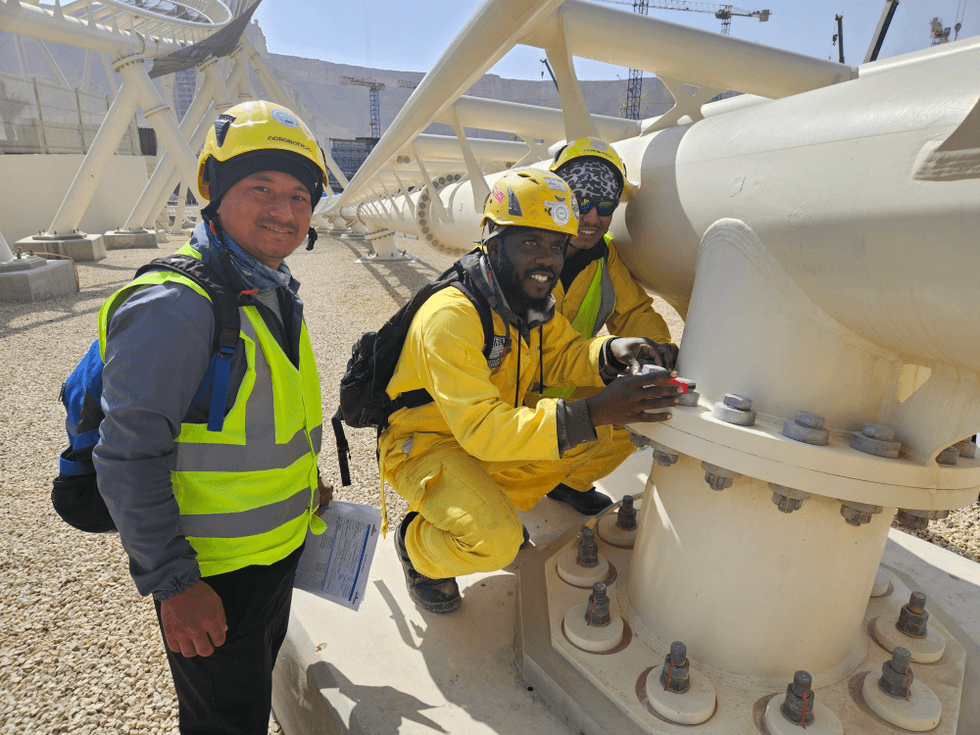
The next step was to train the rope access team on how to install the Bolt-iT sensors. This was done during the day before the park opened, on a low-level track flange for ease of access. The installation team was surprised by how simple it was to fit the sensors and was soon confident enough to proceed with the installation the following morning.
The installation was scheduled to begin between 2:30 and 3 am the following morning, after the park closed and the operations team granted access. Three sites were chosen for the initial session: one on a low-level tight turn and two on the ‘camel back’.
The sensors' straightforward, quick installation process enabled all three sites to be completed in a single six-hour early-morning shift. This timeframe included travelling between sites, climbing to the designated flanges, and completing all safety procedures.
Sensors are strategically placed around the track to provide continuous 24/7 monitoring in difficult-to-access areas and in sections with higher forces, such as turns.
Enhanced maintenance and safety
Six Flags Qiddiya City now utilises advanced ‘AI at the edge’ detection to enhance its maintenance and safety plans, adding a new data dimension beyond traditional inspections that has not been seen before in the industry.
In mechanical engineering, relying on just one vibration sensor can result in incomplete or misleading conclusions about an asset’s condition.
Accelerometer readings generally "fade" (decrease in amplitude) the further the sensor is placed from the source of vibration or impact. As energy travels through a structure, damping reduces vibration amplitude over distance, resulting in lower acceleration measurements at points farther from the source.
This can lead to failures being either misinterpreted or entirely overlooked.
This is why Bolt-iT employs multiple sensing technologies, which are processed and compared by the onboard AI. Thanks to this DTV-patented technology, the maintenance team can instantly see any changes to the structure and/or fixing positions.
Testing has demonstrated that it is possible to monitor 32 nuts and 32 bolts on a flange connection with just four sensors.
Demonstrating innovative tech
Lee Hollinshead, founder of D-Tex Visual, says:
"Working with Francis and the team at Six Flags Qiddiya City is a great experience. From the beginning, just by being given the chance to explain our technology, Six Flags now has the very best in detection technology watching over this amazing feat of coaster engineering.
"Likewise, D-Tex Visual have been given the platform to show some of what we can do. This has been instrumental in us now integrating our data with third parties and opening up major opportunities in other sectors such as mining and rail.
"I urge the industry not to instantly dismiss approaches from SMEs; you never know what you might uncover."
See also: D-Tex Visual presents new AI sensors for increased safety & efficiency