From 2 to 4 June, over 900 science engagement professionals convened in Gothenburg, Sweden, for the Ecsite Conference 2026, the annual meeting of the European network of science centres and museums.
Hosted by Universeum, the event brought together museum leaders, exhibition developers, educators, researchers and industry suppliers for three days of learning, networking and debate on the future of public engagement with science.
With a programme spanning more than 70 sessions, keynote presentations, hands-on workshops, Deep Dives and a bustling trade show, Ecsite 2026 reflected a sector navigating rapid technological change while reaffirming the value of in-person experiences and community connection.
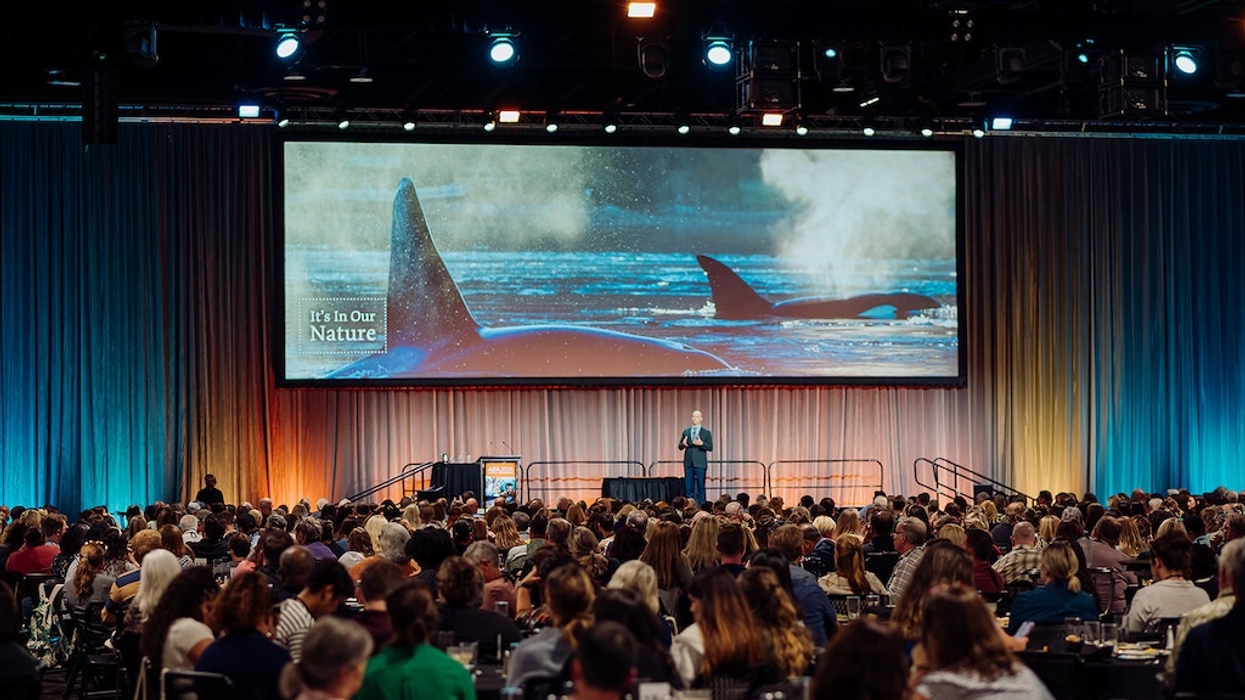
 Ecsite 2026 brought together people working in museums, science centres, and science engagement for three days of workshops, planel discussions, keynotes, networking and more Image © Ecsite
From discussions on AI and digital engagement to sustainability, inclusion and new approaches to exhibition design, this year's conference offered a snapshot of the opportunities and challenges shaping science centres and museums worldwide.
We look back at some of the key themes, standout sessions, industry innovations and conversations that defined Ecsite 2026.
Day one
There were a series of Deep Dive sessions on Tuesday morning, sponsored by VISIT Group, that attendees could register for ahead of the conference, including the Marketing Focus session.
Marketing Focus
This was an interactive workshop that discussed current and important marketing topics and trends across the sector. The session also offered attendees the opportunity to break out into groups to discuss, collaborate, and apply their learning to case study examples.
The session opened with an address from Linda Conlon, chief executive at the International Centre for Life in Newcastle. Her message to the room was that, given the current economic and social factors facing the industry, museums need to think more commercially and talk more about money.
This was then followed by insights from blooloop's Tom Robinson, covering the latest trends we are seeing across the attractions industry worldwide.
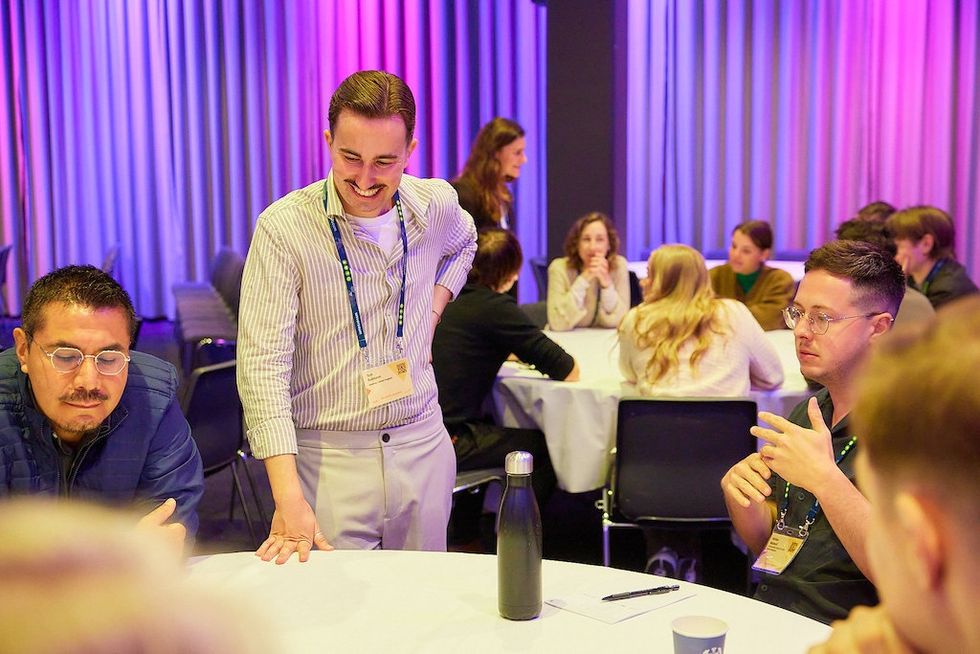 Discussions underway during the Marketing Focus deep dive session at Ecsite 2026Image © Ecsite
From optimising content to ensure AI visibility to using weather API’s to encourage visits during extreme temperatures, the session highlighted case studies from theme parks, museums, aquariums and beyond to give a glimpse into what attractions are doing to rewrite the marketing playbook in an ever-changing visitor landscape.
Emelie Lundborg Boon, digital sales manager, and Eric Edblad, head of sales and communication at Universeum, then made a case for museums to use OTAs to reach international visitors, fill low-season gaps, and engage guests earlier in the planning journey.
“OTAs should complement, not replace, our direct sales channels," said Edblad. “If OTA’s bring the right guests at the right cost, we scale. If not, we adjust.”
Vesa Kuokkala, head of marketing, sales and research at Heureka, explained how the science centre is reaching new audiences through marketing special events.
He shared three strategies ranging from adult-only evenings to talks focused on mental health. Whilst their core audience still remains families, they have seen how special events can help to attract new audiences and boost attendance during quieter times.
Ecite 2026 officially opens
The opening ceremony officially kicked off the action on Tuesday afternoon, where we were warmly welcomed by our hosts, Universeum.
Ecsite president Maria João Fonseca addressed attendees alongside the CEO of Universeum, Carina Halvord; the Deputy Lord Mayor of Gothenburg, Håkan Eriksson; the president of the Regional Council, Renée Bengtsson; and Ecsite director Catherine Franche.
Halvord spoke about the profound responsibility of science centres and science engagement professionals who are "fuelling the minds of tomorrow's decision makers."
She also spoke of the need to bring the humanities, arts, and design into the world of science communication, moving from STEM to STEAM. This was a recurring theme throughout the conference.
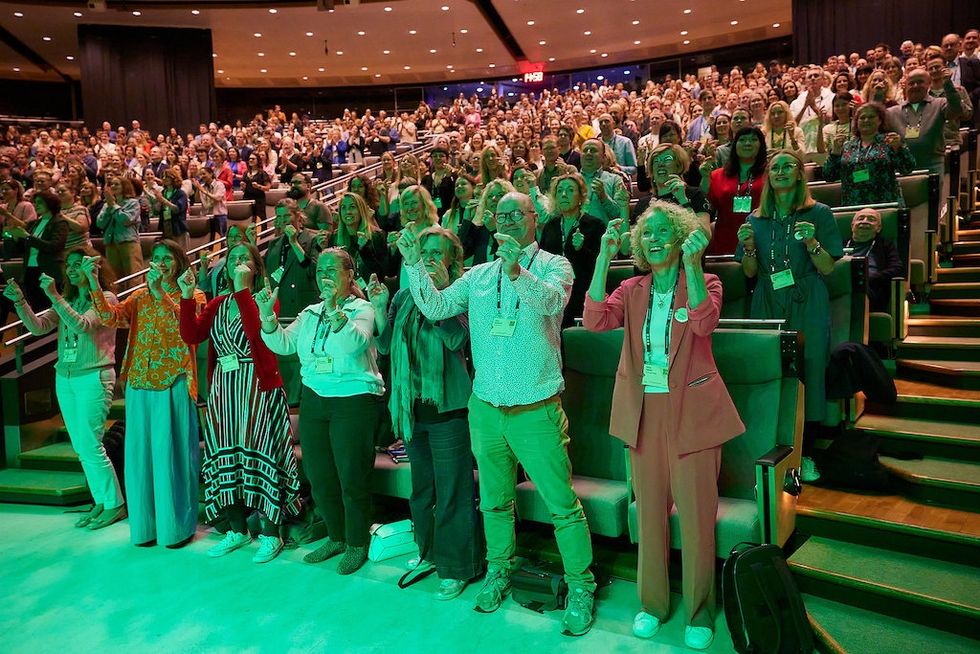 During the Ecsite 2026 opening ceremony, our hosts, Karin Ö. & Andreas Tärnvind from Universeum, led the crowd in creating a rainforest soundscapeImage © Ecsite
Halvold talked about having the courage to imagine entirely new ways of living, and wrapped up her welcome by encouraging attendees to "challenge each other, learn from each other, and inspire a better future."
Fonseca spoke about optimism in her speech, saying that rational, scientifically grounded optimism can be a catalyst for change and that curiosity can overcome indifference. Science, she said," allows us to bring together the past, present, and future, and learn from it."
She described Ecsite as an opportunity to gain deeper knowledge of what peers across the industry are doing, and urged delegates to make the most of the time they had together at the conference.
Meanwhile, Franche talked about how small ideas and connections can have a big impact, saying, "We are units of nuance, of resistance against uniformity and standardisation...Science denial is on the rise, pushed by loud voices.
"If people don't trust science, they simply won't cross our doors...Without science-based decisions, what will the planet become?" she added, emphasising how the science engagement sector is larger together.
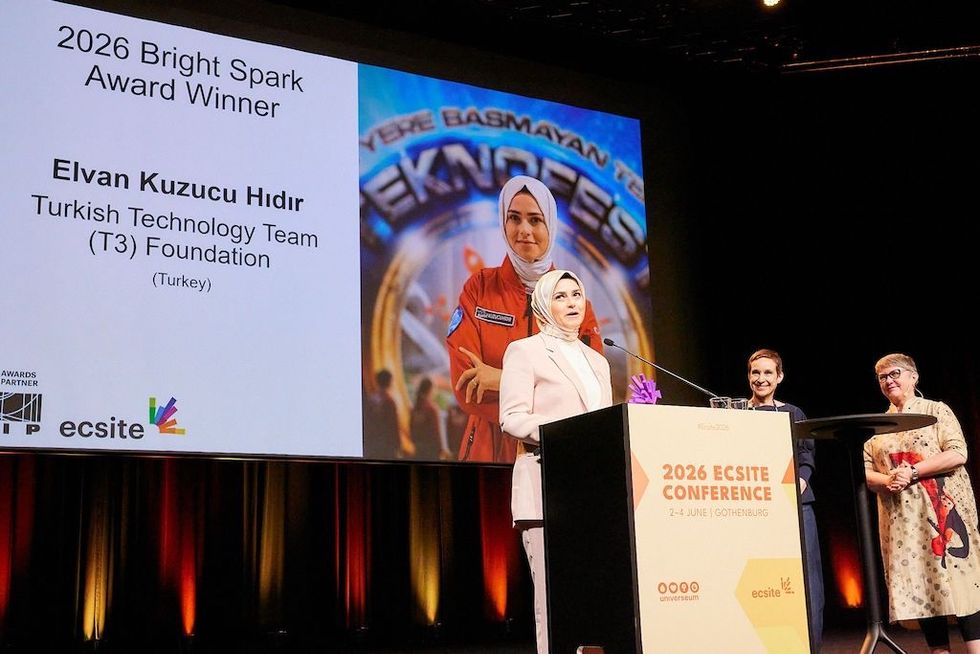 Elvan Kuzucu Hıdır, PhD, chairperson of Türkiye Teknoloji Takımı Vakfı, is this year’s Bright Spark winnerImage © Ecsite
During the opening ceremony, the annual Mariano Gago Ecsite Awards were also announced.
Elvan Kuzucu Hıdır, chairperson of Türkiye Teknoloji Takımı Vakfı, is this year’s Bright Spark winner, while ITQB NOVA received the Excellence in Science Engagement Award for Oeiras Experimenta Living Lab: Climate-smart crops for sustainable food production.
What's new in travelling exhibitions?
The conference then began in earnest with several concurrent sessions running throughout the afternoon.
We attended both parts of What’s new in travelling exhibitions?, a fast-paced introduction to some of the latest touring shows available to museums and science centres.
Highlights included Future of Food by the Science Museum Group, which explores how science is helping to develop more sustainable ways to grow, prepare, and distribute food, as well as Tone Tubes from MobilesMusikMuseum and Planetary Health from Deutsches Museum.
National Geographic spoke about its digital delivery system for exhibitions across Europe and beyond, including recent shows Photo Ark and Oceans, and shared a sneak peek of the new Museum of Exploration in Washington, D.C.
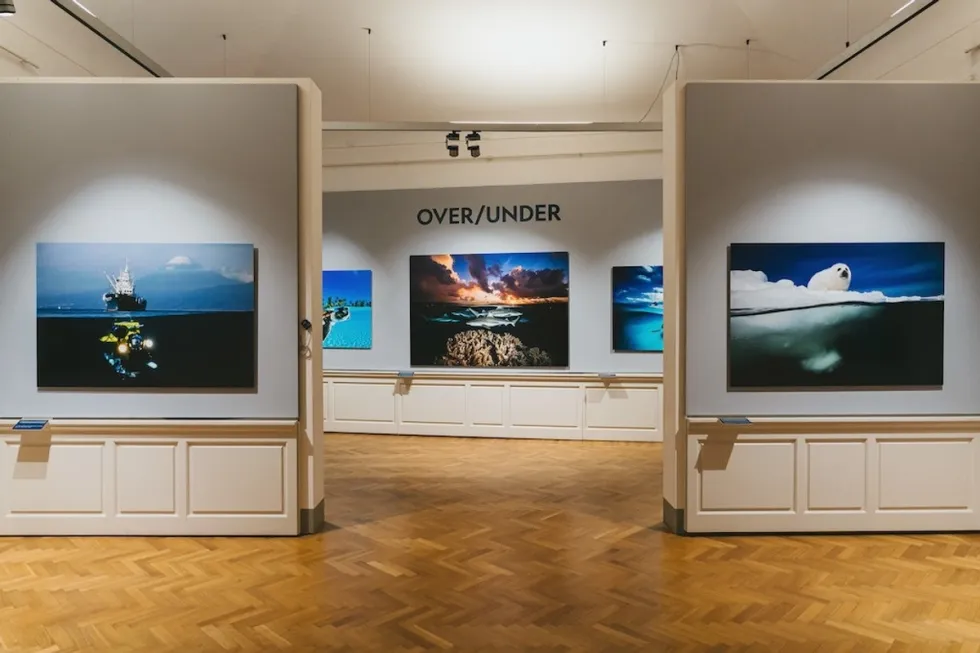 Oceans on display earlier this year at its debut venue, Villa Bardini in FlorenceImage credit Stefano Casati
Earth Works from Science North focuses on planetary health, fusing art, science and imagination to explore solutions in a fun way, while Cap Sciences' Anatomik Park turns the human body into a funfair for hands-on, interactive learning.
Another notable travelling exhibition is Exhibits Development Group's science-driven and experiential Sherlock Holmes: The Exhibition, which invites visitors to follow in the footsteps of the iconic detective. The company also highlighted Electric Playhouse Travels.
We heard from the American Museum of Natural History, which is showcasing a new touring exhibit called Impact: The End of the Age of Dinosaurs, alongside current shows Elephants and Sharks, as well as from National Museums Scotland about a new exhibition under development on Dolly the sheep and the art of cloning.
Imagine presented Sean Kenney's Brick Masters Studio, an interactive experience that explores the intersection of creativity and science through sculptures built with Lego. Other new exhibitions in development from the company include Frank Lloyd Wright, De-Extinction, Oceans, Patrick Dougherty, and a partnership with Walt Disney Archives.
The Natural History Museum introduced Our Story with David Attenborough, a cinematic experience produced by the award-winning filmmakers behind many of Sir David’s documentaries.
Finally, Universcience highlighted a new travelling exhibition, Gardening. This invites visitors to reconnect with non-human life while exploring their relationship with nature.
See also: How to build a travelling exhibition: the expert guide to modular design and global logistics
Events on Tuesday evening included the Newcomers Meetup and the New Ecsite Members Onboarding, both at Universeum.
The Networking Gateway also took place that evening at World of Volvo, a unique brand home that invited guests to get hands-on and learn about Volvo's legacy of innovation, while connecting with peers and enjoying local food and drink.
Day two
Gaming and science engagement
On Wednesday morning, Level up! Game mechanics for engaging science learning looked at how game design principles can be applied to create more engaging and impactful learning experiences.
Game mechanics are becoming one of the most powerful tools in exhibit design within science centres and museums, and this session brought together leaders in the sector to share their best practices:
Yumi Miyahara from Miraikan, Mayssa Aboalsamh of ilmi Science Discovery and Innovation Center, Eric Londatis from Imaginary, Meredith Doby of The DoSeum, and Adriana Magni from Kiss the Frog.
Aboalsamh presented Mission Red Sea, one of the upcoming experiences guests can see when ilmi opens in Riyadh next year. The social VR experience invites visitors to collaborate to explore, protect, and restore the Red Sea, moving through time to see healthy reefs in the future. “Game mechanics help turn curiosity into engagement" said Aboalsamh.
Doby echoed that sentiment, sharing how The Doseum reaches the tween demographic through gamification.
She highlighted several exhibitions, including Spy Academy, Uniquely Us, and Dream Tomorrow Today, in which game mechanics allow visitors to delve deeper into the content and engage older children more effectively.
These exhibitions also utilise the latest in RFID technology from Experios to track players' performance.
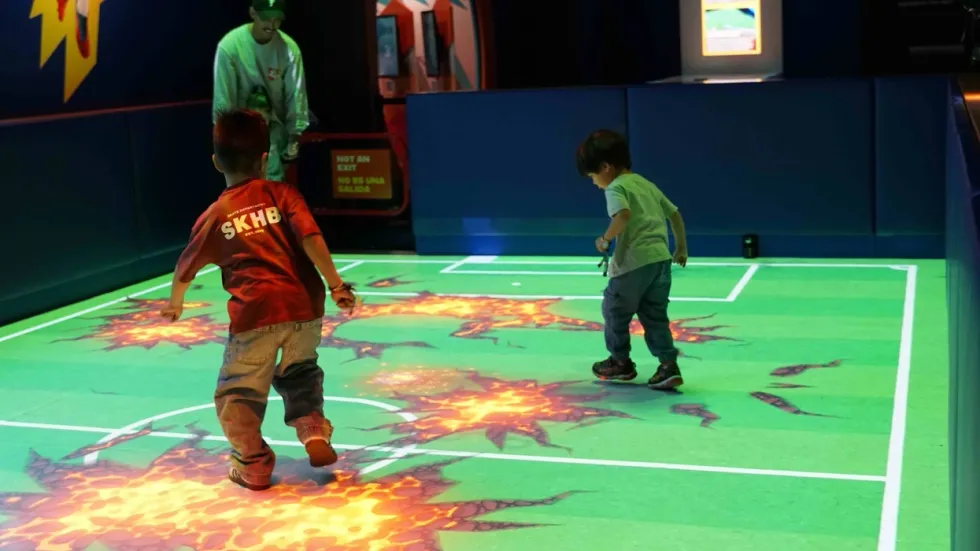 Perot Museum's Soccer: More Than a Game features interactive challenges with real-time feedback Image courtesy of Kiss the Frog
Magni of Kiss the Frog spoke about Perot Museum's Soccer: More Than a Game to show gamification mechanics in practise. Again, using Experios (a division of Kiss the Frog) bands, visitors can save their progress across 20 football-themed interactive challenges and receive real-time feedback to drive skill progression and dwell time.
Highly visible multiplayer games like The Field is Lava and personalised mascot interactives also help to engage audiences with the exhibit.
Miyahara shared Miraiakan’s Quantum Computer Disco exhibit, which turns gate-based quantum programming into a DJ experience to “make the subject less scary and more funky”, proof that “science communication doesn’t always have to be serious”, said Miyahara.
Londatis of Imaginary shared design lessons from its touring Disasters exhibition. The key to its success, Londatis said, was making the games easy to learn and hard to master, whilst keeping the play loop short and replayable.
Reflecting the educational aspect of science centres and museums' missions, he emphasised the importance of not being afraid to let visitors lose, as failure is a learning mechanism.
Trust the audience
Meanwhile, in 'Risky museographic choices: Can we trust our audiences?', we heard from Jean-Christophe Denis of the University of Edinburgh, Caroline Vrammout of Universcience, Celia Bachmann of Stapferhaus, and Candice Hittier of CERN.
For an icebreaker, attendees were asked whether they would let visitors walk through in-use workspaces, take a bath in money on the museum floor, or let guests use real research equipment. After voting with our feet, we learned that these were all real scenarios the speakers would be exploring.
Focusing on Universcience's Gardening exhibition, Vrammout spoke about how the team worked to translate the actions of gardening into an indoor travelling exhibition.
It uses many different hands-on experiences to communicate various concepts, for instance, a veggie dating app to learn about plant pairing. The goal is to engage guests' senses and emotions, sparking curiosity about the science of gardening.
Vrammout said that, yes, there can be fears around whether components will be damaged by visitors, but "our role is to find a solution." She advised prototyping, starting small, and trusting the process.
At Stapferhaus, a centre that engages with major social and political topics, Bachmann detailed how the institution placed a great deal of trust in the audience with a display that invited them to 'bathe' in a room full of real coins.
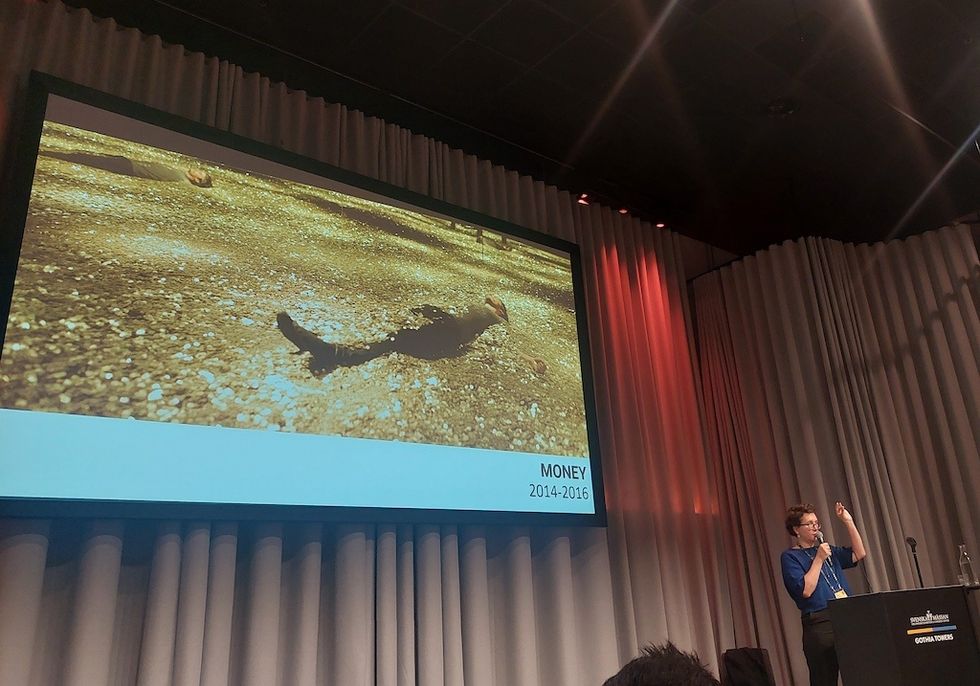 The Stapferhaus Money exhibition explored the emotional and social impacts of wealth, prompting visitors to swim in "rooms full of coins"Image credit C. Blanco Coates
While they estimated a loss of 20,000 Swiss francs, the total loss was only 9,190 by the end. Many of these coins were taken unintentionally, caught in pockets and clothes, and some people returned them once they realised.
Attendees also learned about a travelling exhibition currently being developed by the University of Edinburgh: an escape game set in a real research lab, aimed at engaging members of the public with current biofilm research.
Meanwhile, at CERN, the world's largest particle physics lab, the visitro tour was redesigned. The challenge was to rethink the space, preserving its soul while adding supporting elements and bringing the public closer to the action.
Part of the tour passes through a vintage control room that is still in use. The screens can switch from control mode to display mode. Hittier advised: "Respect the workspace and the people working there." Communication with all parties was vital from the beginning of the process.
Participants then split into groups to develop ideas for their own 'risky' exhibition proposals. Topics included a rage room, an immersive experience from the point of view of a worm, and talking to the dead using AI
Talking to parrots
Wednesday's keynote,Talking to parrots, or how to make sense of AI, was delivered by Simone Natale, Associate Professor at the University of Turin.
Natale spoke about the case of Alex, a grey parrot that was the subject of thirty years of experiments between 1976 and 2007, under the scientific lead of biologist Irene Pepperberg.
LLMs, or large language models, are, according to Natale, "stochastic parrots" - they do not understand the meaning of the language they process. Like parrots, they imitate human language but do not understand it. Yet they are still taken seriously as communication partners.
For Pepperberg, language was seen as a means to study animal cognition, not as the goal.
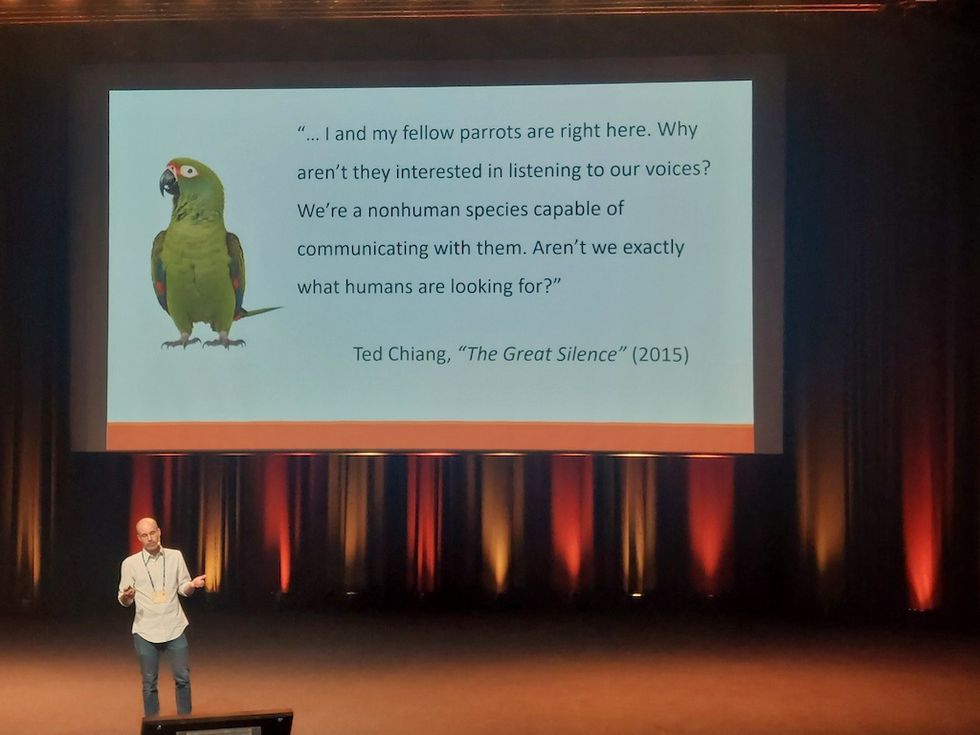 During his keynote, Natale discussed a thought-provoking quote by Ted ChiangImage credit C. Blanco Coates
Natale also explored the concept of "One-to-no one communication" - experiences in which we are unable to assess whether there is a subject on the other side who listens, or whether the feeling of being listened to and understood is a product of our own imagination.
A key characteristic of this type of interaction is that the interlocutor is both reachable and unreachable at the same time.
When it comes to AI adoption and experimentation, Natale pondered the roles cultural institutions such as science centres and museums play and the kinds of interlocutors they could create.
He spoke about the importance of taking control by developing knowledge and understanding within the cultural organisation of both cultural and technical issues related to the customisation of AI.
When it comes to customising LLMs for public engagement, it can be seen as a new way to give visitors access to information, one that is interactive, open-ended and conversational, for instance with AI-powered docents or historical figures.
Dating for exhibits
In The beauty of obsolescence: Giving new life to old exhibits, we were invited to swipe left or right on a selection of exhibits handpicked by the panel: Elisabeth Limbeck-Lilienau from Technisches Museum Wien, Gunnar Behrens of Archimedes Exhibitions, and Thierry Dassé and Samia Lorrain from Universcience.
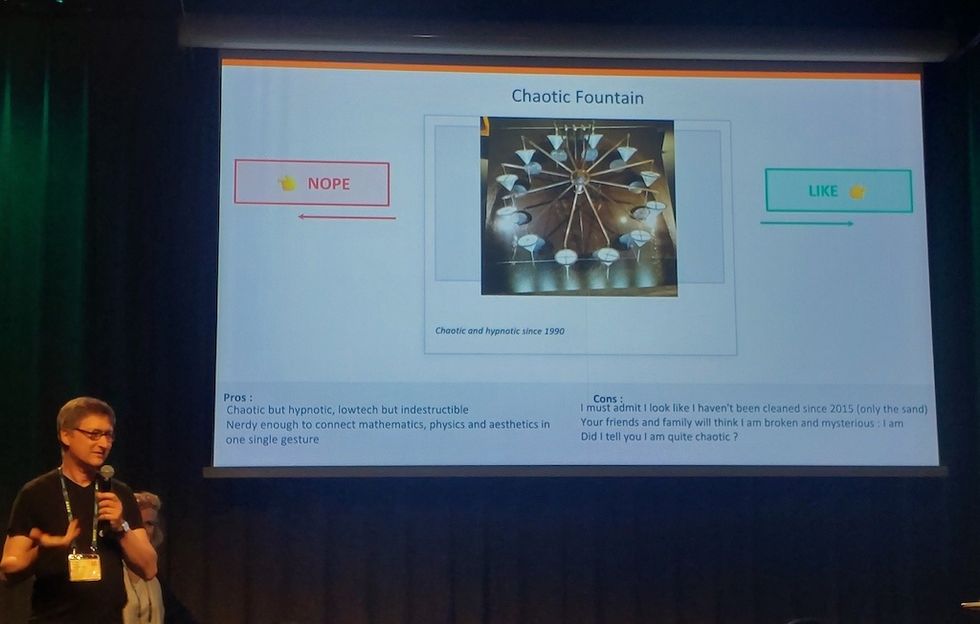 Each exhibit came with a list of pros and cons, or red and green flags in dating parlance, to help participants decide whether to swipe left or rightImage credit C. Blanco Coates
Each of the exhibits featured, including the first Austrian steel-making converter, a Chaotic Fountain, the Orbitogramme, the Hermes 3000, a prototype for a washing machine designed to last 100 years, and a vintage post bus, had a list of 'red flags' and 'green flags' to help attendees decide.
Once the votes were cast, participants split into four groups to decide how we could fix these broken, out-of-date, or unloved artefacts, constrained by budget, lack of new materials, or the inability ot make physical changes to the object.
It was a useful exercise in thinking creatively to breathe new life into exhibits.
Revenue by design
AI was on the agenda again in the afternoon. Revenue by design: Distribution strategy and AI in the experience economy, hosted by VISIT with Universeum and Liseberg, looked at what “revenue architecture” means in practice
The session opened with a question to the panel: what’s more dangerous right now, moving too fast on AI or not moving fast enough? The panel concluded that attractions can’t stand still and that it's better to make mistakes and learn from them. “It’s important to not be left behind”, said Thibault Miclo, head of AI at VISIT.
Carl-Johan Holmén, VP go-to-market & partnerships at VISIT, emphasised the importance of working with review sites, since LLMs really value them, and of responding to all reviews, even negative ones.
He predicted that AI will move from discovery to transaction, citing embedded checkout systems integrated into social platforms. For this, he encouraged attractions to ensure their inventory is in UCP format, so AI can easily access their offerings and complete safe transactions in the future.
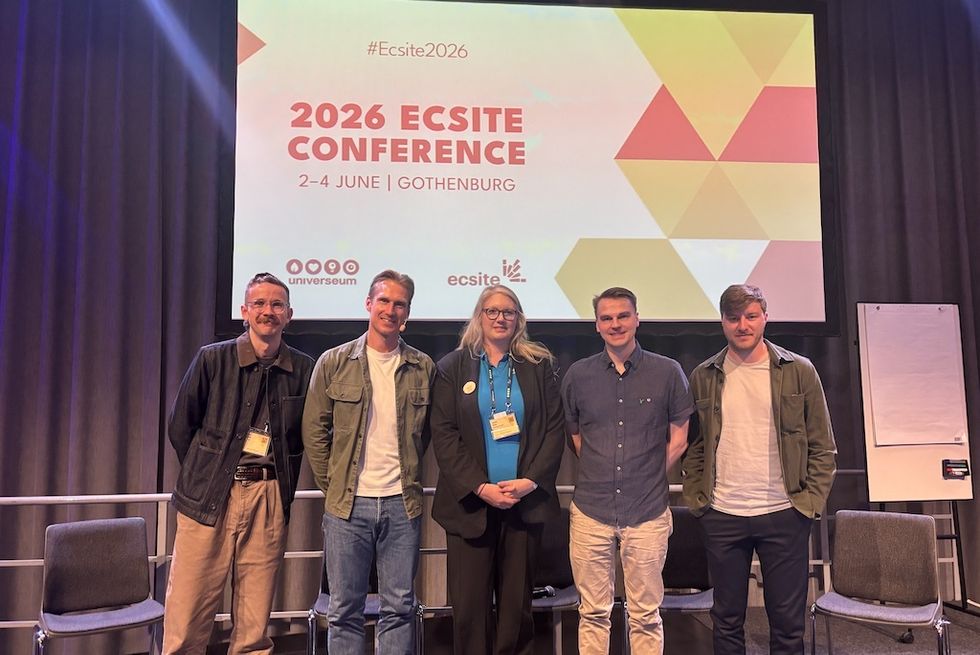 'Revenue by Design' speakers at Ecsite 2026 L to R: Declan McCann, Carl-Johan Holmen, Emelie Lundborg Boon, Johan Thorell, Thibault MicloImage credit T. Robinson
At Liseberg, Johan Thorell described how the park tailors its offerings and communications based on guest profiles, using AI to recommend only relevant offers based on the length of their visit and whether they are travelling or local.
He also highlighted that AI is not the best solution for replacing key moments of hospitality during a visit. “Where the guest is expecting an exceptional experience, that's where you want the human touch."
Miclo highlighted the growing role of generative search in trip planning and echoed Thorell’s view that AI should recommend products visitors will genuinely want and enjoy. This, he said, would improve the visitor experience, leading to better reviews and increased return visits.
For Emelie Lundborg Boon at Universeum, generative search as a method of trip planning poses a risk to attractions with stale data on their sites and other platforms.
LLM models had been communicating to schools planning trips that Universeum is free to visit, which only applies to those in the Gothenburg area. Liseberg has had similar troubles, with AI pulling seasonal event data from previous years, leading the theme park to do a digital spring clean of information available online.
Building audience connections using social media
With the growing importance of social media communication across sectors, Beyond the feed: Building real audience connections using social media examined how to build genuine audience connections across B2B and B2C channels.
Led by Madisson Pilliske from Ecsite, the session featured Laura Gosney of The Natural History Museum, Roosa Hopeamaa from Heureka, and Laure Rigaud-Soares of Universcience.
Gosney focused on the museum’s yearly multisite exhibition Wildlife Photographer of the Year, urging teams to be nimble and “make the most of assets you already have at hand”. For WPY, this takes the form of working with the strong images, aligned influencers and global moments like World Reptile Day.
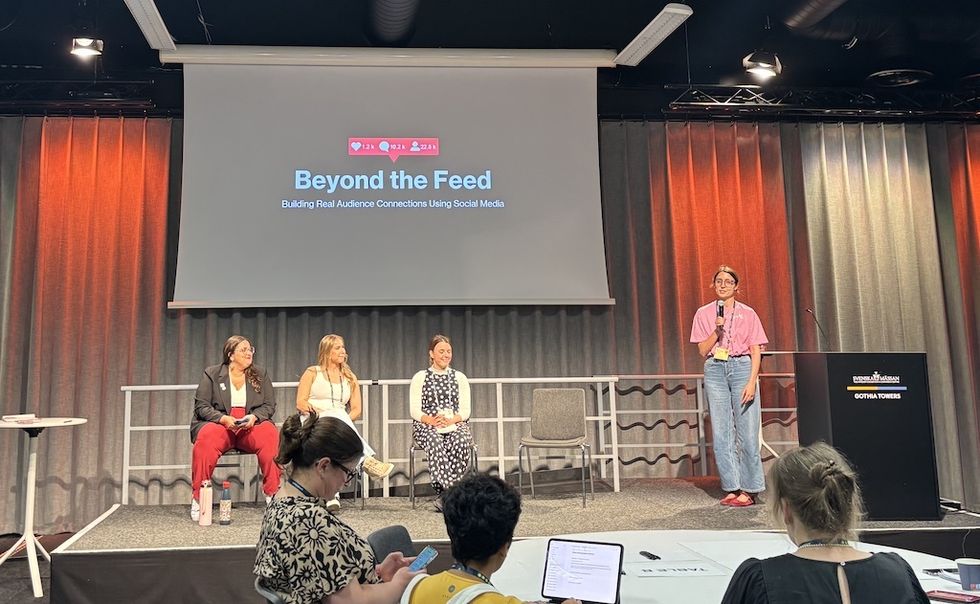 Beyond the Feed panel at Ecsite 2026. L to R Laure Rigaud-Soares, Roosa Hopeamaa, Laura Gosney, Madisson PillikseImage credit T. Robinson
Hopeamaa spoke on the importance of smaller marketing teams knowing their audience and prioritising no more than three social channels to reach them.
Through this, content can be adapted across multiple platforms, building cross-channel strategies in which the same story can be told to different audiences in formats suited to them.
From a B2B perspective, Rigaud-Soares showed how Universcience’s campaigns promoting touring exhibitions have evolved over time.
For them, a 360-degree campaign across industry press, email, and social channels has been a successful way to raise awareness and drive engagement across their portfolio.
Real AI lessons
AI in science centres and museums: Lessons from four institutions discussed how to develop exhibitions that engage the public in making sense of AI while keeping up with rapid change.
Ari Krakowski from Lawrence Hall of Science, Eric Dimond of Exploratorium, Christoph Kremer of Ars Electronica Center, and Linz Tobias Kösters of Imaginary shared their experiences.
Dimond spoke of the challenges, including the fact that the field is moving so fast that it is hard for museums to remain contemporary. Exploratorium has been leaning into known design principles and pedagogy and learning how to apply them to this new content.
One of the questions his team wanted to explore with the content was, How do these technologies teach us about ourselves? They also worked with artists to explore the topic, including Mimi Ọnụọha, who produced the Library of Missing Datasets.
Visitors were also asked about their biggest fears and hopes around AI.
Krakowski explained some of the thinking behind the Lawrence Hall of Science's Inside AI exhibition, which the team designed to support AI literacy and focus on intergenerational learning. With different explanatory layers, the exhibit invited experimentation and AI 'breaking'.
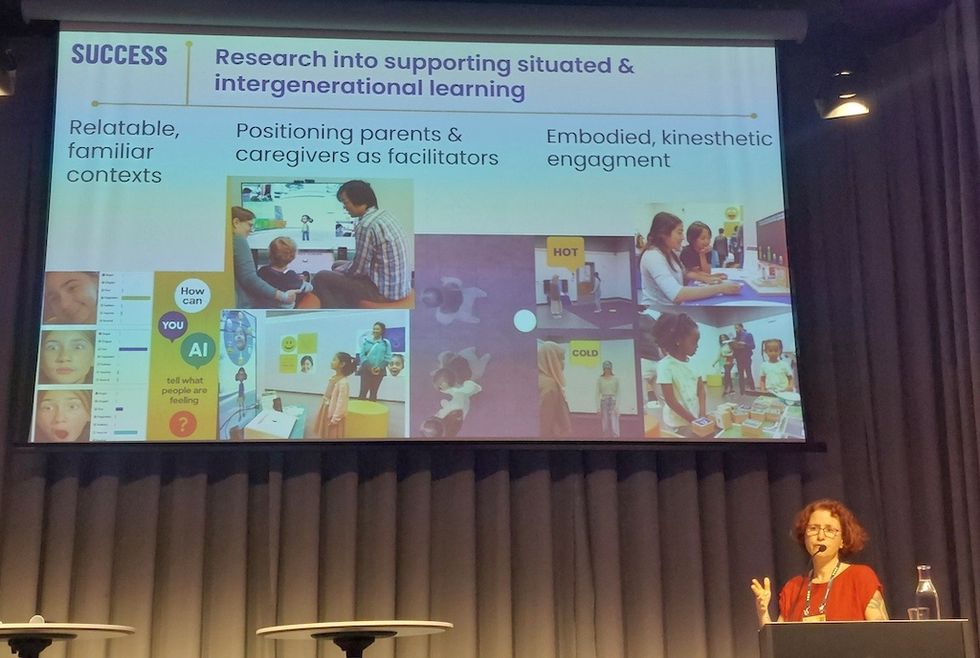 Ari Krakowski shared what the team at Lawrence Hall of Science learned in designing an exhibit about AI Image credit C. Blanco Coates
A key factor for Krakowski was to balance playful curiosity with critical reflection. One challenge the team faced was bias when testing open-ended image-gen exhibits, and they eventually abandoned this concept to avoid othering visitors.
Kösters then presented Imaginary's You Are AI exhibition. For his team, the task was about communicating scientific truths without losing visitors, and, like many of the panellists, he spoke about the difficulty of staying current when the tech is moving so fast.
In the exhibition, AI is rendered understandable through playful interactions. It aimed to bridge the gap between code logic and real-world societal impact.
Kremer shared details of how the Ars Electronica has been using Lego to explain AI. The team trained a computer to recognise which animal a visitor has built using AI. This proved to be a useful way to talk about AI hallucinations; the computer always delivers a solution, rather than saying it does not know.
Immersive technology
Next up, Rethinking the economics of science venues: How institutions are innovating revenue strategy through immersive tech was moderated by Cosm’s Kirk Johnson.
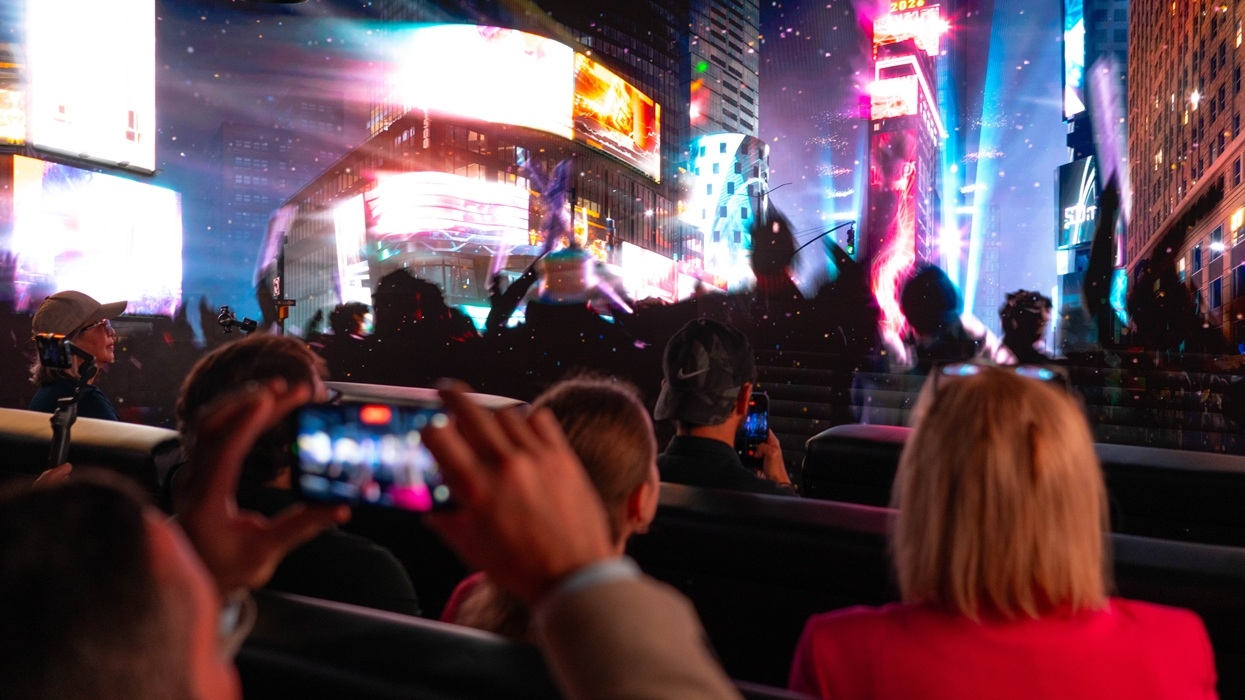
In this session, he was joined by Martin Fuchs from Prague Planetarium, Markus Schack of Mediendom Kiel, and Tim Florian Horn from Stiftung Planetarium Berlin, who discussed how versatile, high-resolution domes are transforming theatres from single-purpose venues into multi-functional platforms.
When it comes to domes, Cosm's goal is to continue to increase the quality of both the tools and the content; new advances connect with and engage audiences, supporting organisations in reaching their goals.
Fuchs explained why Prague Planetarium chose the CX System LED dome, a comprehensive platform that combines LED displays, software, and immersive content. He said the team saw a prototype in China and was "blown away." Since the refurbishment, the planetarium has sold out 2000 shows in a row.
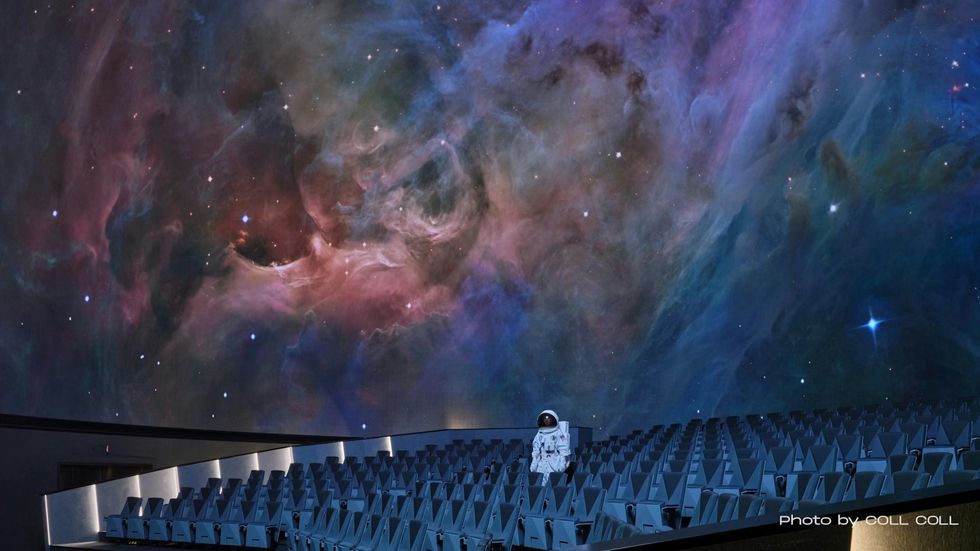 Prague Planetarium's new CX System-powered LED Dome was previously described as a 'Dream machine' by creative diector Martin Fuchs Image credit COLL COLL
Florian Horn discussed the challenges of running multiple sites and how content can be adapted for venues of different sizes. He asked how operators can bring together storytelling from immersive rooms and other venues, saying there is much to learn from each other.
While the conversation included both LED and projection-based domes, Schack said: "Once you see an LED dome, you cannot go back to projection."
See also: Dream machine: Prague Planetarium's immersive transformation
On Wednesday evening, the trade show Happy Hour closed proceedings at the conference centre, before the Nocturne got underway.
Hosted by the team at Universeum, the event featured a variety of entertainment, local food and drink, and the now-legendary Ecsite karaoke session.
Attendees could explore the different spaces within the science centre, take part in a 'Fear Factor' challenge involving touching and eating bugs, come face to face with animatronic dinosaurs and low-flying toucans, and experience the centre's immersive Wisdome on the top floor.
Day three
Constructive criticism
We began Thursday morning with Sink or rethink: Workshop for constructive criticism in exhibition design, which borrowed from the Shark Tank TV format but with an exhibition-focused twist.
Audrey Chang from Science Gallery International, Jussi Kahlos of Heureka, Brad MacDonald of Parsons School of Design, Robert van der Linde from Kossmanndejong and Cynthia Doumbia from National Geographic supervised as participants broke into groups to explore a range of unfinished or underdeveloped exhibition ideas that had been pitched.
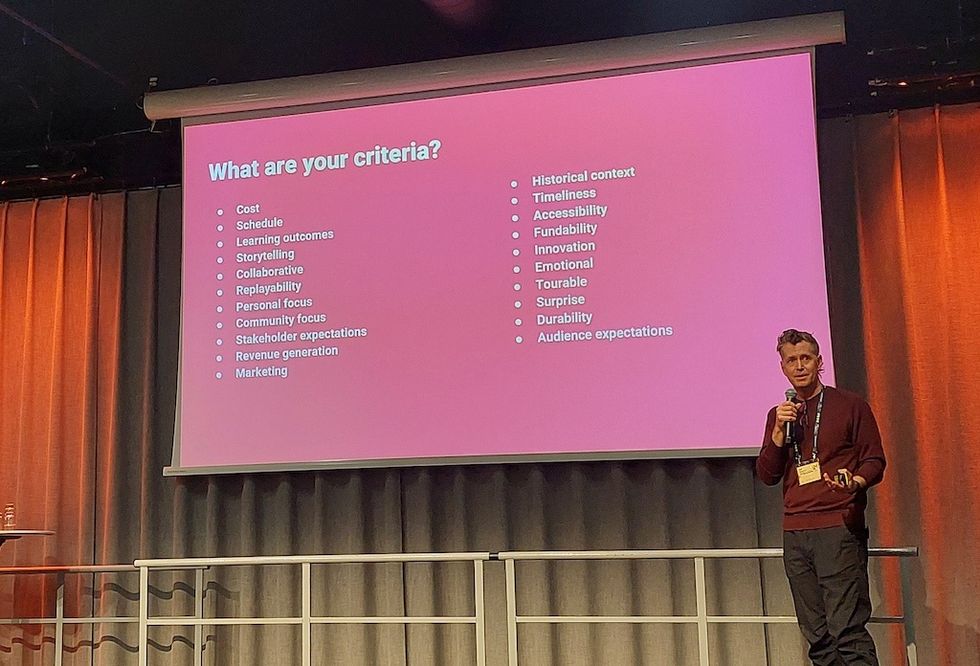 Ecsite's 'Constructive criticism in exhibition design' was a Shark Tank-style session, but with participants taking a supportive role to explore how to get the ideas off the groundImage credit C. Blanco Coates
Through this exercise, attendees were able to take away useful tools, knowing that all good ideas start unfinished. The goal of the critique session was not to knock down ideas, but to help them grow.
Introducing the session, MacDonald spoke about deliberately switching between critique modes: possibilities, or what could this become; and problems, or what might go wrong. He also introduced the idea of pre-valuation to establish criteria before ideation.
Community science
Menno Schilthuizen, a professor at Leiden University, delivered the second keynote of the Ecsite 2026 conference, titled The Urban Naturalist: how community science is coming full-circle.
This raised the question of whether a scientific mindset is exclusive to scientists and academics.
He spoke about the transition from the science of the 19th century, spearheaded by amateurs and curious explorers who used science to make sense of their environment, to the professional bodies of the 20th century, when the individual scientist or naturalist was shunted to the sidelines.
However, things are coming full circle today, explained Schilthuizen, thanks to the open science model, which is now removing barriers that prevented people from getting involved in science. 80 to 90% of all the scientific research ever published is now available to the public, including both professional and community scientists.
"Now, a 20th-century science lab sits in your smartphone," he added. People can be part of cutting-edge science from their homes.
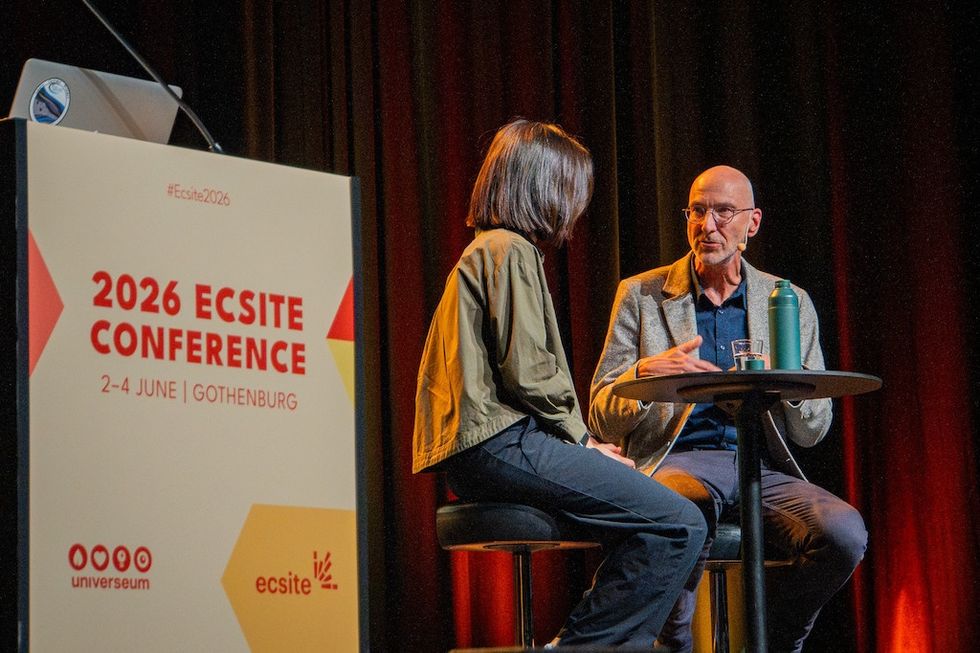 Following his keynote, Schilthuizen also took audeince questions in a session moderated by NHM's Camilla ThamImage © Ecsite
He also explored the city as a scientific playground for a new generation of community scientists. It is a completely new environment, shaped by us, with impermeable surfaces, fragmented nature, and different kinds of pollution.
He cited examples such as Sigrid Jakob, who built her own DNA lab in her kitchen, which fits into two shoeboxes, so she can sequence DNA for mushrooms, and a mini flagship species in Kuala Lumpur, where community scientists have made the firefly their mascot for the Bukit Kiara community rainforest, encouraging the community to get involved.
One community in the Netherlands used science and art to successfully campaign for the closure of a road where threatened species were being killed by speeding motorists, documenting the dates and species of each incident and then commemorating each one with willow crosses installed at the side of the road.
Schilthuizen said: " You don't need a scientific background, you just need curiosity and community."
Connecting with nature and the future
Later in the morning Redefining educational goals in the age of climate crisis explored how science education helps people connect with nature and the future, not just understand them.
Speakers included Vesa Lepistö from Heureka, Thomas Ziegler Larsen of Naturcenter Amager Strand, Nils Petter Hauan from VilVite, Bergen Science Centre, Marianne Guriby of The Climate House, Natural History Museum of Norway, and Anne-Laure Mayer from Universcience.
The session asked, "Does science education sometimes create distance from nature rather than connection?"
For VilVite, Petter Hauan said the goal is to provide people with the tools they need to make informed, sustainable choices, while Guriby said that for The Climate House, the aim is dialogue and future imagination.
Heureka, said Lepistö, has moved from exploration to future literacy. By being realistic about sustainability challenges and presenting holistic sustainability thinking with imagination, the science centre helps visitors to experience complexity, imagine futures, and navigate uncertainty.
Mayer talked about how Universcience focuses on creativity, collective intelligence, and participation over interaction.
Participants then considered and discussed a key question: "How are our educational goals changing in the light of the sustainability crisis, and are we honest enough to admit when they have not been working?"
Connecting mission delivery to revenue
Sales is an inside job: Connecting mission delivery to revenue explored whether sales and institutions' missions can coexist.
Led by Troy Rainville of Imagine, and Agnes Ruiz from the American Museum of Natural History, the panel, which included Hilde De Laet from Hidrodoe, Josh Sarver from COSI, and Franziska K. Lang of Experimenta, was of the opinion that they are the same thing.
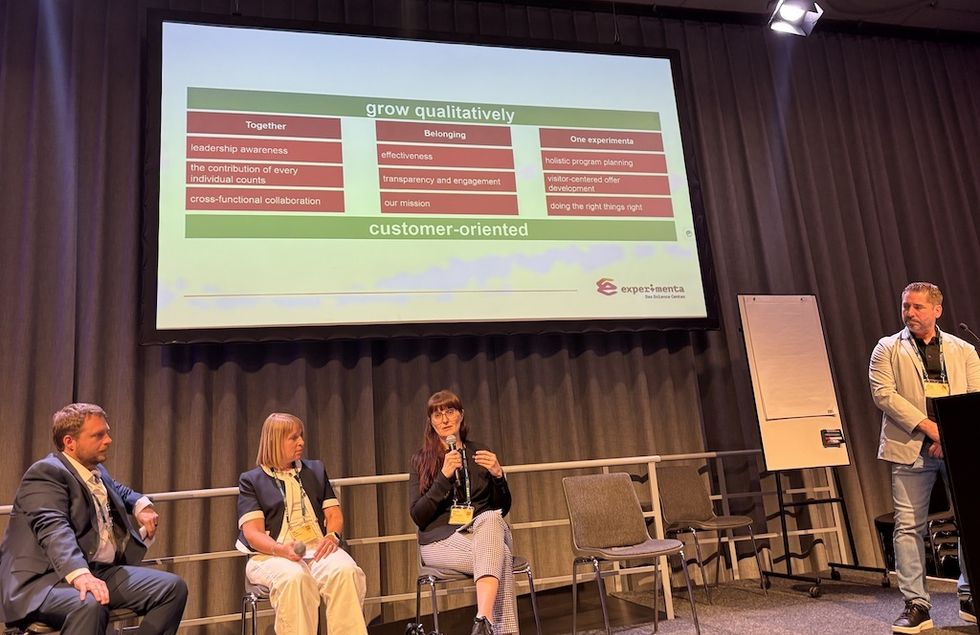 'Sales is an inside job' Ecsite speakers. L to R Josh Sarver, Hilde De Laet, Franziska K. Lang, Troy RainvilleImage credit T. Robinson
For them, sales is mission delivery, not a department within your organisation, and revenue comes from a great guest experience.
“We are one team," said Sarver, emphasising that guests don't discern between departments when visiting. “If we are leaking on our brand, our promise to our guests, that is an opportunity lost.”
Hilde shared a similar sentiment. At Hidrodoe, all staff are involved in the front-of-house experience, and reviews are a key KPI. Even the smallest frictions, from out-of-stock toilet paper to anything that slows the pre-visit journey, are monitored and actively improved.
Franziska also emphasised the importance of staying customer-oriented and hospitality-driven to deliver on Experimenta’s mission.
At the museum, all staff undergo a comprehensive onboarding process to help them understand all aspects of the business, including sales, and to ensure they are aligned with a common goal.
Immersive storytelling
Another common thread throughout Ecsite Conference 2026 was the rise in immersive-driven experiences within the science centre and museum sectors.
Between fact and fiction in immersive storytelling, Chris Whitby of the National Science and Media Museum, Alessandra Bogi from Lucid Realities, James Monroe from the Museum of Science, Boston, and Dee Laval of V!VANT Productions explored this across their institutions and projects.
Whitby spoke about the National Science and Media Museum’s latest exhibition YOU:MATTER, created with Marshmallow Laser Feast. He reflected that visitors often don’t expect to find art in science museums, yet it is a major driver of engagement.
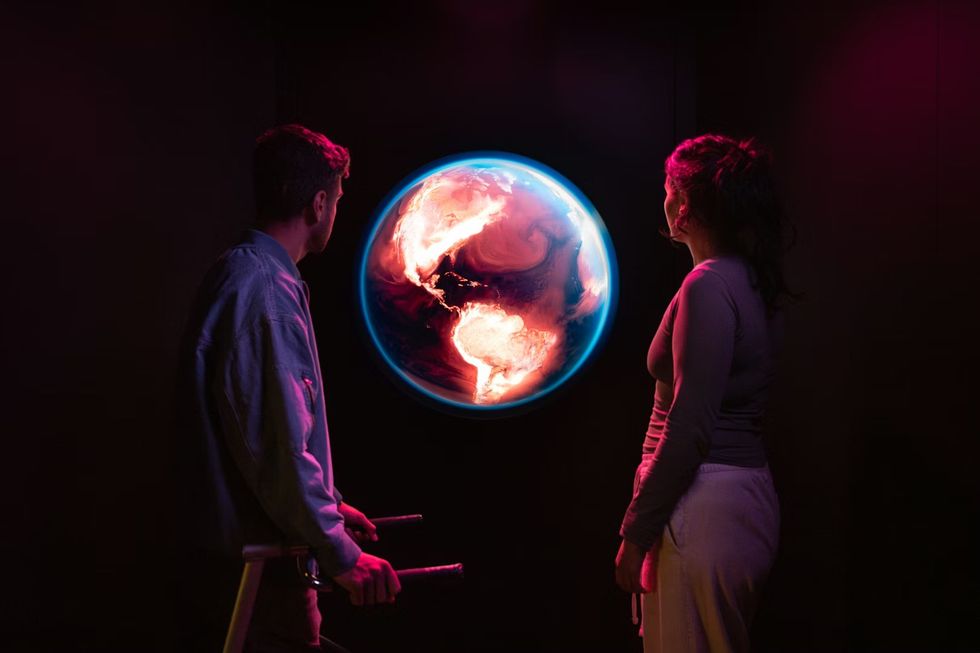 YOU:MATTER is a multi-sensory, narrative-led experience inviting audiences to explore their profound connection with the cosmos Image courtesy of National Science and Media Museum
At the Museum of Science in Boston, the team have unveiled plans for Public Science Common, a new flexible venue coming to the museum.
This will feature a state-of-the-art immersive venue developed in collaboration with Ars Electronica, where projection-mapped content responds to audience interaction with the space.
Bogi shared details about Dimensional Journeys, a project from Lucid Realities currently in development. This VR experience will explore how the medium can create active, multisensory learning through hand tracking and content that reacts in real time to visitors' movements.
Laval posed the question of whether immersive experience fosters critical thinking or obedience among audiences. They argued that immersive exhibits are a perfect art form for fascism, and that we are already seeing political forces use the medium as a way of spreading propaganda.
For Laval, an antidote to the audience’s lack of critical consciousness when encountering immersive works is to make things stranger and weirder, revealing the mechanics and disrupting the illusion.
“Lie, and then show the lie,” said Laval, as a way to give audiences agency to truly engage with the content they are seeing.
Sponsorship vs. partnership
From sponsoring to partnering: Involving companies in science engagement was a roundtable on how companies can become more involved in science engagement, with Stephanos Cherouvis of Ecsite, Petra Palm of Universeum, Marjut Sirola from Heureka, and Lolita Couchene of Nausicaa.
Business involvement is often seen as sponsorship, but new models move beyond financial support, with businesses becoming active partners in science engagement. Examples provided by the speakers showed how these collaborations create shared value and impact.
We learned about Nausicaa's Mr Goodfish campaign, which engaged the entire seafood value chain. The goal was to help reduce human pressure on vulnerable fish stocks by changing the practices of the fishing industry and consumers.
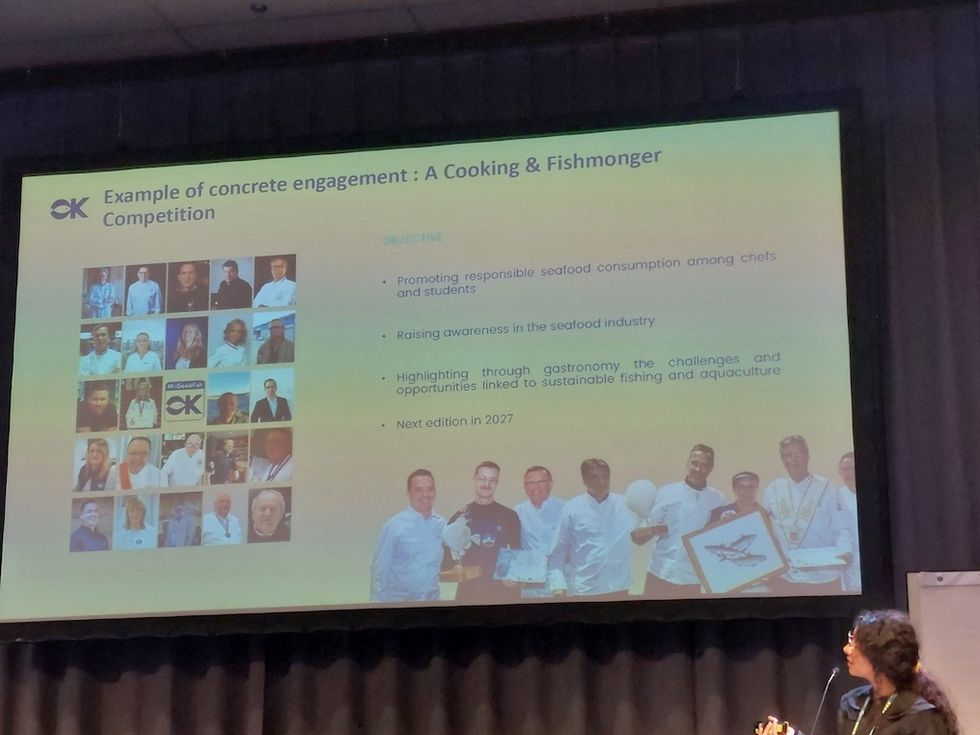 Lolita Couchene of Nausicaa explained the centre's Mr Goodfish initiative as an example of good partnership in this Ecsite 2026 sessionImage credit C. Blanco Coates
For this purpose, science was translated into practical recommendations to support a positive approach and make decision-making easier for consumers. Partners included chefs' associations, catering companies, large retail chains, fishmongers, producers and more.
Palm, alongside Marie Orn of AstraZeneca, presented the long-term effects of their partnership, including increased social inclusion and equitable access to science, as well as a strengthened skills supply within STEM.
Sirola explored Heureka's partnership with Abloy, a Finnish company specialising in locks, access control and security solutions.
The initiative included a month-long campaign with special workshops where visitors explored how locks work by building their own personal lock, and an interactive activity booth where visitors could leave their messages for the future in a tailor-made time capsule.
Trying out and implementing different partnership projects helps develop diverse partnership models, said Sirola. She also advised choosing partnerships wisely, preferring quality over quantity.
The trade show floor at Ecsite 2026
Beyond the conference session, Ecsite 2026’s show floor brought together exhibitors from across the science centre and museum industry, showcasing the latest in travelling exhibitions, interactive tech and robotics.
The American Museum of Natural History's dedicated travelling exhibitions team were exhibiting, showcasing its catalogue of exhibitions, photography displays and planetarium shows, including its latest planetarium show, Encounters in the Milky Way.
National Geographic presented highlights from its catalogues of touring exhibitions, including Oceans and a Greater Wisdom, while Universcience showcased its new touring exhibition, Dance, and previewed the international tour of its Cats & Dogs exhibition, which will be on tour from Autumn 2026.
Also on the show floor were Exhibits Development Group and its sustainability platform culturenut, which helps museums recycle and upcycle retired exhibition assets.
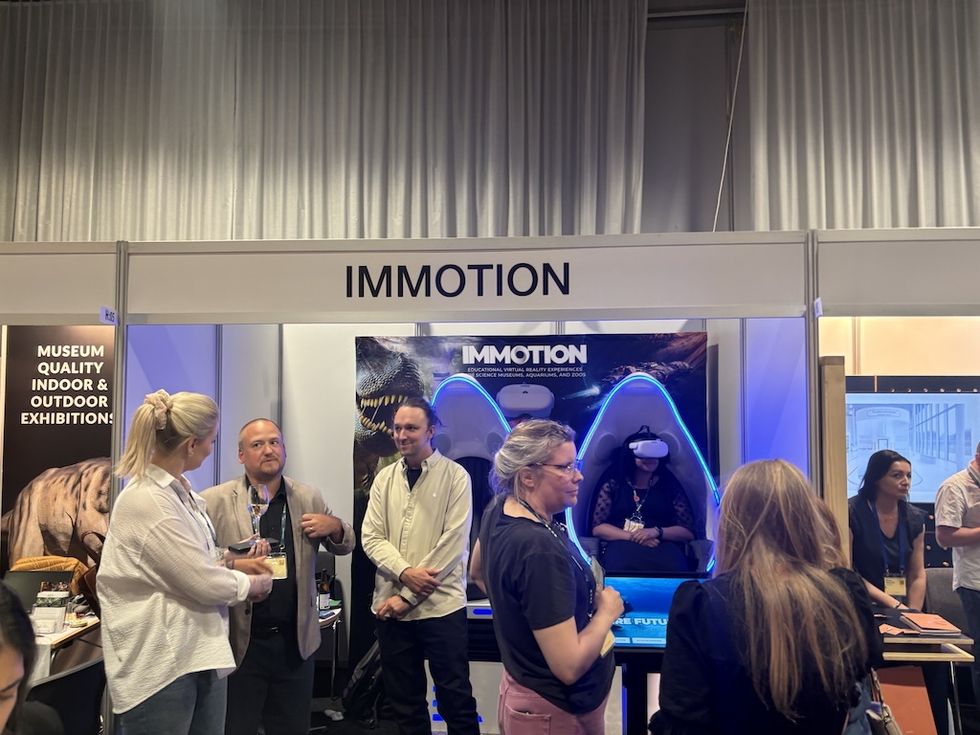 Visitors to the Immotion booth at Ecsite 2026 could experience a variety of VR titles including Polar OdysseyImage credit T. Robinson
Guide-ID was showcasing its Podcatcher Pro audio guide system, which has recently been deployed at Anne Frank: The Exhibition in New York, and Immotion, a leader in out-of-home VR for attractions, presented its new immersive film, Polar Odyssey.
On the fabrication side, Research Casting International was exhibiting its work in preserving, restoring, and fabricating museum specimens, highlighting recent projects including the Natural History Museum of Abu Dhabi and the renovated Age of Dinosaurs galleries at the Royal Ontario Museum.
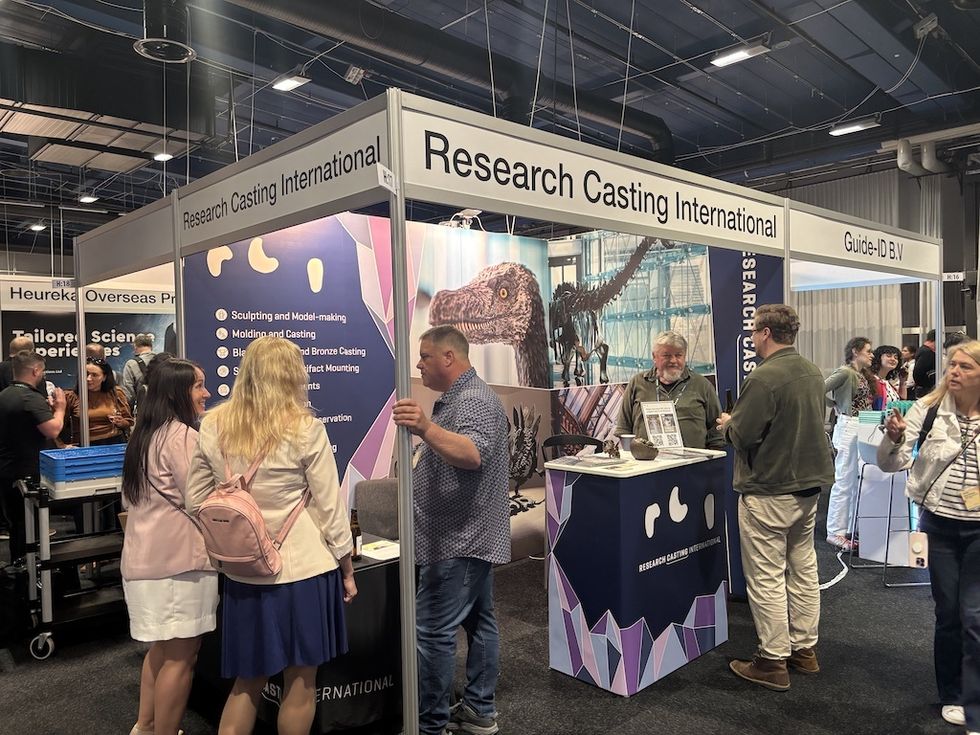 The Research Casting International team were on hand to meet Ecsite attendees on the trade show floorImage credit T. Robinson
Berlin-based companies Interactive Scape and Werk5 shared a booth focused on inclusive design and interactive tech, demonstrating Scape X Surfaces. This new innovation utilises projection, object tracking, multitouch and gestures to bring surfaces to life and create engaging interactives for museums and science centres.
Lutra Interactive, a game design studio based in Sweden, showcased two of its simulation games. This included EcoWeb, which uses food web models to explore biodiversity and ecosystem change, demonstrating the knock-on effects of species decline on wider populations.
The team also presented Visual Crime Scene, a digital forensics simulation that recreates crime scenes in 3D using laser scans, CCTV footage and AI.
Dyno Robotics was exhibiting, bringing its RoboGuide to roam the show floor. The RoboGuide won first place in the Guest Journey category at the 2024 blooloop Innovation Awards.
Key themes from the conference
The Ecsite 2026 Conference highlighted key trends shaping science centres and museums.
It emphasised strengthening public trust through participation and dialogue. Speakers stressed that science communication should go beyond sharing information to enable visitors to explore, question, and connect with science.
Another major focus was the growing integration of creativity, the arts, and immersive technologies into science engagement.
The shift from STEM to STEAM was a recurring theme throughout the conference, with organisations using storytelling, gaming, virtual reality, interactive exhibits, and artistic approaches to make complex scientific topics more accessible and memorable.
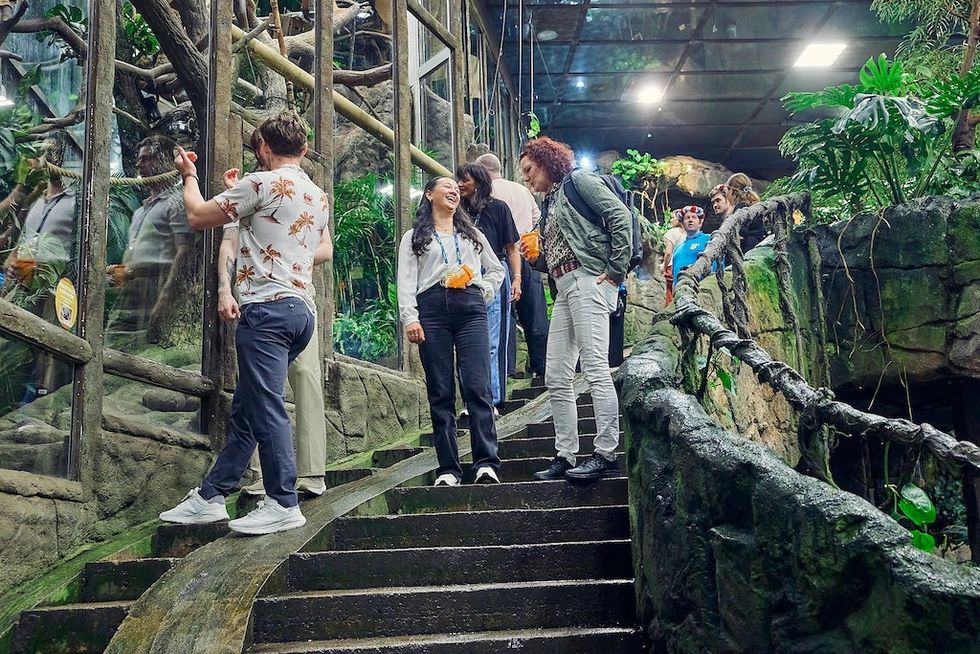 Universeum hosted the Nocturne at Ecsite 2026, opening its doors to attendeesImage © Ecsite
These approaches aim to foster deeper emotional connections with audiences and encourage curiosity-driven learning.
Artificial intelligence was also a recurring theme. Sessions examined both the opportunities and challenges of AI, ranging from enhancing visitor experiences and organisational operations to building public understanding of emerging technologies.
Many speakers emphasised the importance of AI literacy and critical thinking, arguing that institutions have a responsibility to help audiences navigate the social and ethical implications of AI while preserving the value of human interaction.
Sustainability and climate engagement were another important theme. Presentations focused on helping people imagine and work towards more sustainable futures through science education, community participation, and environmental storytelling.
Rather than focusing solely on knowledge transfer, many organisations are encouraging visitors to think critically about their role in addressing global challenges.
Looking ahead to Ecsite 2027
During the closing ceremony, the hosts, Universeum, were thanked, as were the Ecsite teams who organised the conference and programme, and the event's many insightful speakers.
It was then revealed that Ecsite 2027 will take place in Paris from 8 to 10 June and will be hosted by Universcience.
The event will be centred at the Cité des Sciences et de l'Industrie and will also extend across several of Paris's most renowned science, innovation and heritage venues, including Citéco – Cité de l'Économie, the Musée des Arts et Métiers, and the Palais de la Découverte, following its long-awaited reopening.